

The cave lion, Panthera spelaea, was a large cat of Late Pleistocene Eurasia. Bones range from western Europe across Siberia and into Beringia, while cave art and ancient DNA provide separate windows on its appearance and evolutionary history. Each evidence type answers a different question: a skeleton constrains anatomy, isotopes record assimilated food, and genomes trace ancestry.
Older works used the combination Felis spelaea; genetic evidence supports a distinct lineage rather than a local population of living lions. The species belongs in the Ice Age animals catalogue, alongside mammoths and woolly rhinoceroses, although its behaviour must be reconstructed from less direct traces.
Quick facts
| Scientific name | Panthera spelaea (Goldfuss, 1810) |
|---|---|
| Group | Felidae, Pantherinae |
| Age | Late Pleistocene |
| Range | Eurasia, including northern steppe regions |
| Evidence | Skulls, teeth, limb bones, traces and ancient DNA |
| Diet | Large herbivores; isotope patterns vary by region |
What can the fossils tell us?
Georg August Goldfuss named the animal Felis spelaea in 1810 from material associated with Zoolithen Cave in Bavaria. Later research changed the genus combination and traced the history of the original material. Thousands of later bones are comparative specimens, not the name-bearing type.
Genome data from twelve cave lions distinguish the cave-lion lineage from modern lions. A divergence estimate near 1.7 million years is model-dependent, and some late individuals show admixture signals. These results describe ancestry, not the behaviour of every population.
Carbon and nitrogen isotopes in collagen can compare a lion’s assimilated diet with local food webs. Reindeer were important for many sampled animals, while some results allow other prey. Isotope values do not identify a particular kill or prove one universal menu.
Upper Palaeolithic images attributed to cave lions sometimes show rounded ears and no obvious mane. Style and species identification remain interpretive, and a scene with several cats cannot establish a stable pride.
Discovery and the name
Georg August Goldfuss described the animal as Felis spelaea in 1810, drawing on material from Zoolithen Cave in Bavaria. Later authors moved it between generic names as they compared its skull and teeth with other large cats. The current name Panthera spelaea reflects recognition of a separate species, although the boundaries of regional forms remain debated.
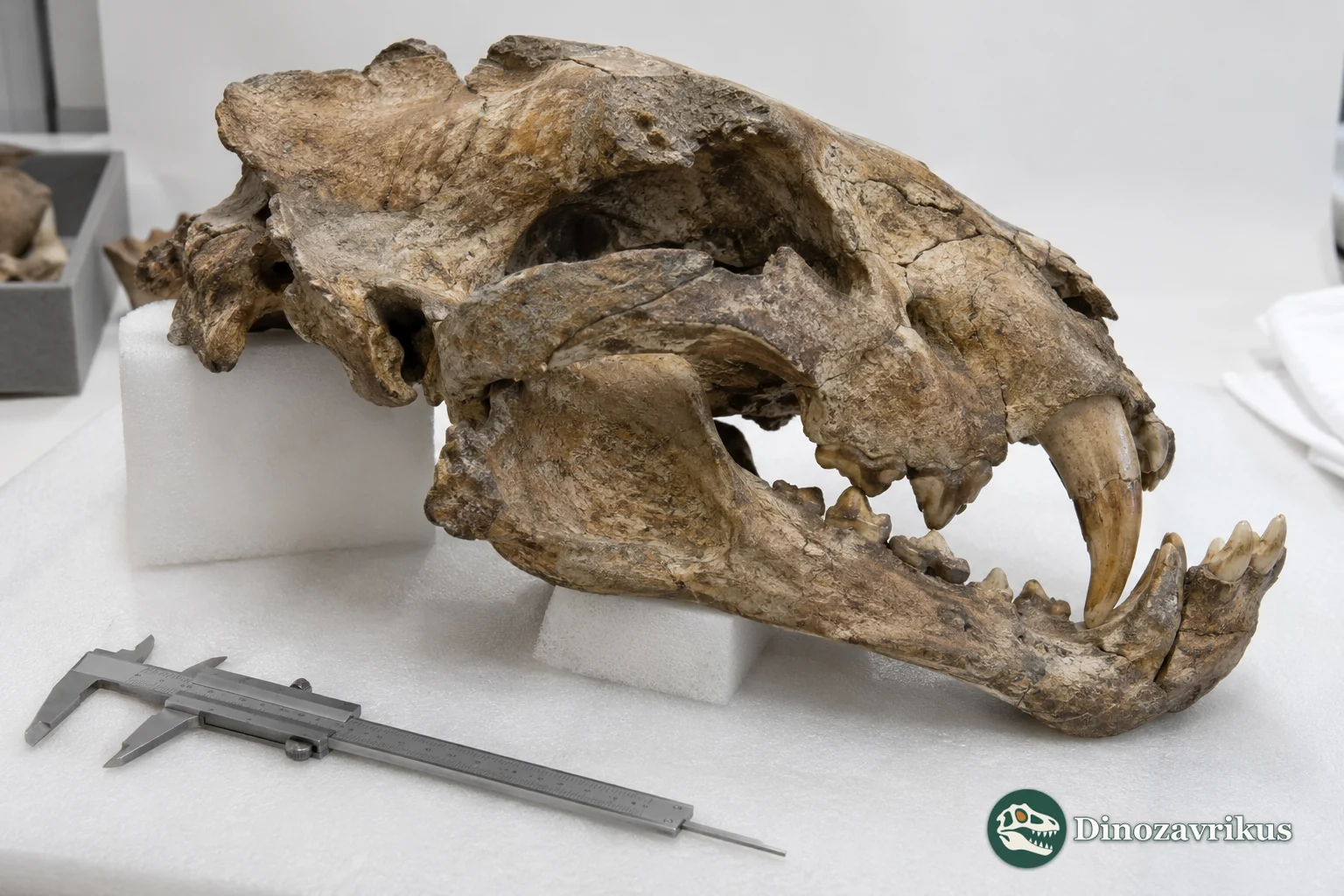
The historic material associated with the name must be kept distinct from the many later finds. European and Asian collections contain skulls, jaws, teeth and limb bones from cave deposits, open sites and natural traps. A bone accumulation may span different animals and times rather than record one population or a single event.
Range and chronology
Cave lions are known from a broad Eurasian range, from western Europe and the Caucasus to Siberia and Beringia. Climatic shifts altered suitable habitats and the contact between populations. Proposed subspecies and regional names should not be treated as proof of permanently sharp boundaries.
The fossils belong to the Late Pleistocene, but individual finds span different intervals. Direct radiocarbon measurements, stratigraphic context and specimen condition matter. Older collection pieces without secure layers cannot be given the same chronological weight as directly dated material.
Skull, teeth and body size
The skull and teeth show a large cat with powerful jaws and cutting carnassials suited to processing meat. Limb bones indicate a strong terrestrial animal. Size differs among specimens, and sex, age and geography affect comparisons. A striking estimate from one skeleton is not a fixed value for the species.
Its proportions were comparable to those of large living lions, but claims that it was consistently much larger depend on the bones and scaling method selected. Body mass and shoulder height are often estimated from incomplete remains using comparative equations. The secure conclusion is a large predator; one “typical” number is less certain.
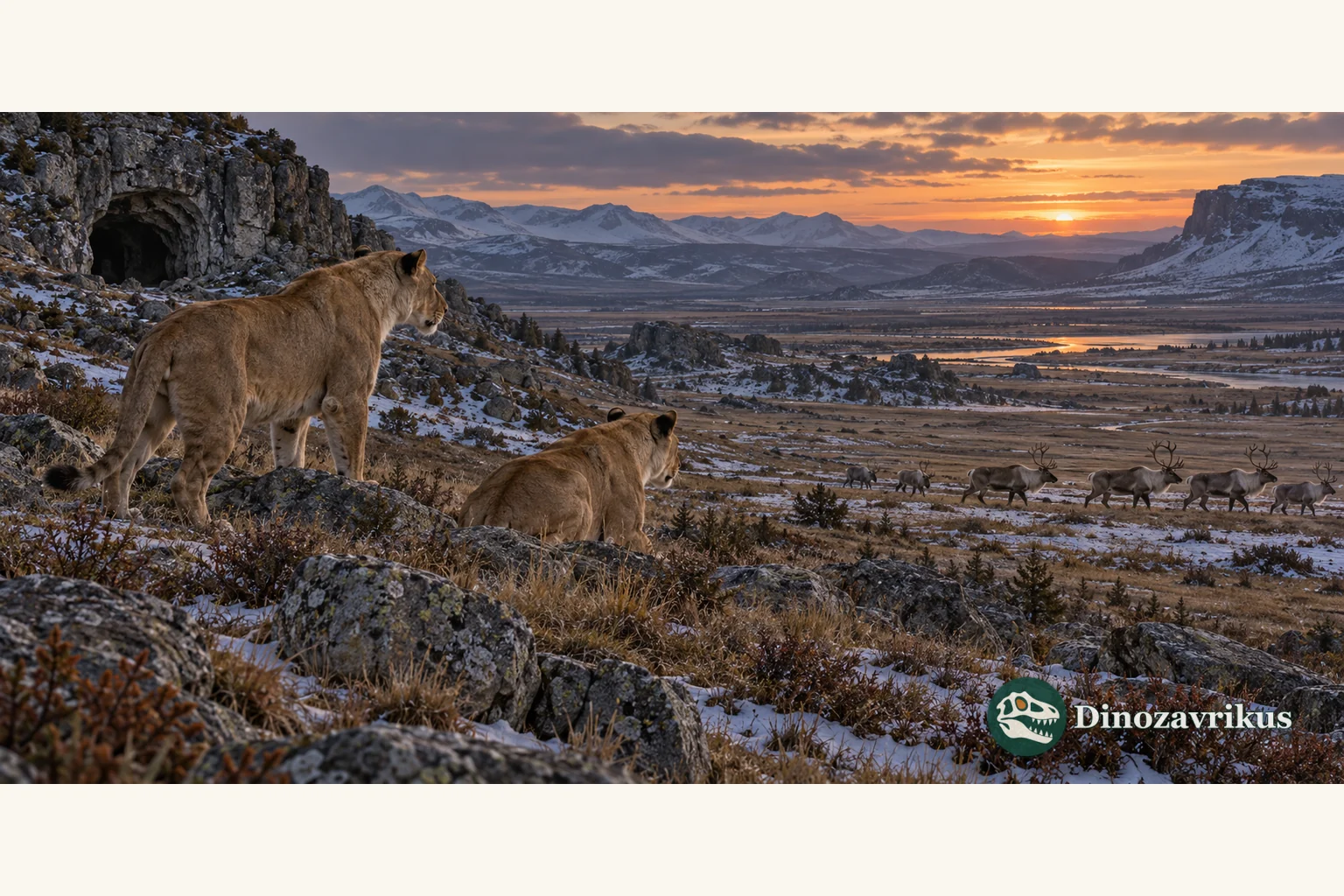
No direct evidence preserves a mane or exact coat. Cave images sometimes depict cats without an obvious mane and with rounded ears, but artistic convention cannot establish the appearance of every male. Fur density and colour in modern reconstructions remain artistic choices.
Prey and feeding ecology
Skeletons and teeth establish a large carnivore within Pleistocene food webs. Collagen isotope studies connect many sampled lions with northern ungulates, including reindeer. Results from some localities allow other food sources, but those interpretations depend on the regional sample and its comparison set.
Isotopes average dietary inputs while tissue formed; they do not show how food was obtained. They cannot distinguish a kill from scavenging or kleptoparasitism. Individual and regional variation argues against one prey species for the entire range. Coexistence with mammoths and woolly rhinoceroses does not show that adult giants were routine prey.
Genomes and relationships
Ancient DNA clarified the cave lion’s place among big cats. A study of twelve genomes recovered a lineage distinct from living lions. A divergence estimate of about 1.7 million years comes from demographic modelling and depends on its assumptions; it is not the date of a single fossil event.
Genomes also preserve signals of later gene flow between some populations. One Central or East Asian animal dated to roughly 20,000 years ago carries a small ancestry component related to modern lions. This points to a complex history without erasing the species distinction or describing every cave lion.
Behaviour and extinction
Bones, tracks and spatial patterns do not directly reveal a social system. Some cave-art panels depict multiple cats, but the images are stylised and species attribution can be uncertain. A group of painted animals does not establish a permanent pride, just as sparse fossils do not prove solitary lives.
Cave lions disappeared near the end of the Pleistocene as ecosystems and large-herbivore communities changed. The last dates differ by region, and old specimens require scrutiny. Climate shifts, prey availability and human influence may have interacted; the evidence does not identify one cause for the whole Eurasian range.
Frequently asked questions
Was the cave lion a subspecies of the modern lion?
Ancient genomes support a distinct cave-lion lineage. Gene-flow signals between some populations do not make Panthera spelaea an ordinary geographic population of living lions.
Why is it called a cave lion?
The name reflects the history of cave discoveries, not a claim that the animal lived underground. Fossils also come from open localities and other deposits.
Did cave lions have manes?
Bones and DNA do not preserve an exact coat. Some cave images show no obvious mane, but stylised art is not conclusive evidence for every male.
What did cave lions eat?
Isotopes from many individuals indicate an important role for northern ungulates, especially reindeer. Diet varied, and the analyses do not identify a specific hunting event.