

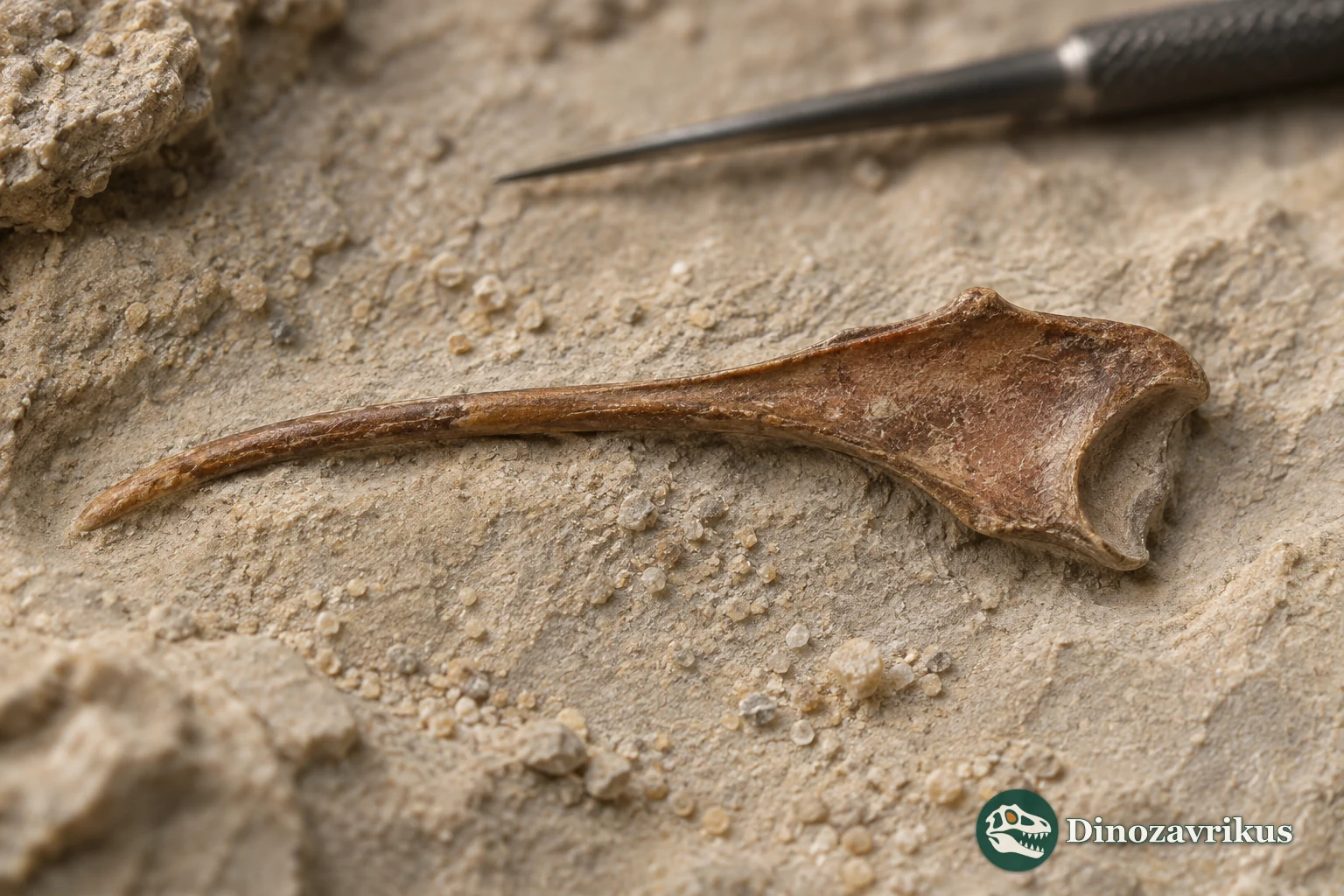
Paradiscoglossus was a Late Cretaceous frog from what is now Wyoming. Its most informative fossils are isolated ilia, bones of the pelvis. A crest along the shaft, a low bump and a deep pit near the hip socket help researchers distinguish it from other frogs found in the same deposits.
Quick facts
| Group | Frogs (Anura) |
|---|---|
| Age | Late Cretaceous, Maastrichtian |
| Region | North America, Wyoming, United States |
| Type species | Paradiscoglossus americanus |
| Scientific name | Paradiscoglossus |
| Diet | Exact prey is unknown |
What can the fossils tell us?
The holotype is a hip bone from Maastrichtian beds in Wyoming. Its ridges and depressions are used to identify the species.
The complete type ilium was estimated at about 20 mm. Comparison with other frogs suggested an approximate snout-to-vent length of 70 mm.
The type material lacks a skull. The hip bones allow comparisons with other frogs, while details of the head and the exact position within Anura remain uncertain.
Small fossils from the Lance Formation
Richard Estes and Borja Sanchíz established the genus and species in 1982. The holotype is held by the University of California Museum of Paleontology. It comes from the late Maastrichtian of Wyoming. The Lance Formation has yielded several frogs, most represented by scattered bones. A jaw and a hip bone found at the same site can therefore belong to different species.
Reading the ilium
The crest along the shaft bends inward, bounding a broad groove. Close to its rear end is a low, elongate swelling. A deep pit beside the hip socket opens upward and back. These features in combination make the bone recognizable. Comparative work estimated a snout-to-vent length of around seven centimetres from the ilium.
Why the Romanian bones matter
Some ilia from the Hațeg Basin in Romania were compared with Paradiscoglossus. A later revision assigned that material to Paralatonia. The comparison shows why a similar crest on a single bone does not establish that the same genus lived on both sides of the Atlantic.
Frequently asked questions
What fossil identifies Paradiscoglossus?
The type is an ilium, a pelvic bone with a distinctive longitudinal crest and relief around the hip socket.
Where is the genus securely known?
The identified material comes from the Late Cretaceous Lance Formation of Wyoming in western North America.
How big was Paradiscoglossus?
Researchers estimated a snout-to-vent length of about seven centimetres based on the size of its ilium.
Did it also live in Romania?
A revision assigned similar Romanian ilia to Paralatonia. Those fossils do not establish a European occurrence of Paradiscoglossus.