

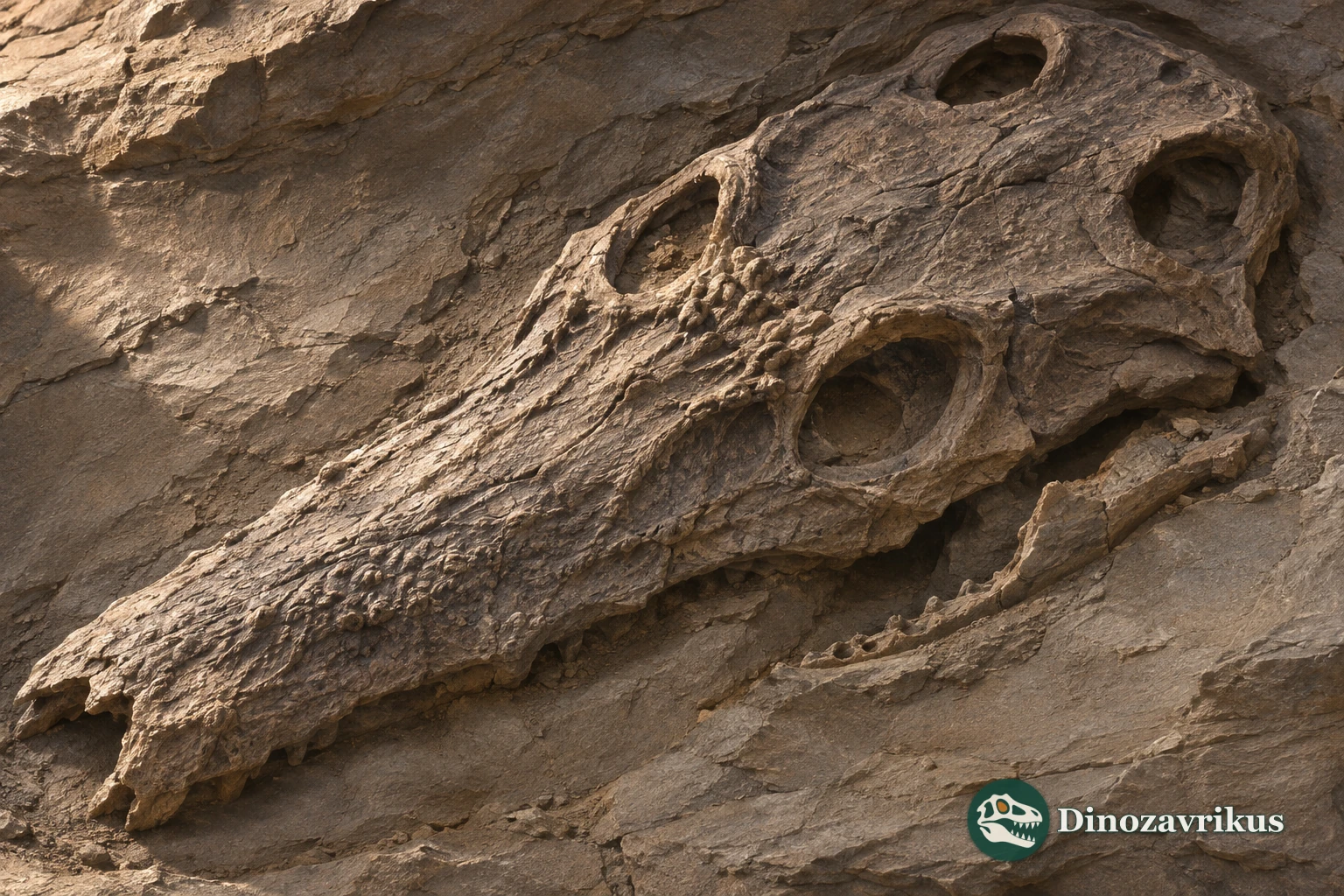
Paralligator was a crocodyliform from Late Cretaceous Mongolia. A prominent ridge between the eyes and two clusters of enlarged upper tooth sockets help identify the genus. The nearly complete skull of the type species preserves both visible features and cavities hidden within the bones.
Quick facts
| Type species | Paralligator gradilifrons |
|---|---|
| Group | Paralligatoridae, Neosuchia |
| Age | Late Cretaceous |
| Localities | Bayanshiree and Nemegt formations, Mongolia |
| Type of the type species | PIN 554/1-1, nearly complete skull |
| Type of the second species | PIN 3726/501-1, partial skull |
What can the fossils tell us?
PIN 554/1-1 from the Bayanshiree Formation preserves the bar between two openings in the skull roof. It is broader than in several other skulls of the genus.
CT data allow models of the braincase cavity, canals for nerves and the air spaces beside the middle ear.
Both type specimens came from the Bayanshiree Formation. Some skulls from the younger Nemegt Formation are assigned to the genus with no confident species identification.
Two type skulls from Mongolia
Ekaterina Konzhukova established Paralligator in 1954. The nearly complete skull PIN 554/1-1, the type of P. gradilifrons, comes from Shireegin Gashuun. The partial skull PIN 3726/501-1, type of P. major, comes from Khongil Tsav. Both are from the Bayanshiree Formation and are held at the Borissiak Paleontological Institute in Moscow.
The two species were once placed in Shamosuchus. In 2015 Alan Turner retained its type species, S. djadochtaensis, in that genus and returned P. gradilifrons and P. major to Paralligator. The latter has a more pronounced ridge between the orbits and two clusters of enlarged maxillary teeth, compared with one in S. djadochtaensis.
Variation among skulls
A 2025 study applied P. gradilifrons only to the type, an adult with an unusually wide bony bar between the openings in the skull roof. Other skulls previously assigned to that species have a narrower bar. The authors raised the possibility that some of the variation reflects species differences.
The same study restricted P. major to its own type. It treated Maastrichtian specimens from the Nemegt Formation, including a skull from Nogon Tsav, at genus level. These finds extend the record of Paralligator while leaving the younger fossils’ species identities open.
Inside the braincase
Computed tomography reveals surfaces concealed by neighbouring bones. Researchers reconstructed the cavity inside the braincase, traced canals for cranial nerves and described pneumatic recesses around the middle ear. These features can be compared across species even when the outer skull is incomplete.
The arrangement of the cavities is consistent with paralligatorids near the base of Eusuchia, the group that includes living crocodilians. A digital endocast represents the space bounded by bone. It preserves information on broad proportions and connections of cavities, while the soft tissues themselves have decayed.
Frequently asked questions
How does Paralligator differ from the type species of Shamosuchus?
It has a stronger ridge between the eyes and two clusters of enlarged upper tooth positions.
Where were the type skulls found?
Both came from localities in Mongolia exposing the Bayanshiree Formation.
How many species are recognised?
A 2015 revision recognised two. The 2025 study restricted both names to their types, leaving other skulls without species assignments.
Why were the skulls scanned?
CT scans reveal internal structures such as the braincase cavity, nerve canals and pneumatic recesses that are hidden by surrounding bones.