

Paranasuchus gasparinae was a large caiman from late Miocene deposits near Paraná, Argentina. Its low snout was broad, with an upward-facing bony nostril well behind the tip. The braincase also preserves part of the inner-ear cavity.
Quick facts
| Group | Alligatoridae, Caimaninae |
|---|---|
| Age | Late Miocene |
| Locality | Paraná, Entre Ríos Province, Argentina |
| Rock unit | Ituzaingó Formation |
| Holotype | MLP-73-IV-15-1, skull fragments |
| Snout shape | Short, broad and low |
What can the fossils tell us?
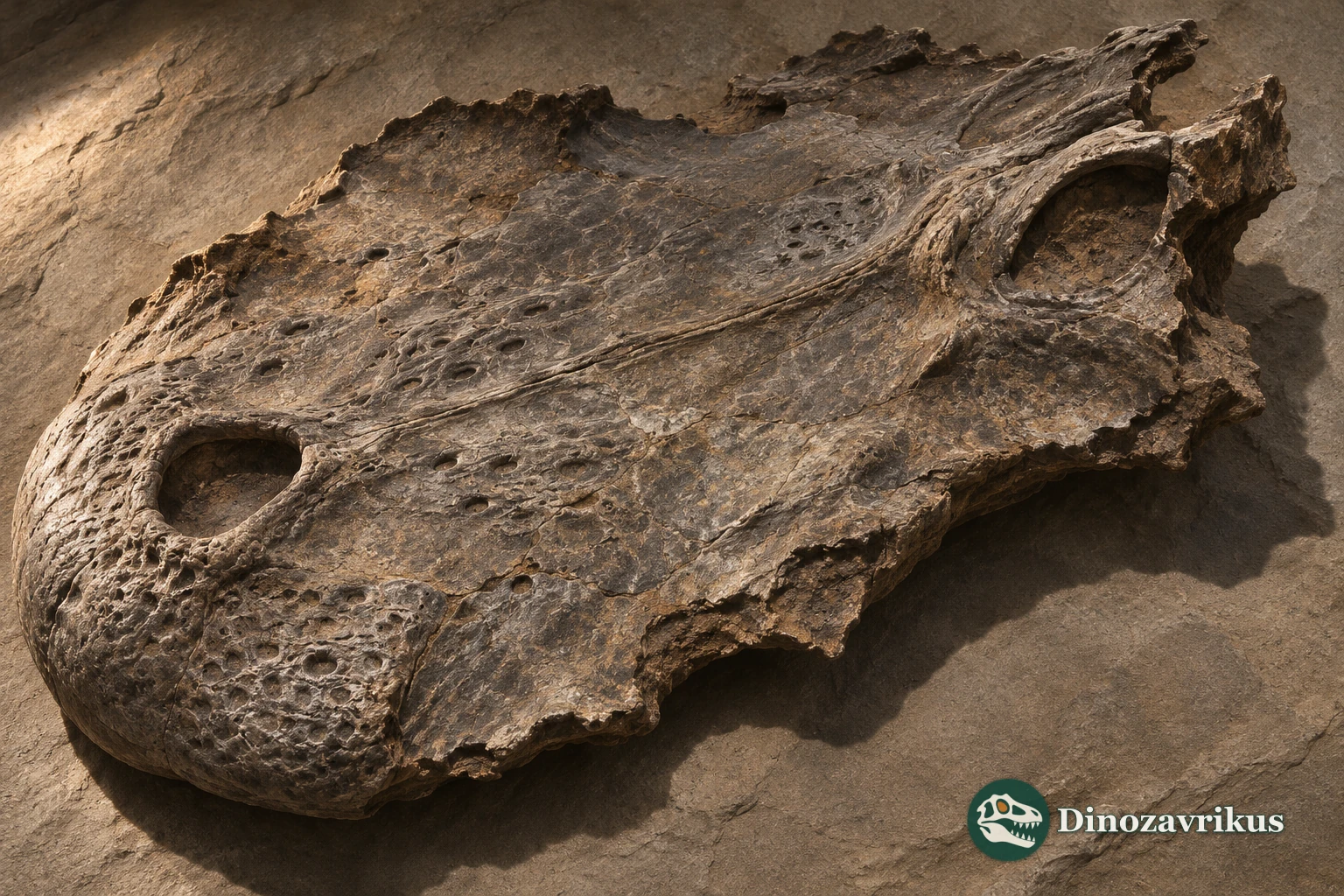
The preserved snout shows an upward-facing aperture separated from the front edge by a broad area of bone.
A latex cast allowed researchers to compare part of the bony labyrinth with the corresponding region in living caimans.
The species was originally placed in Caiman. A later analysis recovered closer affinities with other extinct South American caiman lineages.
The fossils from Paraná
Paula Bona and Ariana Paulina Carabajal described the species in 2013 as Caiman gasparinae, honouring palaeontologist Zulma Gasparini in the species name. The material comes from the late Miocene Ituzaingó Formation in the Paraná area of Entre Ríos Province.
The holotype, MLP-73-IV-15-1, is housed at the Museo de La Plata. It consists of an incomplete snout, with several bones still in contact, and a partial braincase. The original description also referred a fragment of a right premaxilla from the Argentine Museum of Natural Sciences to the species.
The snout and inner ear
The bony nostril opened on top of the low snout. A broad expanse of premaxillary bone lay in front of it. Irregular ridges and pits on the outer surfaces sometimes form a network. Farther back, the opening for the internal carotid artery is visible from the side because the adjacent bony crest is low.
Researchers made a latex cast of the preserved portion of the left inner-ear cavity. The cast captures the shape of the bony space for comparison with the equivalent region in living caimans. It does not identify what Paranasuchus ate.
Why the genus changed
A later study found that this species was more closely related to extinct South American caiman lineages, including the lineage of Purussaurus, than to living Caiman. The authors gave the species its own genus and retained the epithet honouring Gasparini.
The remains indicate a large individual. The snout provides evidence of the shape of the head, but the material is insufficient for a secure estimate of total length or body proportions.
Frequently asked questions
Why was it called Caiman gasparinae?
That was the name given in the original 2013 description. Paranasuchus was later established as a separate genus, and the species epithet was retained.
Which parts of the skull survive?
The holotype includes a partial snout and part of the braincase. A separate fragment of a premaxilla was also referred to the species in its original description.
Where and when did Paranasuchus live?
The material comes from late Miocene rocks around Paraná in northeastern Argentina.
What is distinctive about its bony nostril?
It faces upward and lies well behind the tip of the short, broad snout.