

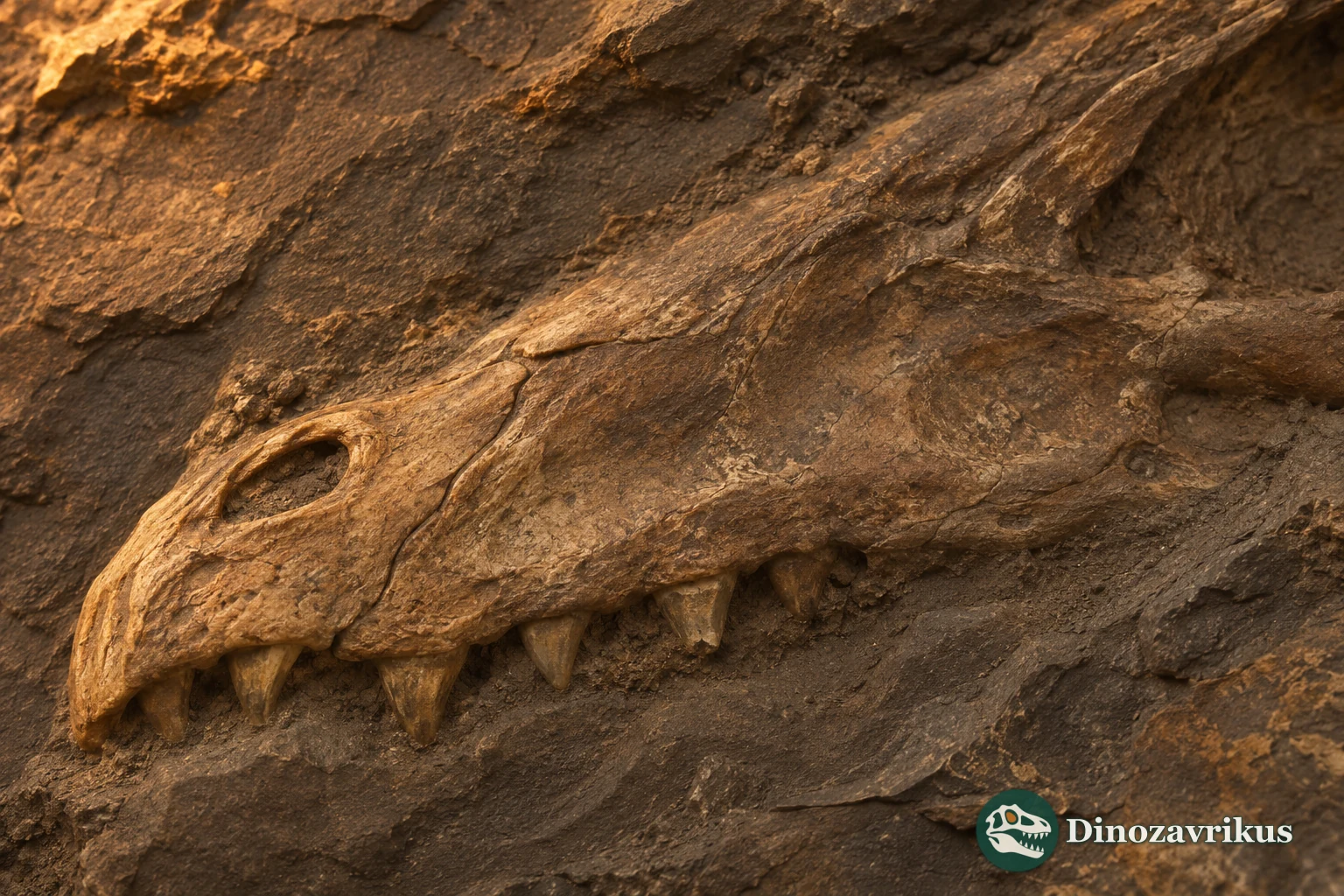
Parasauromalus was an Eocene iguanian lizard. Wyoming has yielded both isolated jaws and more complete skulls. On one of the jaws the narrow bases and flared crowns of the teeth are particularly well preserved.
Quick facts
| Group | Iguanians (Iguania) |
|---|---|
| Age | Early Eocene |
| Region | North America, United States |
| Type species | Parasauromalus olseni |
| Scientific name | Parasauromalus |
| Diet | Exact prey is unknown |
What can the fossils tell us?
Jaws from Wyoming preserve broad crowns with fine striations.
Crown shape and the way the bones overlap at the front of the head help identify incomplete specimens.
Tooth resemblance to living iguanians offers limited evidence about the exact diet or the outline of the whole animal.
From a jaw fragment to more complete skulls
Charles Gilmore named Parasauromalus olseni in 1928 from a fragment of a right dentary from Wyoming. The holotype comes from the Willwood Formation. Two skulls from the Bighorn Basin, YPM VP 008249 and YPM VP 003947, were later referred to the same species. Their position in the rock sequence is documented more precisely than that of the type.
Grooves and faint side cusps
The lower jaw fragments catalogued as UCMP 115106 come from the Wasatch Formation near Bitter Creek. Their tooth crowns are flared and flattened from side to side. Short grooves distinguish faint accessory cusps, while the outer and inner faces carry fine longitudinal striations. Together these details support the referral to the genus.
A snout beside another lizard’s skull
One specimen of Saniwa had a separate snout fragment attached to the front of its skull. A reassessment suggested it belonged to Parasauromalus. The proposed identification rests on general similarity and the distinctive overlap of two bones at the front of the snout. The find illustrates the importance of checking which fragments actually belong to a skull.
The comparison behind the name
Gilmore compared the teeth with those of living chuckwallas, Sauromalus. That resemblance inspired the name. It helps describe the crown shape, and closer relationships require comparisons with other parts of the skeleton.
Frequently asked questions
Which is the type species?
Parasauromalus olseni, named by Gilmore in 1928 from a Wyoming jaw fragment.
What distinguishes the teeth?
They have flared, flattened crowns with fine striations and faint accessory cusps.
When did the lizard live?
Confirmed fossils come from Early Eocene deposits of Wyoming.
Why did researchers compare a fragment with the Saniwa skull?
The unusual way two bones overlap suggested the attached snout fragment came from Parasauromalus.