

Paratriakis is an extinct carcharhiniform shark genus identified chiefly from small isolated teeth. Its type species came from Turonian France, and later finds extend across Europe and the Middle East. A body shape similar to a small houndshark is plausible by comparison, but no complete specimen underlies the cover art.
Quick facts
| Genus | Paratriakis Herman, 1977 |
|---|---|
| Type species | P. bettrechiensis, Turonian France |
| Group | Carcharhiniformes, Triakidae |
| Principal evidence | Small isolated teeth |
| British species | P. subserratus and P. tenuis |
| Danish occurrence | P. curtirostris in Cretaceous and early Danian beds |
| Body length | Not measured from the described teeth |
What can the fossils tell us?
Herman named P. bettrechiensis in 1977 from Turonian France. Dental characters do not reveal fin shape.
Underwood and Ward described P. subserratus and P. tenuis using crown shape, cusp inclination and root characters. Counts of teeth are not counts of animals.
P. curtirostris teeth occur in Upper Cretaceous chalk and early Danian deposits at Stevns Klint. They do not trace individual population continuity.
The name and its dental foundation
Jacques Herman established Paratriakis in 1977, with P. bettrechiensis from Turonian France as the type species. Later studies place the genus in Triakidae within Carcharhiniformes. This placement comes from tooth comparisons; it is not a directly preserved whole skeleton.
A tooth's position along a jaw changes its shape. Comparing several positions is therefore crucial when separating similar small sharks. Palaeogaleus provides another example of why positional differences matter.
British teeth and two named species
Underwood and Ward studied teeth from phosphatic chalk of Coniacian, Santonian and Campanian age. Samples were processed to recover tiny vertebrate remains. Their 2008 description named P. subserratus and P. tenuis from these collections.
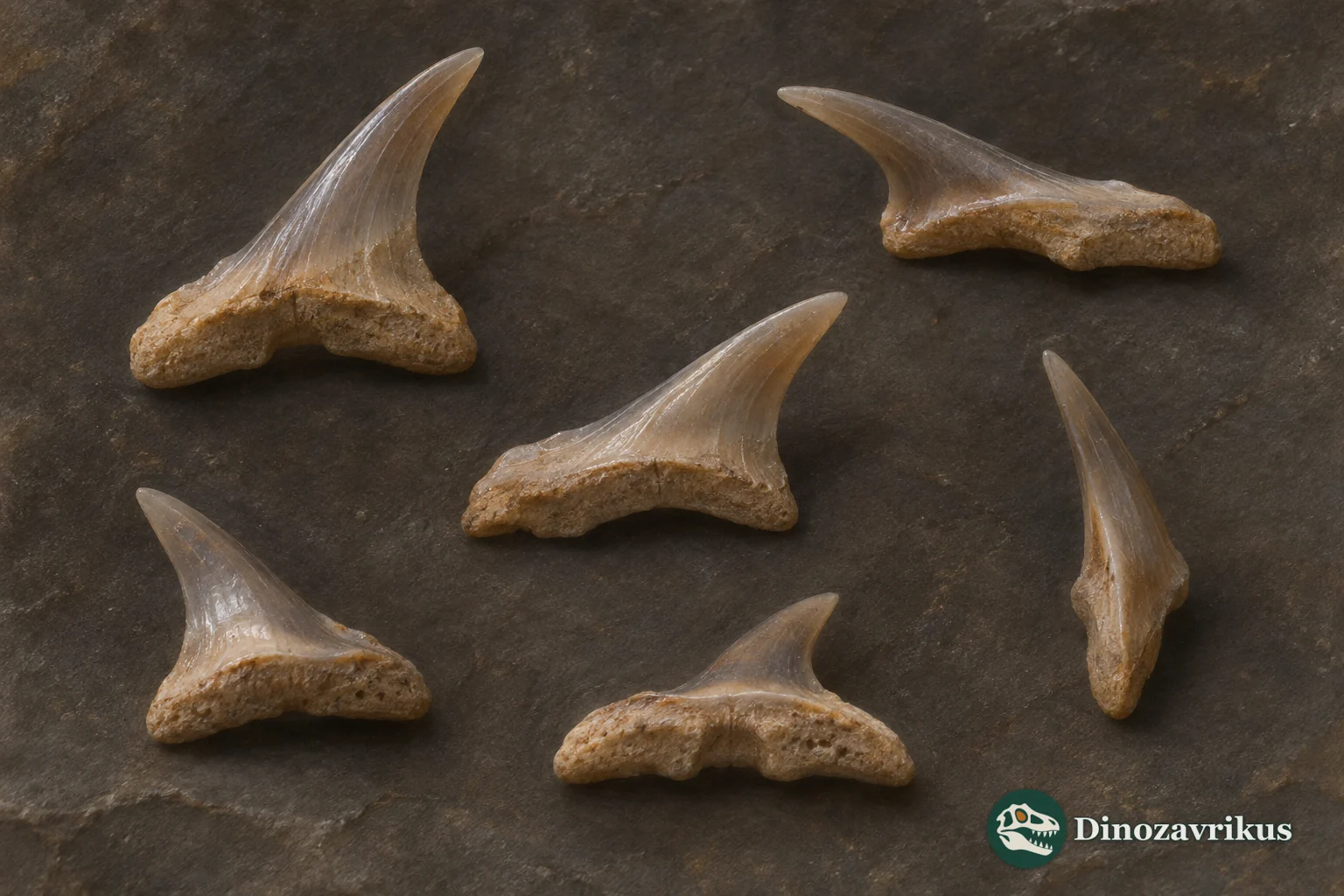
The P. subserratus holotype BMNH P. 66407 is a lateral tooth from middle Santonian Boxford. The study lists 271 teeth for this species from several British localities, not 271 individual sharks. The teeth reach about 3 mm in width, have strongly asymmetrical crowns and a backward-inclined main cusp. A weak distal cusplet inspired the species name.
A slender-toothed relative
The P. tenuis holotype BMNH P. 66413 also came from Boxford. Its tooth cusp is longer and more delicate than in P. subserratus. Root and crown details distinguish it from the type species too. An isolated tooth may be ambiguous without a comparative series; the picture below is an illustration, not a photograph of those numbered fossils.
The broader lamniform teeth of Cretalamna belong to a different shark order. Similar geological settings alone cannot establish close kinship.
Across the Cretaceous–Paleogene boundary
At Stevns Klint in Denmark, P. curtirostris teeth occur in chalk and in lower Danian deposits. Adolfssen and Ward documented 18 specimens from the Stevns Kridtbrud chalk and 56 from Fiskeler samples at Rødvig and Højerup. The range shows that this dental form is recorded on both sides of the boundary, without tracing a continuous local population.
The main cusp is strongly inclined towards the jaw corner, and anterior teeth are somewhat taller than lateral ones. These details can be tested on fossils. Body colour, lifespan and movement patterns cannot.
What its appearance may have been
Comparison with living triakids supports a cautious slender shark outline. The teeth could have served in taking small prey, but no associated stomach contents establish a particular diet for these fossils. The whole body length remains unmeasured. The underwater animal in the cover image is deliberately treated as reconstruction rather than a documented specimen.
Frequently asked questions
Which is the type species of Paratriakis?
P. bettrechiensis, named by Herman in 1977 from Turonian France.
Is a complete Paratriakis skeleton known?
The published evidence discussed here consists mainly of isolated teeth; the whole body in illustrations is inferred.
Do 271 British teeth mean 271 sharks?
No. The count is of teeth assigned to P. subserratus. A shark replaces many teeth in its lifetime.
Is it recorded after the Cretaceous?
Yes. Teeth referred to P. curtirostris occur in early Danian deposits in Denmark.