

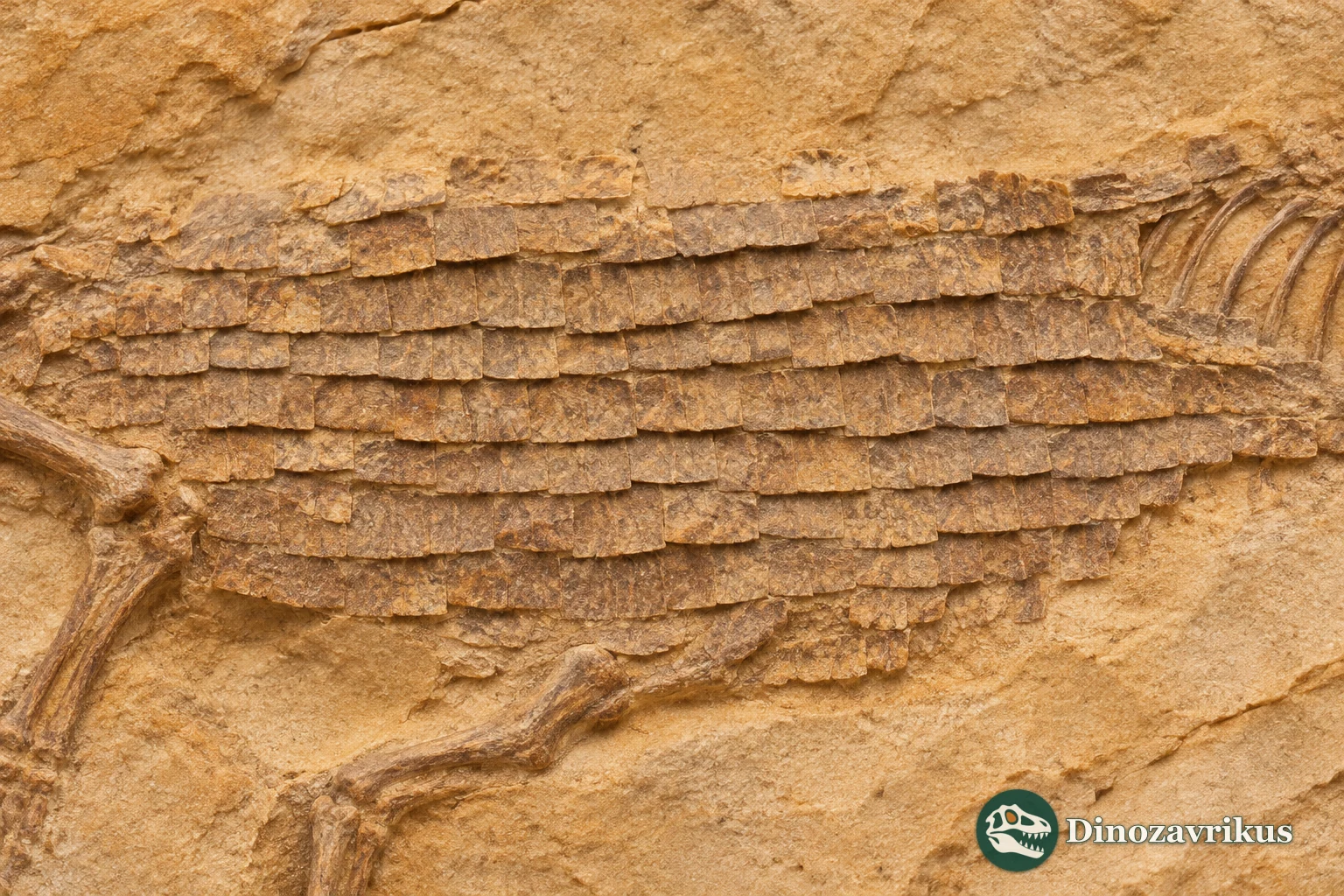
Parmeosaurus lived in the Gobi region during the Late Cretaceous. Its skin contained small bony plates called osteoderms. Rectangular plates overlapped across the back. On the belly, paired narrower pieces joined to make larger rectangular elements.
Quick facts
| Group | Scincoids (Scincoidea), stem lineage |
|---|---|
| Age | Late Cretaceous, Campanian |
| Region | Asia, Mongolia and China |
| Type species | Parmeosaurus scutatus |
| Scientific name | Parmeosaurus |
| Diet | No direct evidence |
What can the fossils tell us?
The type specimen, IGM 3/138, preserves a skull and articulated postcranial bones. Other fossils from the same locality reveal the skull roof and portions of the armour.
CT study of IVPP V 10080 revealed compound belly plates made of two joined pieces. This feature and comparisons of the skull helped establish its identity.
An anatomical analysis places Parmeosaurus on the stem of Scincoidea. Its tooth form is known, but there is no direct dietary evidence.
The type skeleton from Ukhaa Tolgod
Keqin Gao and Mark Norell described Parmeosaurus scutatus in 2000. The type specimen, IGM 3/138, preserves a skull and an articulated skeleton from Ukhaa Tolgod, Mongolia. Other specimens from the same site provide clearer views of parts of the skull. The generic name comes from a Greek word for a small shield. The species name also refers to the armour.
How the armour fitted together
In the Chinese specimen IVPP V 10080, osteoderms cover the trunk, limbs and tail. Most of the measured dorsal plates are about 2.6–2.9 mm long. They overlap along the length of the body, like shingles. The belly components are roughly half as wide as the back plates, and two joined components make up each compound element.
Why the Chinese skeleton changed names
IVPP V 10080 comes from Bayan Mandahu in Inner Mongolia, China. It was first identified as Bainguis because of the shape of its plates. In 2018, Liping Dong and colleagues examined the skeleton with CT and compared it with two new pieces from the same locality. One preserves part of a skull beside dorsal osteoderms. The other preserves a humerus with ventral osteoderms. The combined evidence supports assigning all three specimens to Parmeosaurus.
Jaws and scincoid relationships
Parmeosaurus had an elongated skull with a snout compressed from side to side. Its closely spaced teeth include robust crowns with three tips. A comparison of skull, jaw and osteoderm characters found a close relationship to the lineage leading to modern scincoids. The 2018 analysis placed Parmeosaurus on the stem of that group.
Frequently asked questions
Has Parmeosaurus been found outside Mongolia?
Yes. Three specimens from Bayan Mandahu, China, have been assigned to the genus.
What formed the armour of Parmeosaurus?
Osteoderms, small bone plates that formed within the skin. They are preserved on the head, body, limbs and tail.
How did the belly plates differ from those on the back?
The back carried individual rectangular plates. Each compound plate on the belly consisted of two narrower pieces.
Can one plate identify the lizard?
Several unrelated fossil lizards have similar plates. Structure, arrangement and any associated bones allow a more reliable identification.