

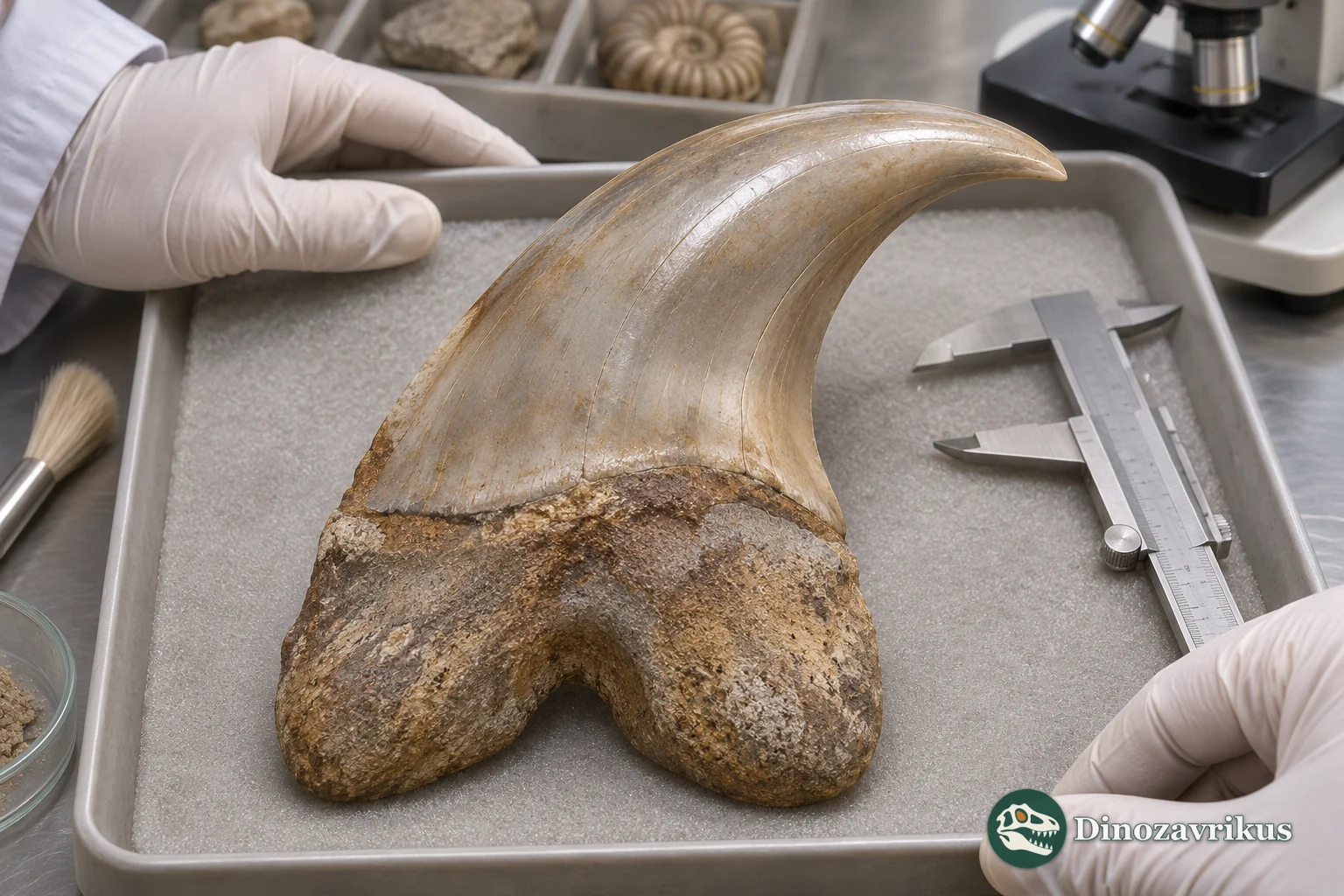
Parotodus was a large extinct lamniform shark. Its best-known species, P. benedenii, left thick curved teeth without serrations. The cover is an artistic reconstruction: the teeth do not preserve a complete body or its colour.
Quick facts
| Genus | Parotodus Cappetta, 1980 |
|---|---|
| Best-studied species | Parotodus benedenii (Le Hon, 1871) |
| Group | Lamniform sharks |
| Material | Mostly teeth; one associated set of 114 teeth |
| Measured Florida tooth | UF-VP560835, 57.39 × 34.23 mm |
| Late occurrence | Piacenzian Tuscany |
| Body length | Over 7 m is an estimate, not a measured skeleton |
What can the fossils tell us?
Le Hon named Oxyrhina benedenii in 1871. Cappetta later erected Parotodus. The alternative spelling benedeni appears in literature, but the 2023 review retains the original ending.
Kent and Powell interpreted teeth from the basal Yorktown Formation as remains of one originally intact dentition, revealing positional differences within the jaws.
The lateral tooth UF-VP560835 from Florida measures 57.39 by 34.23 mm. Its dimensions do not directly measure body length.
GAMPS-00876a/b document occurrence in the Valdelsa Basin. One tooth establishes survival into the Piacenzian, later than some earlier range summaries suggested.
A name revised from Oxyrhina
Le Hon introduced the species as Oxyrhina benedenii in 1871 from an Antwerp-area tooth. Henri Cappetta made it the type species of Parotodus in 1980. Although benedeni is widespread in later publications, a 2023 nomenclatural discussion explains why the original ending is retained. These spellings do not identify separate species.
The thick crown, distally hooked tip, smooth cutting edges and stout root separate the teeth from many other large sharks. A Florida lateral tooth, UF-VP560835, measures 57.39 mm by 34.23 mm. Those are tooth dimensions. Jaekelotodus offers a comparison among fossil lamniform teeth, but its anatomy cannot simply be transferred to Parotodus.
A rare associated dentition
Most Parotodus teeth occur alone. Kent and Powell described 114 associated teeth from the basal Yorktown Formation at Lee Creek, North Carolina, in 1999. They interpreted the assemblage as the remains of one originally intact dentition. Anterior, lateral and posterior teeth vary considerably within it, helping identify isolated finds.
The set provides a better view of the jaws than single teeth, but it contains no full body, skin, fins or stomach. A 2023 synthesis allowed a length exceeding 7 m as an estimate based on comparison. It is not the measurement of an excavated skeleton. Palaeohypotodus likewise illustrates how diagnostic fossil teeth and body reconstructions answer different questions.
Tuscany and the late history of the species
GAMPS-00876a and GAMPS-00876b are two teeth from the Valdelsa Basin in Tuscany. The latter is largely complete and was placed in the lower jaw from its crown and root. Part of the former's crown was restored with modelling clay for display; that restored portion is not an intact fossil character.
A Tuscan specimen from the lower Upper Pliocene shows that P. benedenii survived into the Piacenzian. Some older range summaries had ended it in the Early Pliocene. This is a revised fossil range, not evidence that the species survives today.

An ecological interpretation, with limits
The thick unserrated teeth and distribution of records led researchers to infer open-water habits and a diet involving large soft prey or scavenging. No stomach content accompanies the Tuscan teeth, so a particular prey species or hunting sequence cannot be identified. Colour, exact tail shape and body mass in artwork are also unmeasured.
Frequently asked questions
Why is Parotodus sometimes called a false mako?
The nickname reflects an older comparison of teeth with mako sharks. Its own genus was later recognised; the nickname is not proof of close relationship with a living mako.
How many teeth were found together in North Carolina?
Kent and Powell described 114 teeth from the Yorktown Formation and interpreted them as an associated dentition.
Was Parotodus longer than seven metres?
A 2023 comparative synthesis allowed a length above 7 m, but no fossil skeleton was measured at that length.
How late did the species live in the Mediterranean?
A Tuscan tooth documents P. benedenii in the Piacenzian, within the Late Pliocene.