

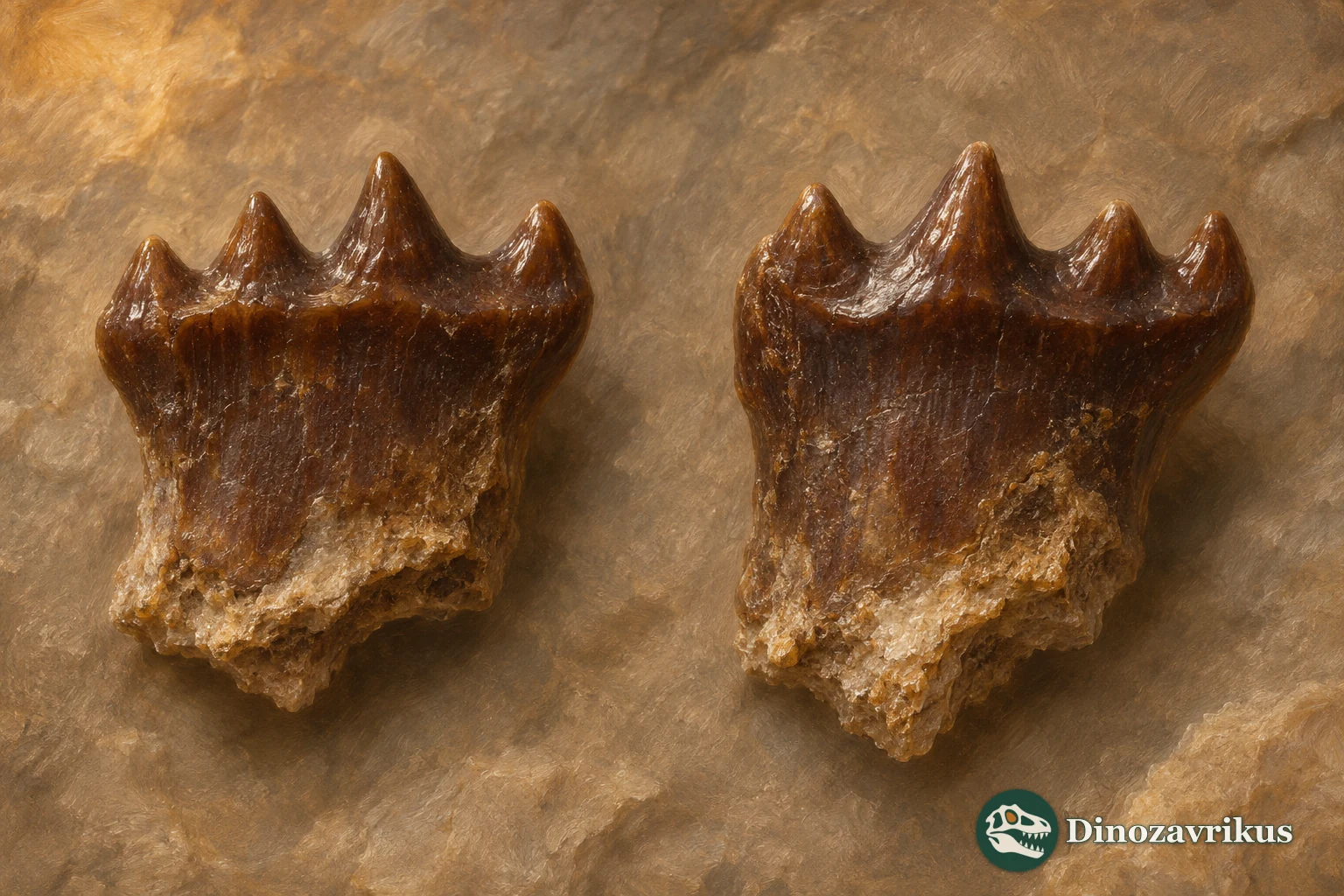
Peneteius was a lizard from Late Cretaceous North America. Its type species had simple pointed teeth at the front of the jaw and broad teeth with several cusps at the back. The complexity of those rear crowns has drawn comparisons with mammal molars.
Quick facts
| Group | Polyglyphanodonts (Polyglyphanodontia) |
|---|---|
| Age | Late Cretaceous, Campanian and Maastrichtian |
| Region | North America, United States |
| Type species | Peneteius aquilonius |
| Scientific name | Peneteius |
| Diet | Diet unknown |
What can the fossils tell us?
In the type species, the upper rear teeth had six cusps and the lower rear teeth had two. The front teeth had simpler crowns.
The shape of the crowns offers clues about how the teeth met when the jaw closed. The similarity to mammal molars evolved independently.
Specimen MWC 8871 combines characteristics of both named species. The tooth alone is insufficient to identify which species it represents.
Two kinds of teeth in one jaw
Richard Estes named Peneteius aquilonius in 1969 from the Upper Cretaceous Hell Creek Formation in Montana. Jaws described later show narrow, forward-leaning teeth with single points at the front and much wider teeth at the rear. Dicothodon also has teeth expanded across the jaw. Peneteius adds a more elaborate arrangement of ridges and individual cusps.
Two species and one difficult identification
Campanian fossils from Utah were first described under a separate genus. Comparison of the jaws and teeth led to their reassignment as Peneteius saueri. An isolated tooth has also been described from Campanian deposits in Texas. A six-cusped upper tooth from Colorado combines features of both named species. Its base resembles P. aquilonius, while the angle of its transverse ridge is closer to P. saueri.
What the teeth suggest about feeding
The crowns suggest that Peneteius processed food between the rear teeth. Their transverse ridges and cusps would have guided contact between the upper and lower rows. The shape of the teeth gives few clues about the foods it ate. More evidence of wear and of how the teeth fitted together could help narrow down its diet.
Frequently asked questions
Why compare Peneteius teeth with mammal molars?
Its broad hind teeth carried several cusps, giving them a superficial resemblance to molars. These structures evolved independently in the lizard and mammal lineages.
How many cusps did the rear teeth have?
Peneteius aquilonius had six cusps on an upper rear crown and two on a lower one.
When did Peneteius live?
Fossils date to the Campanian and Maastrichtian ages of the Late Cretaceous.
Which species is known from Utah?
Campanian deposits in Utah yielded Peneteius saueri, which was first placed in a genus of its own.