

Pericotoxodon was a large toxodontid notoungulate from Miocene Colombia. Its best-known species, P. platignathus, is anchored to a partial skull with upper teeth, while later finds added another cranium and a femur. A recent study described large tooth marks on two of these fossils, bringing predator–prey interactions into the discussion without recording an actual hunt.
The genus appears in the ancient mammal catalogue. The La Venta material is much more secure than isolated teeth referred to the genus with a question-marking cf. designation.
Quick facts
| Scientific name | Pericotoxodon Madden, 1997 |
|---|---|
| Type species | P. platignathus Madden, 1997 |
| Group | Toxodontidae, Notoungulata |
| Age | Middle Miocene; Laventan South American Land Mammal Age |
| Main locality | La Venta, Huila Department, Colombia |
| Holotype | UCMP 40199, partial cranium with upper teeth |
| Mass estimates | About 616 kg from a femur; 932–982 kg from a partial skull using different models |
What do the Pericotoxodon fossils show?
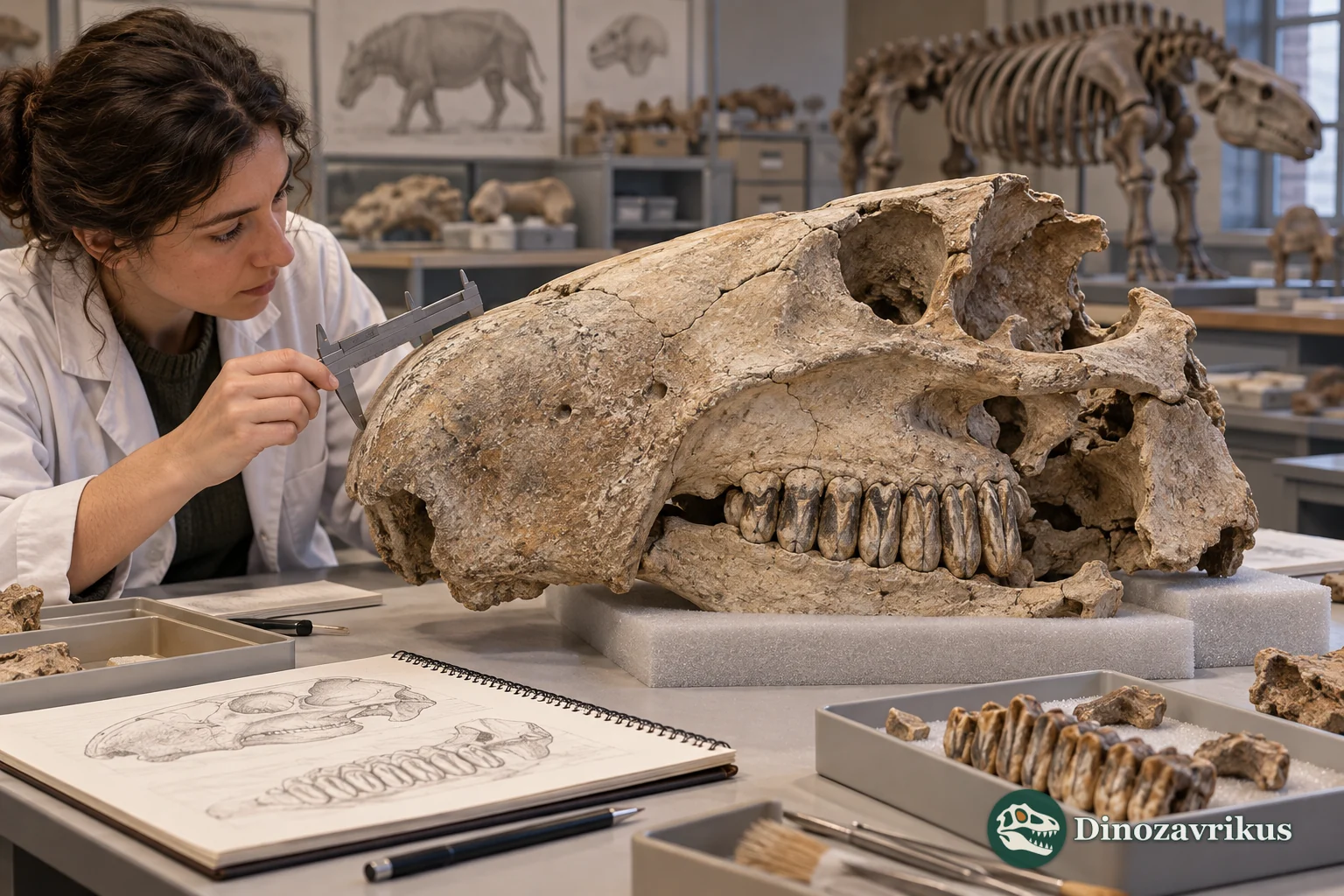
UCMP 40199 preserves part of an adult cranium and upper dentition. Much of the cranial roof is missing, so it is not a complete skull or skeleton.
The preserved cranium is 387 mm long and retains four upper molars. Estimates of 982 kg from M2 length and 931.6 kg from occipital width are model outputs, not a direct weighing.
MNHN.F.VIV77 is a distal right femur referred to a toxodontid. Its estimated mass is about 616 kg. Bite traces show damage to bone, but not whether the animal was hunted or scavenged.
La Venta is the secure core of the record. Peruvian teeth called Pericotoxodon cf. platignathus and a Colombian cf. Pericotoxodon molar remain provisional referrals.
The type and the La Venta sample
Richard Madden established Pericotoxodon in his 1997 monographic study of the mammals of the Villavieja Formation. The type species is P. platignathus. Holotype UCMP 40199, collected by David E. Savage as field number 605, is an adult partial cranium with upper teeth. The left side retains incisors, P2–P4 and M1–M3; the right preserves P3–P4 and M1–M3. The top of the skull is truncated, with much of the region above the middle of the orbits absent.
Additional material from La Venta includes separate cranial fragments, jaws, deciduous teeth and permanent teeth. These fossils do not make up one articulated skeleton. Researchers refer specimens to the same taxon by comparing anatomical features and their geological context, while allowing for variation in tooth shape and wear.
Age, localities and environment
The core sample comes from La Venta in Huila Department, along the Magdalena Valley. Fossils occur in the Honda Group, especially the Villavieja Formation and its members. The assemblage is assigned to the Laventan South American Land Mammal Age in the Middle Miocene, commonly placed at roughly 13.8–11.8 million years ago. This is a regional biochronological interval, not a precise date for each tooth.
Some teeth from the Fitzcarrald Arch in Peru were published as Pericotoxodon cf. platignathus. A fragmentary lower molar from Colombia’s Castilletes Formation was also referred as cf. Pericotoxodon. In both cases the qualifier reflects limited diagnostic evidence; these records may broaden the possible range but are not secure occurrences of P. platignathus.
La Venta preserves a diverse middle Miocene fauna from lowland settings that included rivers, lakes and wetlands. Sediments, plant fossils and associated vertebrates inform the regional environmental reconstruction. No stomach contents or direct feeding traces identify the plants eaten by Pericotoxodon.
Teeth, skull anatomy and body mass
The cheek teeth were high-crowned and continued growing as their grinding surfaces wore down. Enamel folds on the molars vary with tooth position and wear, so an isolated fold is not enough to define a separate species. A 2026 description of partial cranium MPV 826 documented a preserved length of 387 mm and upper molars on both sides. Its enamel-fold pattern was judged consistent with P. platignathus.
The same study estimated body mass at 982 kg from average M2 length and 931.6 kg from interoccipital width. Madden’s earlier estimate was about 798 kg, based on lower-molar crown length and comparisons with living large mammals. A separate distal right femur, MNHN.F.VIV77, yielded an estimate near 616 kg. The values refer to different fossils and anatomical proxies. They are model-dependent estimates, not a measured range for every adult.
The partial skull and isolated limb bone do not establish full body proportions or locomotor performance. No associated complete skeleton of the genus is known.
Bite traces and what they mean
The 2026 study described damage on MPV 826 and nine traces on femur MNHN.F.VIV77: five punctures and four smaller pits. The shapes and dimensions were compared with teeth of the large caiman Purussaurus. Some traces indicate that the bone was still fresh when bitten, supporting contact between a large predator and the animal’s body or carcass.
The fossils do not show whether a living toxodont was attacked, whether it had already died, or how the interaction unfolded. Bite marks are direct evidence of damage; the identity of the maker and the distinction between predation and scavenging are interpretations based on the trace pattern and comparison. The marks cannot reconstruct a chase or prove a particular hunting strategy.
Toxodontid skulls and jaws, including those of much later Toxodon, help frame comparisons within the family. Similarities do not let researchers substitute a younger species’ complete anatomy for the fragmentary Miocene record.
Diet and limits of reconstruction
The durable high-crowned cheek teeth and toxodontid affinities support a herbivorous interpretation, but the precise diet remains unknown. There are no reported stomach contents, diagnostic coprolites or taxon-specific isotope results that would identify particular plants or quantify grazing versus browsing.
Fossils directly preserve a partial cranium, large cheek teeth, a femur and bite damage. Body mass estimates and predator attribution are research inferences. The cover’s coat, colour, soft-tissue proportions and wetland backdrop are artistic choices. Growth, reproduction, social behaviour and most pathologies remain undocumented.
Frequently asked questions
What fossils are known for Pericotoxodon?
The record includes the partial skull and upper teeth of holotype UCMP 40199, other dental and jaw material from La Venta, partial cranium MPV 826 and the referred distal femur MNHN.F.VIV77. They are not one articulated skeleton.
How much did Pericotoxodon weigh?
Published estimates range from about 616 kg for a femur-based model to 931.6–982 kg using two measurements from a partial skull. Madden’s earlier tooth-based estimate was about 798 kg. These are estimates for different specimens and models.
What did it eat?
Its teeth and toxodontid affinities support herbivory, but no direct evidence identifies a particular plant menu or the balance of grazing and browsing.
Do the bite marks prove that Purussaurus hunted it?
The marks are consistent with contact by a large crocodilian and some indicate biting of fresh bone. They do not establish whether the animal was killed during an attack or bitten after death.