

Petrodactyle wellnhoferi lived near the islands of what is now Bavaria in the Late Jurassic. Its name rests on LF 2809, a skeleton with numerous bones that are mostly separated rather than joined. The fossil documents a crested skull, teeth and wing elements, but does not preserve the animal's colour, behaviour or actual prey.
Quick facts
| Named species | Petrodactyle wellnhoferi, Hone and colleagues, 2023 |
|---|---|
| Holotype | LF 2809, largely complete but mostly disarticulated skeleton |
| Locality | Schaudiberg Quarry near Mühlheim, Bavaria |
| Rock unit and age | Mörnsheim Formation, early Tithonian, Late Jurassic |
| Skull | Approximately 258 mm long and 50 mm high |
| Estimated wingspan | About 2.1 m in an immature individual |
| Relationships | Ctenochasmatid; narrower position remains uncertain |
What can the fossils tell us?
LF 2809 includes a skull, jaw, vertebrae, shoulder elements and both wings. The sternum, tail and some hindlimb parts are missing.
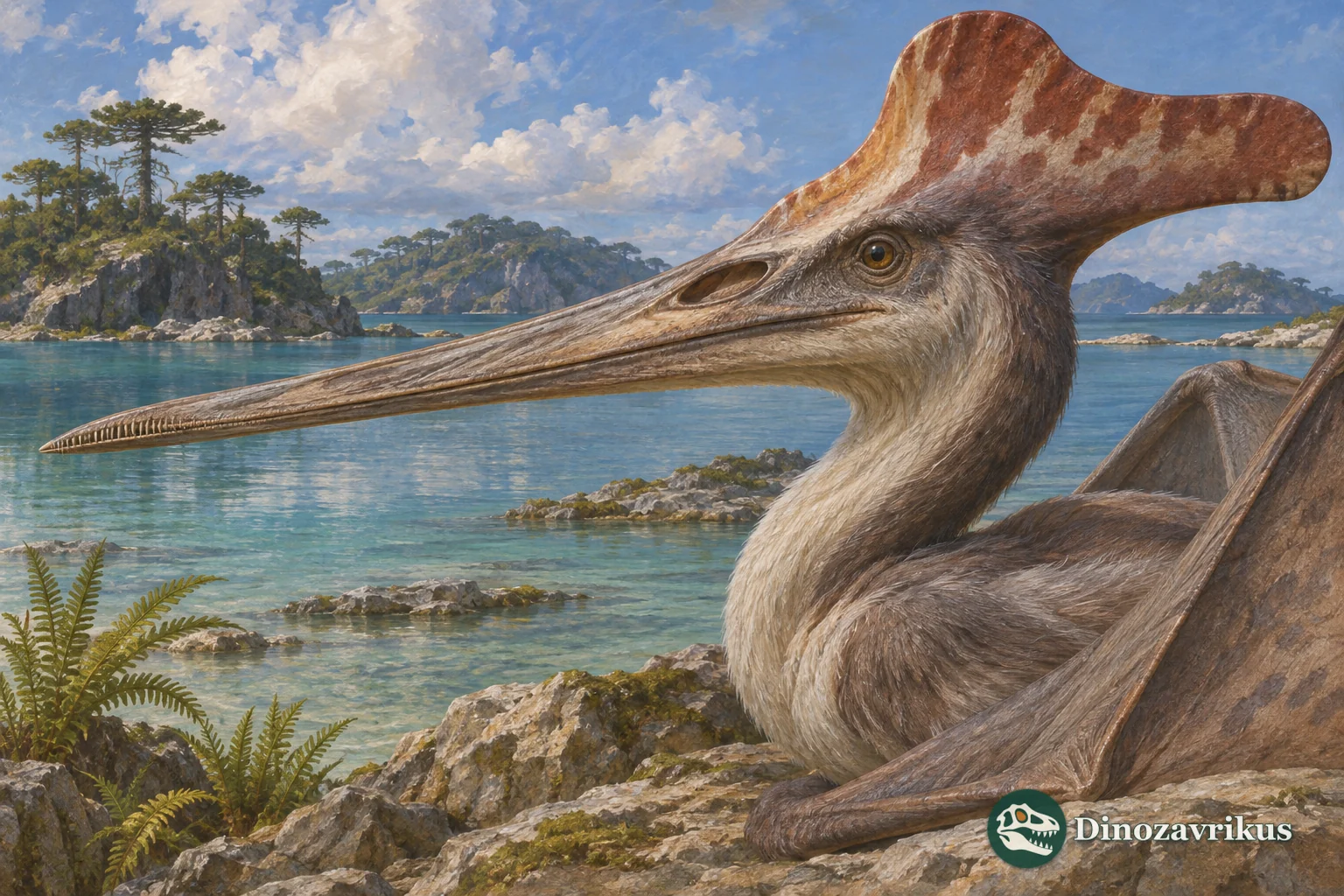
The skull bears a conspicuous bony crest. Neither its colour nor any soft-tissue extension is known.
About 2.1 m is reconstructed from wing bones of an immature animal, not measured from a fully spread wing or an adult maximum.
Small conical teeth survive, but no stomach contents do. Proposed feeding styles depend on comparisons with other pterosaurs.
Discovery and name
The skeleton was discovered during a visit to Schaudiberg Quarry in summer 2010. Ulrich Leonhardt and Roland Pöschl excavated it; Leonhardt prepared the specimen in 2011. The original finder is not identified in the published account. The Lauer Foundation acquired the fossil in 2015 as LF 2809. A cast, SNSB-BSPG 2022 I 23, is kept by the Bavarian State Collection of Palaeontology and Geology.
David Hone, René Lauer, Bruce Lauer and Markus Spindler named the species in 2023. Its species name honours pterosaur researcher Peter Wellnhofer. The fossil comes from the Dritte Rosa layer of the Mörnsheim Formation. Early Tithonian is the geological age of that layer, not a precise death date for the individual.
Skull and wings
The measured skull is about 258 mm long and 50 mm high. Numerous relatively small conical teeth line the anterior jaws, and a bony crest rises from the skull roof. The fossil does not reveal the crest's colour or a possible soft-tissue outline. Teeth alone cannot identify an exact menu.
Both wings preserve elements useful for estimating size. The authors proposed a wingspan near 2.1 m, although the skeleton was not found with wings extended. Its skeletal maturity indicates a subadult. That number cannot be treated as the adult maximum. Missing parts, including the sternum, limit any exact reconstruction of posture and flight mechanics.
Relationships and preservation
The original description placed Petrodactyle among ctenochasmatids, while its precise position within that group remains sensitive to the characters and comparison taxa used. Cycnorhamphus, Ctenochasma and Gnathosaurus illustrate the diversity of jaw forms among related Jurassic pterosaurs. Their missing features should not be copied onto LF 2809.
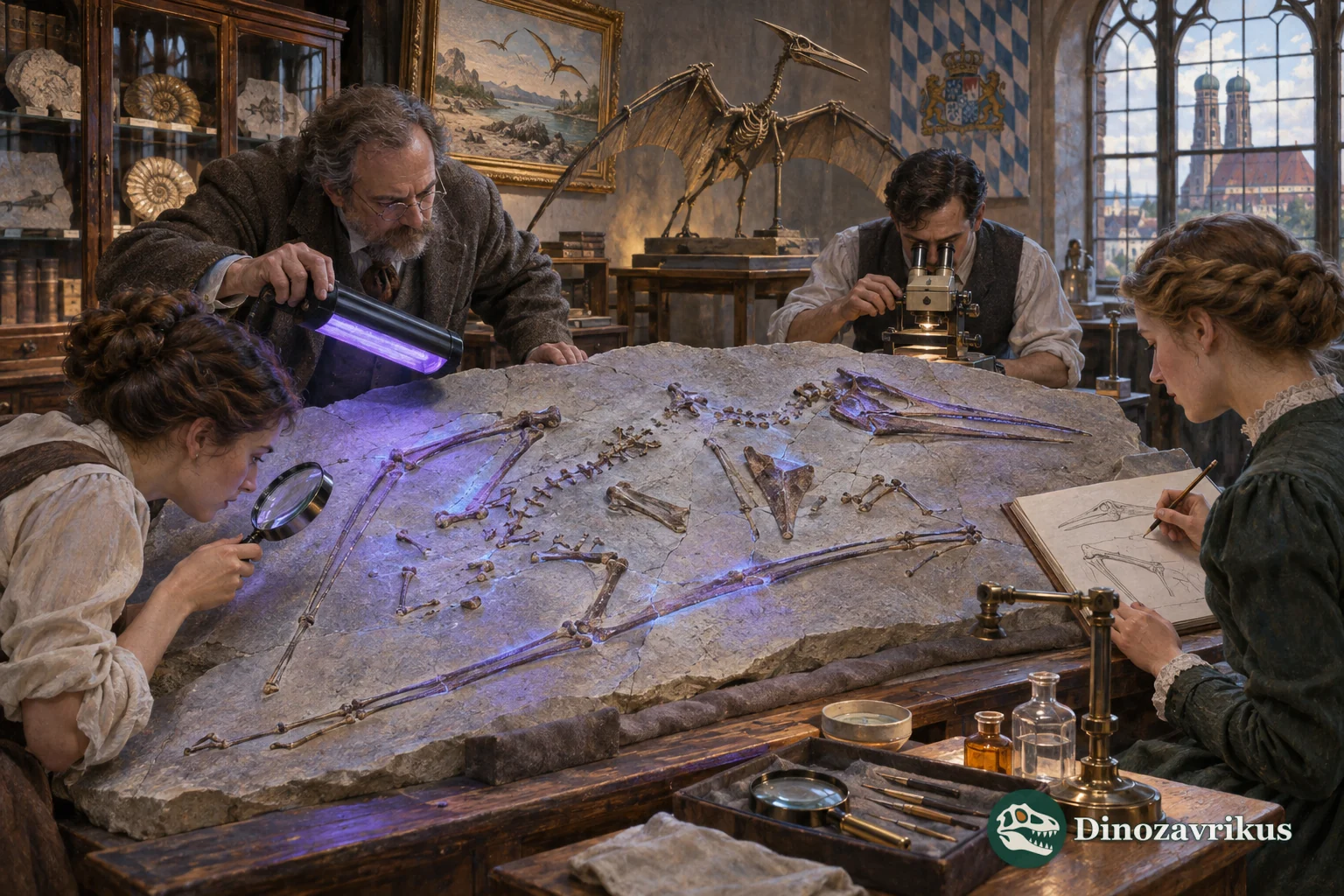
Many bones lie apart on the slab. The original study associated them with one individual but cannot recover every step in decay and movement before burial. Ultraviolet examination exposed details, yet some fluorescence was attributed to preparation materials. It does not demonstrate glowing living tissue.
Limits of the reconstruction
The locality and preserved bones anchor the identification of this pterosaur. Its surface colours, day-to-day behaviour and prey choice were not preserved. Portraits of a living animal and historical laboratory scenes are explanatory illustrations, not photographs of LF 2809 or its actual researchers.
Frequently asked questions
Was a complete Petrodactyle skeleton found?
No. LF 2809 preserves much of the skeleton, including the skull and both wings, but most bones are separated and several regions are missing.
Why is 2.1 m only an estimated wingspan?
It was reconstructed from wing bones, not measured in a fully extended fossil. The individual was immature, so adult maximum size is unknown.
What is known about the crest?
Its bony base survives on the skull. Colour and any extension of soft tissue remain unknown.
Do the teeth establish its diet?
No direct prey remains or gut contents were found. Teeth allow comparative hypotheses but do not give a definite menu.