

Petrustitan was a Late Cretaceous titanosaur from what is now Romania. For nearly a century palaeontologists treated its type species as a member of Magyarosaurus. In 2025 a comparison of the lower leg bones and museum records established a separate genus. It also disentangled several larger fossils once assigned to the species.
Quick facts
| Group | Sauropods, titanosaurs (Titanosauria) |
|---|---|
| Age | Late Cretaceous (Maastrichtian) |
| Region | Europe (Hațeg Basin, Romania) |
| Diet | Herbivorous sauropod |
| Type species | Petrustitan hungaricus |
| Lectotype | NHMUK R.3853, left fibula |
| Estimated length | About 3.2 m for the type individual, estimated by scaling |
| Deposits | Sînpetru Formation |
What can the fossils tell us?
A slender process at the end of the tibia enters a recess in the fibula. The joint and a shared collection number support their attribution to the same animal.
Individual G preserves posterior tail vertebrae with different articular shapes along the series. The type fossils are confined to the lower leg.
Comparison with Magyarosaurus gave about 3.2 metres for the type individual. Its maturity remains unresolved in the absence of bone histology.
The type specimen and its collection number
Friedrich von Huene named Magyarosaurus hungaricus in 1932 using a fibula from near Sânpetru. An old publication misprinted its inventory number. In 2025 Verónica Díez Díaz and colleagues matched the original illustration to the London Natural History Museum specimen NHMUK R.3853. The same number identifies the associated left tibia.
The revision selected the fibula as the lectotype, the specimen to which the species name is fixed, and designated the tibia as the paralectotype. The new name Petrustitan evokes the rocky exposures and the name Sânpetru. Comparison with Magyarosaurus went beyond the simple fact that parts of the Petrustitan type individual were larger.
A distinctive lower leg and an additional skeleton
The fibula has a roughly triangular outline at its upper end. Near the bottom, the inner surface has a recess that receives a slender extension of the tibia. This joint and details of the ridges along the fibula help diagnose the species. The bones are informative even though the type material does not contain the head.
Another specimen in the revision, known as Individual G, includes parts of a forelimb and pelvis, a fibula and several posterior tail vertebrae. One of the vertebrae is concave at the front, and the next is concave at both ends. Other bones formerly assigned to Petrustitan were linked with different individuals or left unassigned.
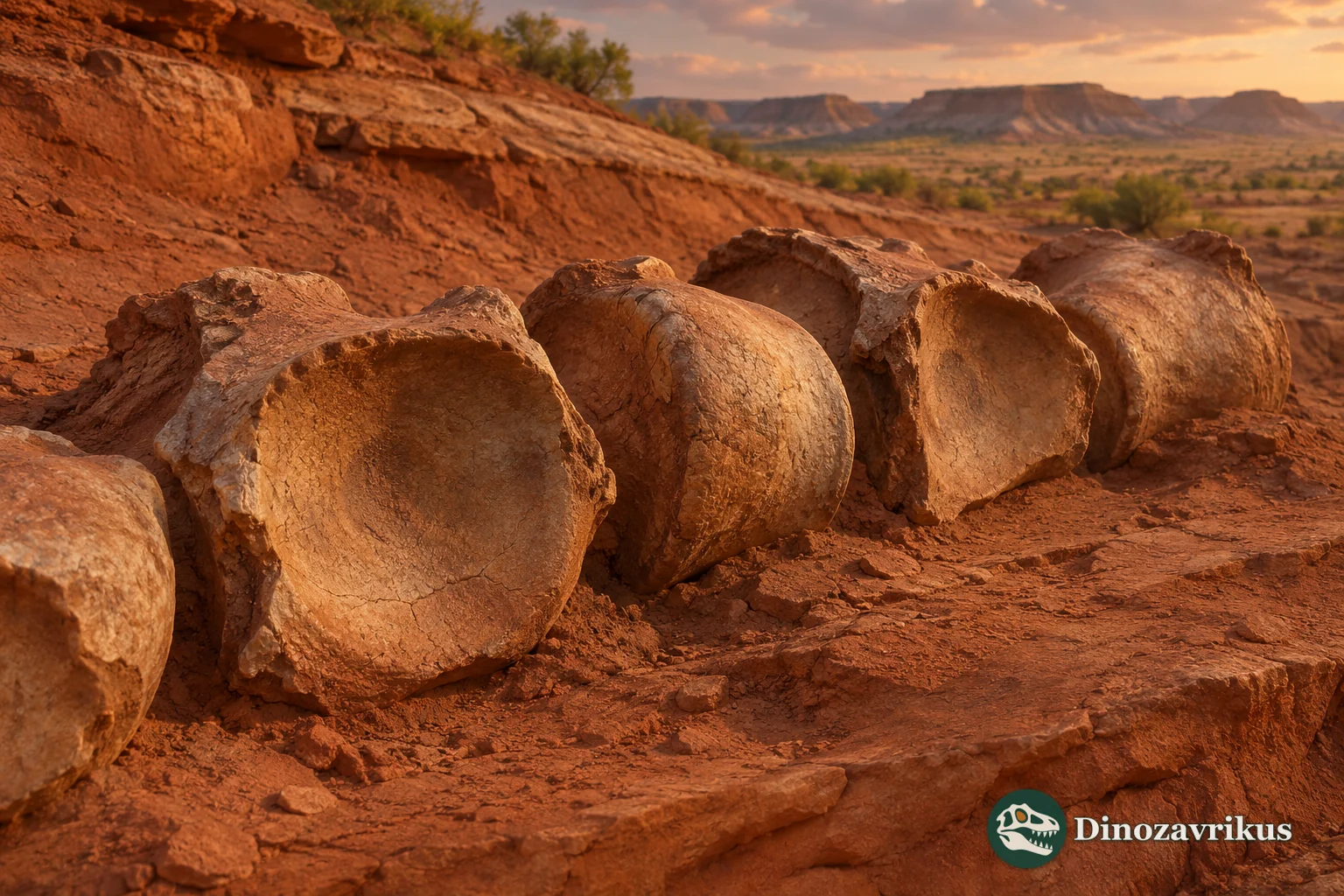
Body size on Hațeg Island
The type material came from the Sibișel River Valley, south of Sânpetru, where the Maastrichtian beds of the Sînpetru Formation crop out. The exact collection point and its position within the deposits are unknown. The stage provides the most useful age for the type specimen.
The 2025 study estimated that the type individual exceeded the largest Magyarosaurus in the comparison by about 16–20 percent in linear dimensions if the animals had similar proportions. The comparison gave a body length of around 3.2 metres. That is small for a titanosaur. With no published bone histology for Petrustitan, scientists still need to establish the maturity of the known animals before making a firm case for island dwarfism.
Frequently asked questions
When was Petrustitan separated from Magyarosaurus?
It was established as a separate genus in 2025 after researchers compared the fossils and their collection records.
Which fossil defines the species?
The left fibula NHMUK R.3853 is the lectotype. Its associated tibia adds evidence of the shape of the lower leg.
How long was the known animal?
Scaling from Magyarosaurus yielded an estimate of about 3.2 metres for the type individual.
Was Petrustitan an island dwarf?
Its estimated size is compatible with island dwarfism. The maturity of the known specimens still needs to be tested by studying their bone tissue.