

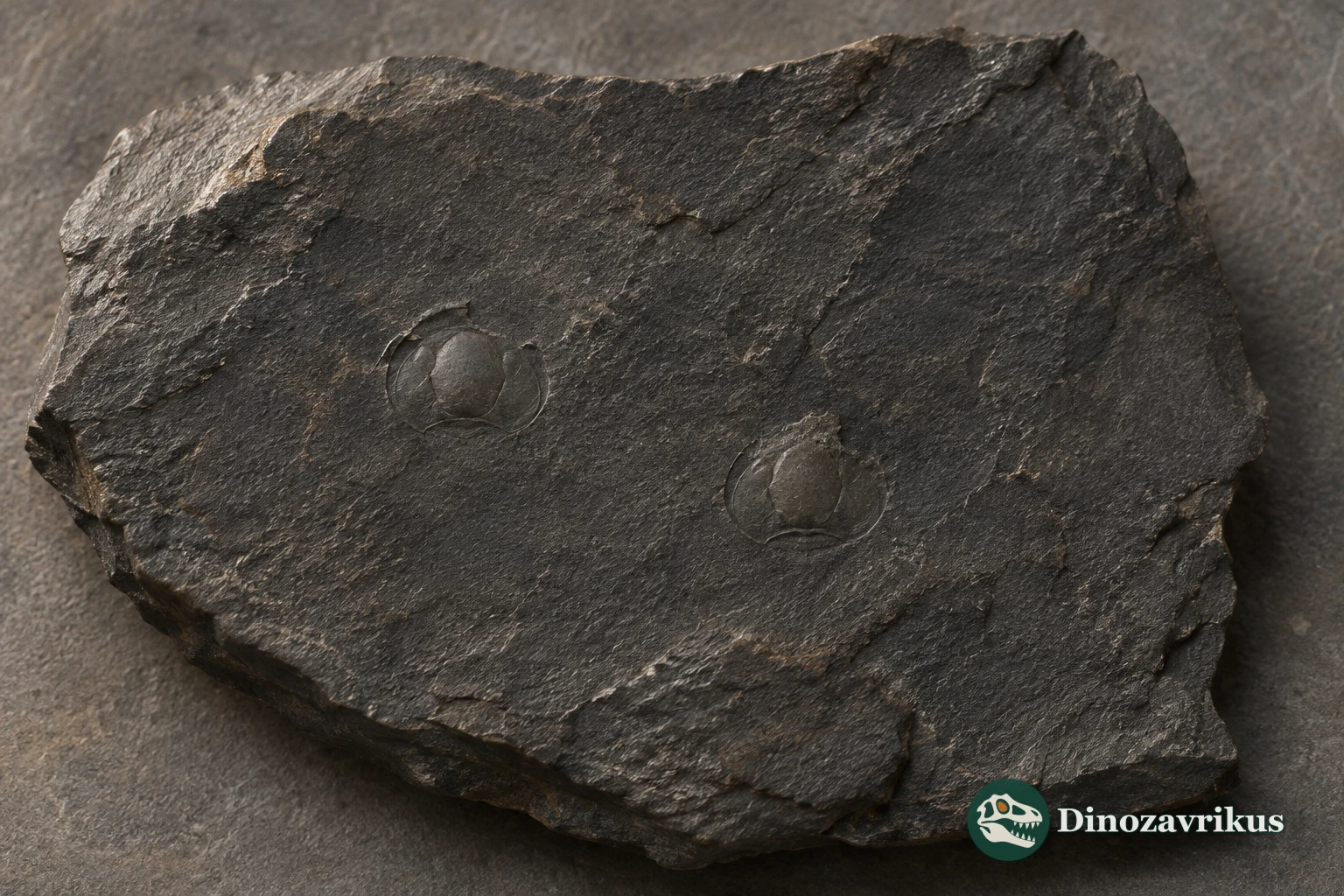
Phaldagnostus is a Late Cambrian agnostoid described from the Altai Mountains. In the type species, the head and tail shields are almost circular. Little relief remains on their surfaces to distinguish them from the shields of other agnostoids.
Quick facts
| Group | Agnostoids |
|---|---|
| Age | Late Cambrian |
| Genus named by | Nikolai Ivshin, 1960 |
| Type species | Phaldagnostus orbiformis |
| Type locality | Kulbich Creek, Altai Mountains |
| Holotype | Por-1, ZSGU collection |
What can the fossils tell us?
The illustration of Por-1 shows the basic outline. It offers few details for comparison with other smooth-shelled agnostoids.
Ivshin noted weak furrows along its sides. In the type species the node on the axis can be barely visible.
The specimen number, locality and horizon tie the generic name to a particular fossil from the Altai.
The fossil from the Kulbich beds
Nikolai Ivshin named the genus in 1960. The holotype of Phaldagnostus orbiformis was found at Kulbich Creek in the drainage of the Kuza River. Ivshin placed the fossil-bearing rocks in the lower part of the Upper Cambrian and illustrated the shield in his figure 48.
Fossils attributed to Phaldagnostus were subsequently reported from several Late Cambrian biozones in the Lesser Karatau range of southern Kazakhstan. These records reflect published identifications that depend in part on how the genus is defined.
Reading the subdued shell relief
Ivshin's generic diagnosis described a smooth head shield without a marginal border, and two thoracic segments with a broad axis and short lateral portions. The tail shield had a narrow border and a long axis that rose only slightly above its surface. In the type species, barely visible furrows define this axis, which sometimes carries a faint midline node.
Disagreement over its identity
Leonid Krasnov compared several Kazakh specimens with Peratagnostus and suggested treating the genus names as synonyms. John Shergold and John Laurie later judged that the original description and figure did not separate the type of Phaldagnostus from other smooth-shelled genera. Later catalogues still list the name Phaldagnostus. The limited published detail of the holotype leaves the proposed synonymy uncertain.
Frequently asked questions
Where was the type specimen of Phaldagnostus found?
At Kulbich Creek in the Kuza River drainage of the Altai Mountains.
What shape were the shields of the type species?
Their outline was nearly circular and the surface was largely smooth. The tail has a faint axis.
How many thoracic segments did Ivshin describe?
Two, with a wide central axis and short lateral portions.
Why is Phaldagnostus difficult to identify?
Its shields are nearly smooth. The original holotype figure offers too few small features for a confident comparison with other effaced agnostoids.