

Phrynosomimus was a small iguanian lizard from Late Cretaceous Mongolia. Bony spikes projected around the back of its short, triangular skull. The overall outline resembles that of living horned lizards, while the teeth and other jaw details point to an acrodont relationship.
Quick facts
| Group | Iguanians (Iguania), priscagamids |
|---|---|
| Age | Late Cretaceous, Campanian |
| Region | Asia, Mongolia, Gobi Desert |
| Type species | Phrynosomimus asper |
| Scientific name | Phrynosomimus |
| Diet | No direct evidence |
What can the fossils tell us?
The type specimen, PIN 3142/318, came from Khermeen Tsav. Skulls from Khulsan and Ukhaa Tolgod provide further details, including bones of the palate.
Several bony projections interrupt the rear outline of the skull. The spikes of the squamosal are especially clear in specimen IGM 3/81.
The head resembles that of a horned lizard. Small triangular teeth attached along the crest of the jaw help place Phrynosomimus among acrodonts.
From Khermeen Tsav to Ukhaa Tolgod
Vladimir Alifanov described Phrynosomimus asper in 1996 from PIN 3142/318. The specimen from Khermeen Tsav preserves a skull and part of the lower jaw. Gao and Norell later described IGM 3/81, a skull from Khulsan with some vertebrae and part of the shoulder girdle, and two incomplete skulls from Ukhaa Tolgod. The fossils represent the Barun Goyot and Djadokhta formations.
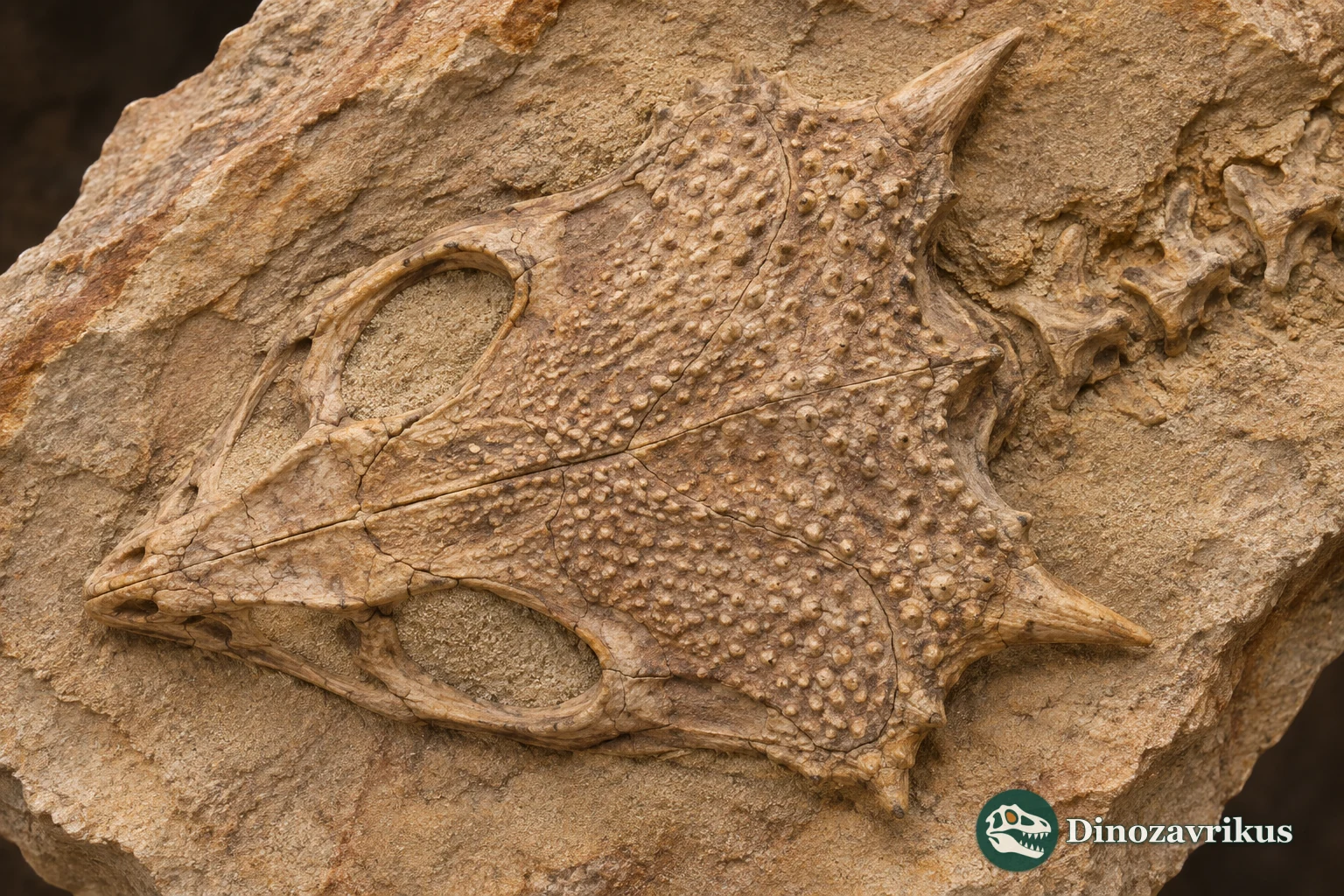
Spines and knobs along the skull roof
From above, the skull was short and almost equilateral in outline. Four prominent spikes were described on the rear and lateral margins of the squamosal. Areas of the skull roof also have small bony knobs. The genus name refers to the resemblance to Phrynosoma, the living North American horned lizards.
Teeth attached along the jaw crest
Most of the tooth row consisted of small triangular teeth fused to the upper edge of the jaw, a condition known as acrodonty. Specimen IGM 3/81 has 11–12 maxillary teeth, while the count in the type is harder to establish from the original illustrations. The teeth and skull characters link Phrynosomimus with early acrodonts such as Priscagama.
A possible way of life on sandy ground
The Khulsan skull was found in poorly cemented sandstone. Its shape and small teeth led researchers to compare the animal with modern lizards that live in sandy places. They suggested that it might have buried itself in sand. The specimen does not record how often it did so or what it ate.
Frequently asked questions
What does the name Phrynosomimus refer to?
It refers to Phrynosoma, the living horned lizards, and the similar outline of the head.
Which bones bore the spikes?
The squamosal and parietal carry bony projections. Small knobs also occur on the skull roof.
What does acrodont attachment mean?
The teeth attach along the crest of the jaw bone. Most of the tooth row in Phrynosomimus had this arrangement.
Is there evidence that it ate ants?
Living horned lizards prompted the comparison. There is no direct record of ant-eating in Phrynosomimus.