

Phuwiangosaurus was a long-necked, plant-eating dinosaur that lived in what is now Thailand during the Early Cretaceous. The genus was named from a partial skeleton from Phu Wiang. Its head became better understood when researchers attributed jaw and skull bones from other localities to the same dinosaur.
Quick facts
| Group | Sauropods, titanosauriforms (Titanosauriformes) |
|---|---|
| Age | Early Cretaceous |
| Region | Asia (northeastern Thailand) |
| Diet | Herbivorous |
| Type species | Phuwiangosaurus sirindhornae |
| Holotype | SM PW 1, partial skeleton |
| Strata | Sao Khua Formation |
What can the fossils tell us?
The holotype SM PW 1 comes from the Sao Khua Formation. It preserves parts of the spine, shoulder and pelvic girdles, and limbs.
Jaw bones and teeth occur with other skeletal material at Phu Kum Khao. The peg-like teeth add evidence of head anatomy beyond the bones preserved in the original specimen.
CT scans of a separate braincase made it possible to reconstruct the space inside it and the channels of the inner ear. They provide another set of features for comparisons among sauropods.
The first finds at Phu Wiang
Valérie Martin, Eric Buffetaut and Varavudh Suteethorn named Phuwiangosaurus sirindhornae in 1994. The genus takes its name from Phu Wiang and the species honours Thailand's Princess Maha Chakri Sirindhorn.
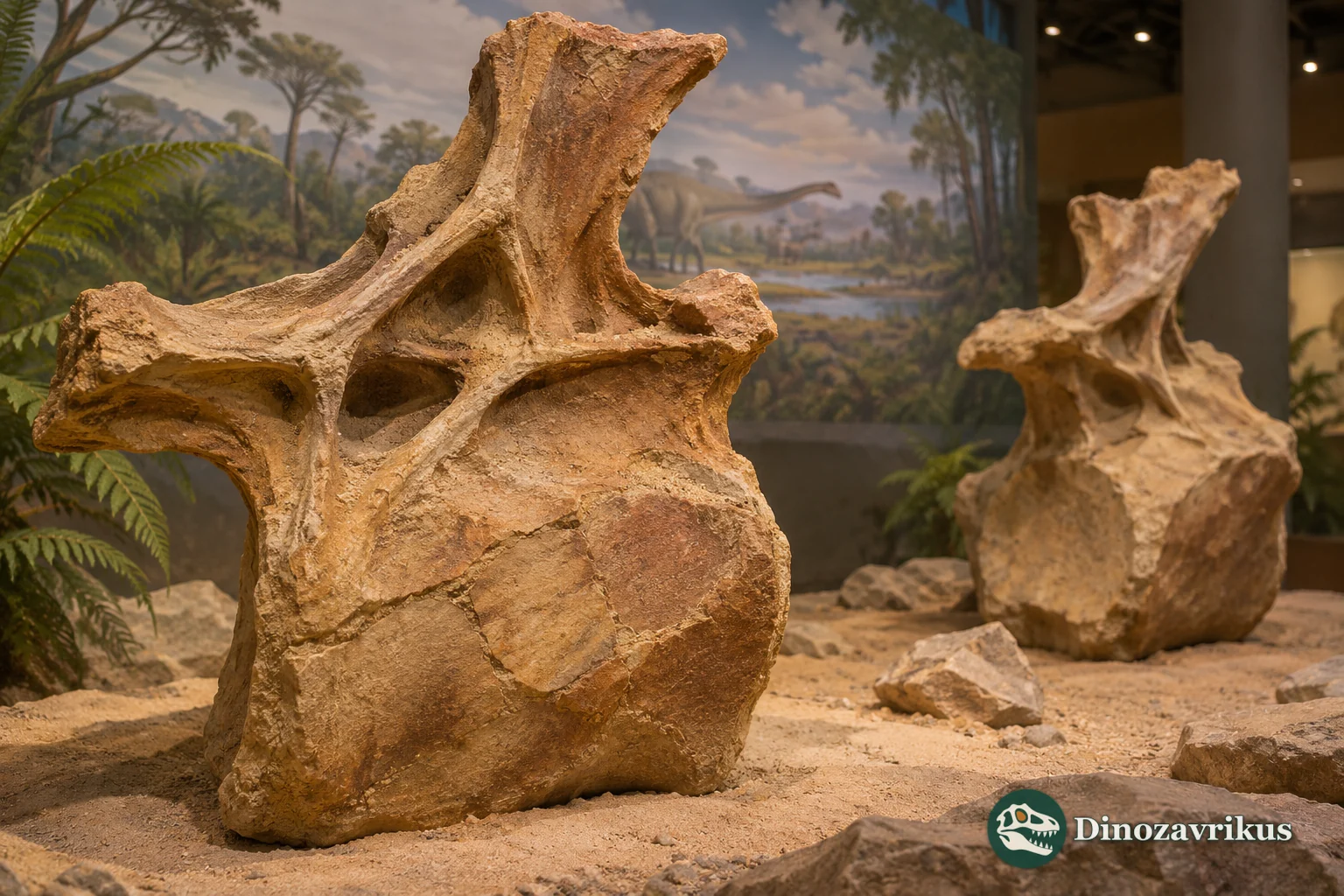
The type skeleton SM PW 1 preserves neck and trunk vertebrae, ribs and bones of the shoulder girdle, pelvis and limbs. Later digging at the type locality recovered more material. A trunk vertebra described as SM PW1-23 preserves details of the bony plates that connect the vertebral processes.
What the skull material adds
At Phu Kum Khao, researchers found remains of several sauropods, including jaw bones and slim, peg-shaped teeth. In some clusters, the teeth retained their original positions relative to each other after separating from the jaw. Their shape is consistent with plant eating, although it does not identify the plants in the diet.
A separate study used computed tomography to examine a braincase referred to Phuwiangosaurus. The scans allowed researchers to reconstruct the internal space of the skull and the anatomy of the inner ear. These structures are hidden when the braincase is examined from the outside.
Relationships among sauropods
Phuwiangosaurus belongs to Titanosauriformes. Its precise position within that group depends on the characters and comparison species included in the analysis. Details of individual bones, including vertebrae, are important for placing both this genus and other Early Cretaceous titanosauriforms such as South America's Ligabuesaurus.

Frequently asked questions
Where did Phuwiangosaurus live?
Its fossils are known from the Early Cretaceous Sao Khua Formation of northeastern Thailand.
What does the species name mean?
It honours Princess Maha Chakri Sirindhorn of Thailand.
What were its teeth like?
Its teeth had narrow, peg-like crowns. These are known from material at Phu Kum Khao.
Why was a braincase CT-scanned?
The scans revealed the internal space of the braincase and allowed the inner ear canals to be reconstructed.