

Phyllograptus is an Early Ordovician graptolite, a colonial hemichordate. Its fossils resemble leaves: four branches spread from the colony’s initial part, and tiny cup-like thecae repeat along each branch. The shape explains the name but does not make the fossil a plant.
James Hall established the genus in 1858, and Phyllograptus typus is its type species. Most evidence comes from thin impressions on shale. The Ordovician Period guide explains why these colonies matter for comparing marine strata.
Quick facts
| Scientific name | Phyllograptus Hall, 1858 |
|---|---|
| Type species | Phyllograptus typus Hall, 1858 |
| Group | Hemichordata, Graptolithina |
| Age | Primarily Early Ordovician; species-level ranges vary |
| Colony | Four branches create a leaf-shaped rhabdosome |
| Fossils | Carbonaceous impressions of colonies and branches |
| Ecology | Colonial; a planktonic life is inferred from context |
| Limit | Fossils do not preserve zooid tentacles or feeding currents |
What can the fossils tell us?
Shale slabs show slender colony branches and repeated thecae. Their number, divergence angles and relation to the initial part help compare species. Compression can bring branches together or hide fine detail.
Thecae are tube-like housings for individual zooids, arranged along the branches. Well-preserved impressions allow their shape and spacing to be studied; carbon film, cracks and rock texture obscure many details.
Rapidly changing and widely distributed graptolites are useful in biostratigraphy. The age of an individual colony depends on species, associated assemblage and bed position; a broad leaf-like outline alone is not a precise date.
Many graptolites lived in the water column, and Phyllograptus is interpreted in that ecological context. A shale impression records colony shape, not zooid tentacles, water flow, drift speed or diet.
Name and classification
The name Phyllograptus combines Greek roots for “leaf” and “write”; the branch impressions can look like lines on a leaf blade. Hall established the genus in 1858, and P. typus is recognised as the type species. Graptolites are placed within Graptolithina among hemichordates. The exact relationships of extinct graptolite groups are assessed from colony construction and comparison with living pterobranchs.
Species assignments in older collections have been revised. Identification requires more than a leaf-shaped outline: the initial part, branch number and angles, and theca shape must be compared. A broken or compressed impression can lose the characters needed for species-level identification.
Colony and branch structure
The graptolite colony skeleton is called a rhabdosome. A typical Phyllograptus form has four stipes that make a symmetrical, leaf-like outline. Thecae – tubular housings for individual zooids – lined the branches. The initial part and sequence of branch formation help researchers understand how the colony grew.
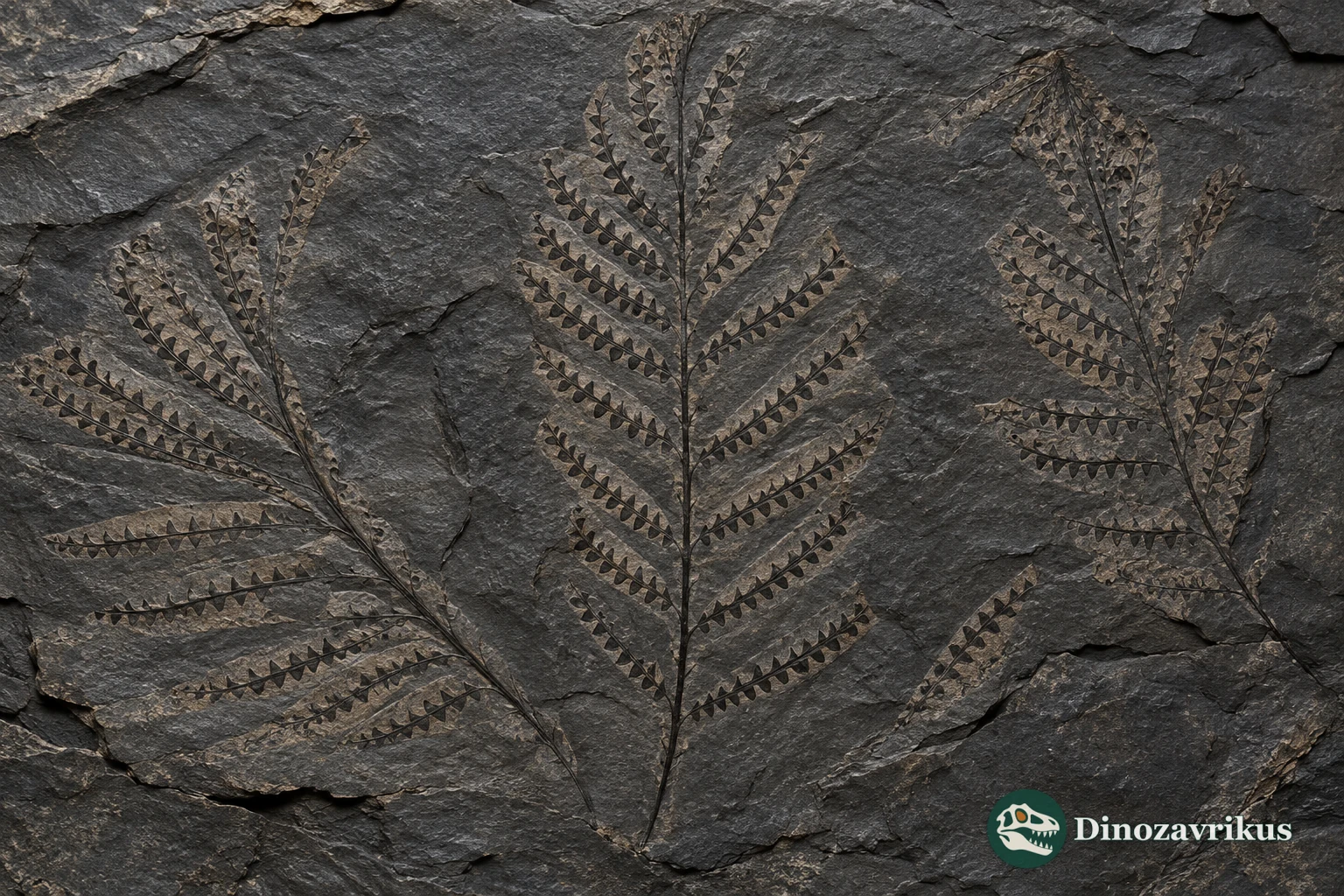
Thecae may be difficult to see. Carbon film, grain size, cracks and compression affect which details remain visible. Photographs and measurements are therefore more reliable than the overall visual impression alone.
Ordovician occurrences and biostratigraphy
Phyllograptus occurs in marine deposits of the Early Ordovician. Individual species and identifications in different schemes may span different intervals, so the genus should not be assigned a single boundary without qualification. Each fossil’s species, locality, formation and bed position need to be checked.
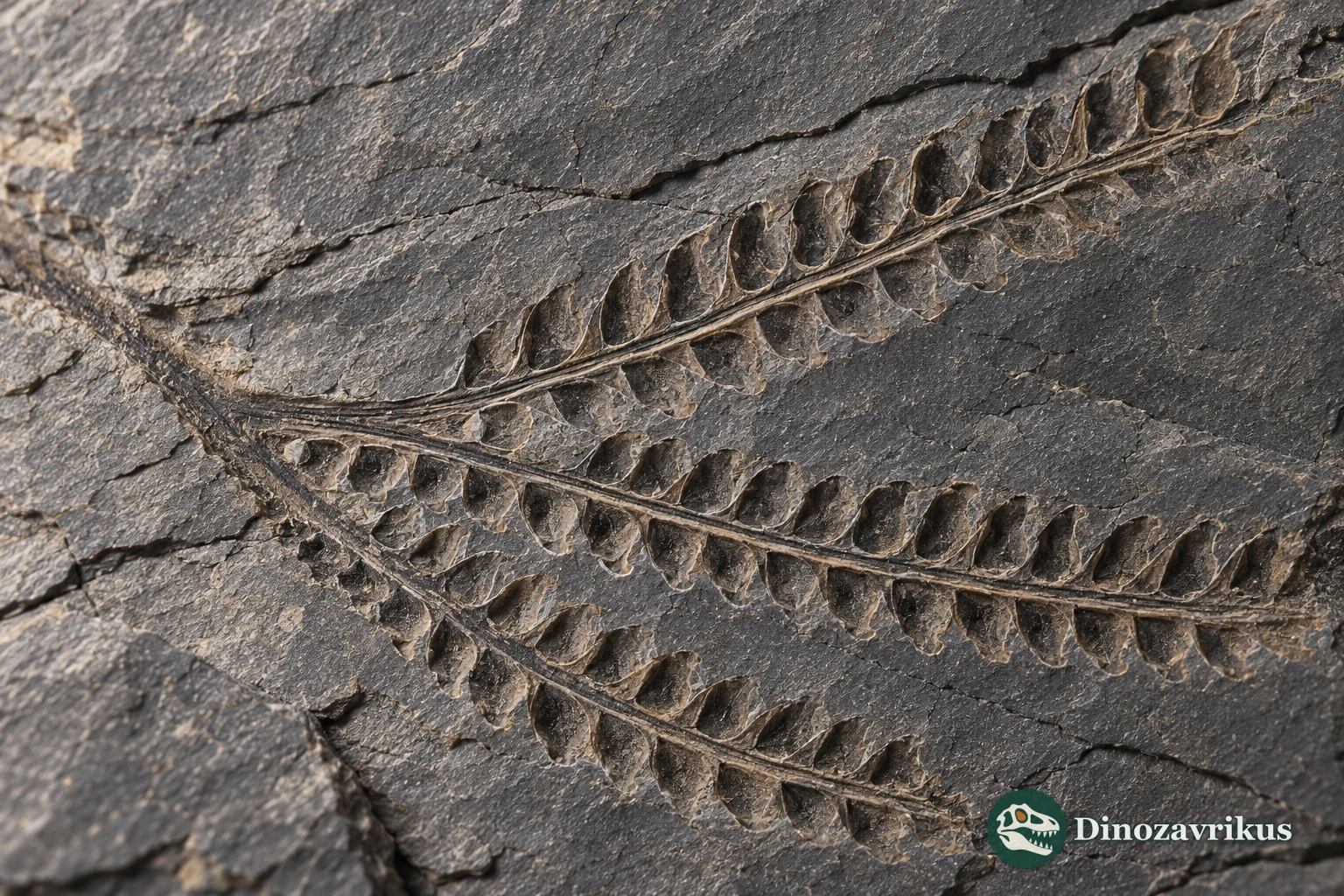
Graptolites are useful for biostratigraphy because some forms were widespread and changed rapidly through time. Yet a precise age does not follow from every similar impression: it depends on identification level, associated taxa and stratigraphic context. An incomplete colony should not be used as a precise date without supporting evidence.
How the colony lived
Many graptolites lived in the water column, and this is a plausible setting for Phyllograptus. The orientation of shale impressions and fossil associations can inform discussions of buoyancy and drift, but do not reconstruct speed or behaviour by themselves. The fossil skeleton records the sequence of thecae, not the zooids’ soft tentacles or the flow around them.
Feeding is commonly interpreted as suspension feeding by comparison with pterobranch zooids. Those soft organs are not preserved in Phyllograptus impressions. Filtration is a reasoned group-level reconstruction, not direct observation of this genus.
Phyllograptus is included in the Early Palaeozoic marine fossil catalogue with other Ordovician fossils. The catalogue spans several groups; adjacent cards do not imply that every organism lived together or at the same time.
Frequently asked questions
Why is Phyllograptus called leaf-shaped?
Its four branches and rows of thecae create a flattened, leaf-like colony outline. This is a shape, not evidence that the fossil is a plant.
What are thecae?
Thecae are small tubular housings along a graptolite branch, each associated with an individual zooid in the colony.
When did Phyllograptus live?
The genus is known chiefly from Early Ordovician marine deposits. The age of a particular species is refined from its bed and associated fossils.
What did Phyllograptus eat?
Its exact food is unknown. Suspension feeding is inferred by comparison with related pterobranchs, but the genus’s soft tentacles are not preserved.