

Piveteausaurus was a predatory dinosaur from Middle Jurassic Normandy. The back of its skull is the only material securely assigned to it. Features around the skull base help compare it with other theropods. Most of the jaws and body are absent from the specimen, so those parts are much harder to reconstruct.
Quick facts
| Group | Theropods (Theropoda) |
|---|---|
| Age | Middle Jurassic (late Callovian) |
| Region | Europe (Normandy, France) |
| Diet | Carnivorous theropod |
| Type species | Piveteausaurus divesensis |
| Holotype | MNHN 1920-7, partial braincase |
| Deposits | Marnes de Dives |
What can the fossils tell us?
The back and base of the braincase and portions of the roof survived at Dives. The snout, teeth and lower jaw are absent.
A broad depression below the occipital condyle and laterally directed processes resemble features of megalosauroids. The single fragment offers limited evidence for a more precise placement.
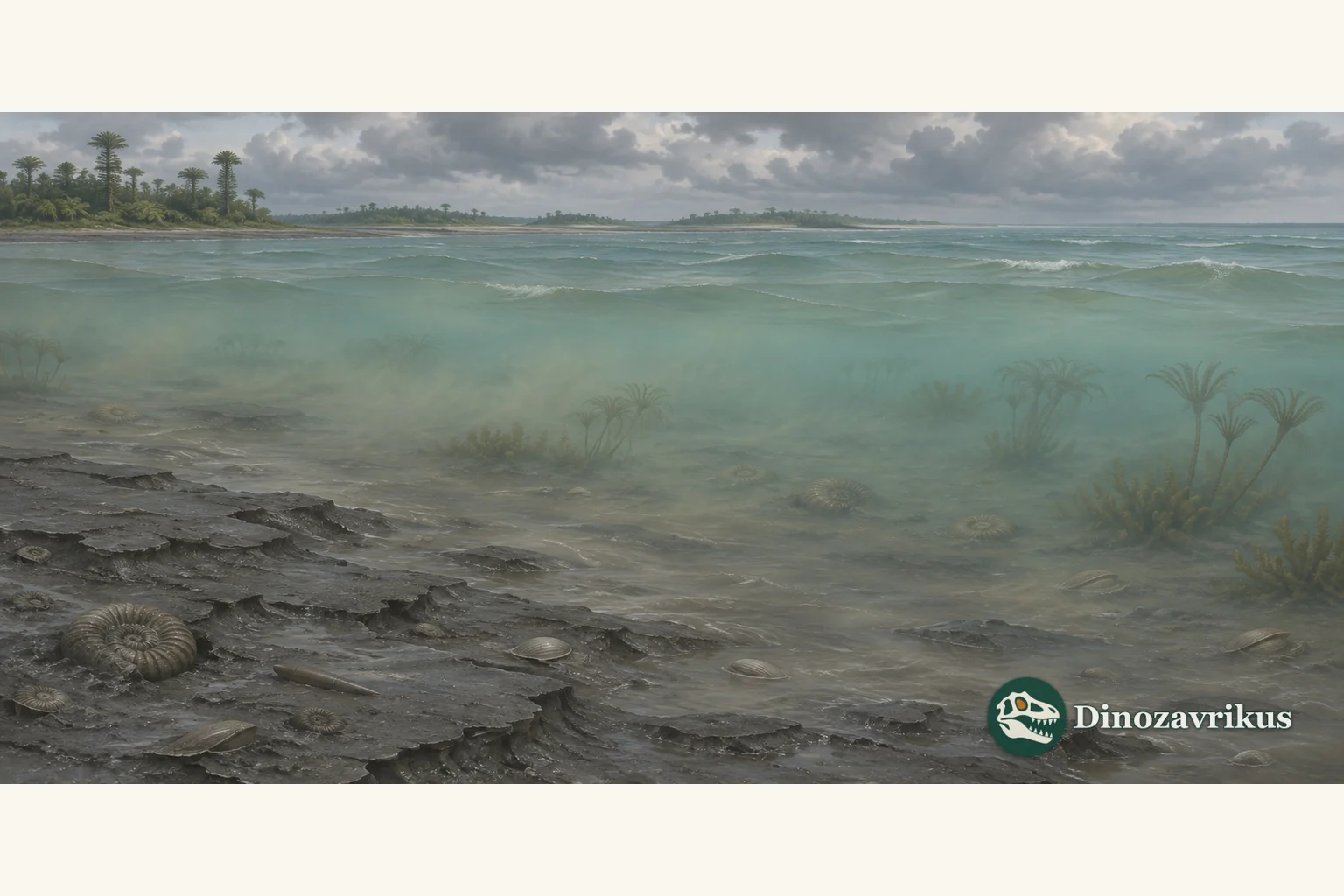
The fossil is generally attributed to late Callovian marl. Early accounts disagree on the exact findspot. The sediment records burial in a marine setting, while the dinosaur's habitat remains indirect.
Several identifications for the same specimen
Jean Piveteau described the partial braincase from the Dives area in 1923 and assigned it to Streptospondylus. Alick Walker made it the type specimen of Eustreptospondylus divesensis in 1964. After comparing it with other theropod skulls, Philippe Taquet and Samuel Welles placed it in a separate genus in 1977 and named it after Piveteau. Specimen MNHN 1920-7 is housed at the Muséum national d'Histoire naturelle in Paris.
What the back of the skull reveals
The surviving bones include relatively long frontals and parietals. Below the occipital condyle, which articulated with the first neck vertebra, a wide depression marks the skull base. The paroccipital processes extend out to the sides. These details resemble parts of the back of the skull in other megalosauroids, including Dubreuillosaurus.
Weathering makes some boundaries between bones difficult to follow. Later comparisons could not confirm all of the sutures shown beside the opening through which the spinal cord passed. The combination of features supports megalosauroid affinities, while the fragment limits more detailed reconstruction of the skull and any estimate of total body length.
A terrestrial animal buried in marine sediment
The fossil is attributed to the Marnes de Dives of the late Callovian, near the end of the Middle Jurassic. The old accounts place it either at the Vaches Noires cliffs near Dives or closer to Dives itself. Remains from land could reach marine deposits in this region. How this individual bone reached its burial site is unknown.
Another piece of a theropod braincase from the Vaches Noires area differs anatomically from the type of Piveteausaurus. It was described separately. The discovery illustrates why other large theropod fragments from the area cannot automatically be added to the known skeleton of this genus.
Frequently asked questions
What part of Piveteausaurus was found?
The type specimen preserves an incomplete braincase, including parts of the roof and the back of the skull.
Why was it once called Eustreptospondylus?
The fossil was originally named as a separate species of that genus in 1964. A detailed comparison in 1977 led to the name Piveteausaurus.
When did Piveteausaurus live?
Its braincase is assigned to the late Callovian stage of the Middle Jurassic.
Can its full length be estimated reliably?
A direct estimate would require more of the skeleton. The braincase primarily offers details for comparing other theropod skulls.