

Plagiophthalmosuchus gracilirostris lived in European seas in the early Toarcian. It had a long, narrow snout and eye sockets that faced mostly sideways. The direction of the sockets distinguished it from many other long-snouted marine crocodylomorphs and gave the genus its name.
Quick facts
| Species | Plagiophthalmosuchus gracilirostris |
|---|---|
| Group | Thalattosuchia |
| Age | Early Jurassic, early Toarcian |
| Localities | Whitby, England, and Dudelange–Bettembourg, Luxembourg |
| Holotype | NHMUK PV OR 14792, nearly complete skeleton |
| Likely diet | Small mobile prey, probably including fish |
What can the fossils tell us?
The bony margins show the orientation of the sockets. They cannot provide a precise field of vision for a living animal.
The Whitby type preserves the head, much of the spine, limb bones and dorsal osteoderms. Other skulls allow finer comparisons of the head.
The 2020 analysis placed the genus at the base of Teleosauroidea. Some later analyses recovered it as a distinct early thalattosuchian branch.
The Whitby skeleton
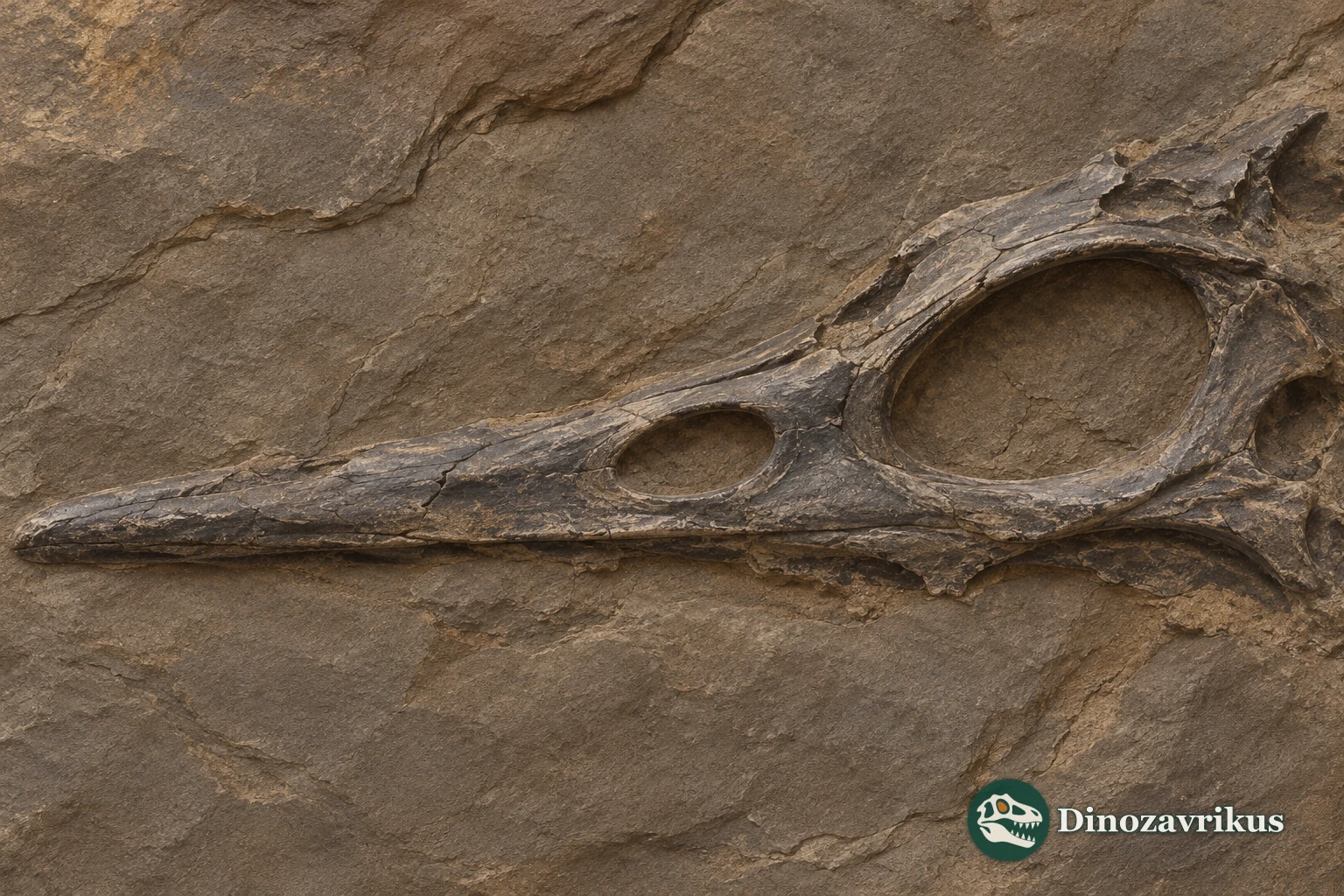
Frank Westphal described the species in 1961 as Steneosaurus gracilirostris. The Whitby holotype, NHMUK PV OR 14792, is held at the Natural History Museum in London. Its long skull is preserved alongside much of the vertebral column, limb bones and some dorsal osteoderms. The paratype, NHMUK PV OR 15500, is a skull with its lower jaw.
A nearly complete skull and mandible, MNHNL TU515, come from the bituminous beds of the Dudelange–Bettembourg area in Luxembourg. Ammonites date the horizon to the early Toarcian. Similarities between the skulls allow comparisons across what is now the English Channel.
A long snout and side-facing eyes
Behind the narrow tooth-bearing part of the skull lies the antorbital opening. Its external opening is appreciably larger than the one farther inside. The orbit opens mainly to the side with a slight upward tilt. Along with other skull characters, these features helped distinguish the genus from animals once classified as Steneosaurus.
Slender teeth and a narrow snout suit the capture of relatively small, mobile prey. Fish have been proposed as an important food source, although the teeth cannot identify individual prey species. Another Early Jurassic form, Pelagosaurus, also had an elongated snout associated with feeding in water.
A place on the thalattosuchian tree
Michela Johnson, Mark Young and Stephen Brusatte erected Plagiophthalmosuchus in 2020. Their analysis recovered it close to the base of Teleosauroidea. The comparison drew on characters from both the head and the rest of the skeleton.
A 2024 revision usually found it on a branch sister to the clade containing teleosauroids and metriorhynchoids. A different assumption about relationships sent it back to the base of Teleosauroidea. Both results place it within Thalattosuchia.
Frequently asked questions
What does the name refer to?
It refers to the mainly sideways direction of the eye sockets.
What remains in the Whitby type?
It is a nearly complete skeleton with skull, vertebrae, limbs and some osteoderms.
Where has it been found outside England?
A nearly complete skull and jaw come from the Dudelange–Bettembourg area in southern Luxembourg.
What prey has been proposed?
The narrow jaws and slender teeth suit small, mobile animals. Fish are a likely food source, though no particular prey is documented.