

Plagiosaurus was a temnospondyl amphibian from Late Triassic Germany. Its skull is best known from the area behind an eye socket. The way the bones meet there helps distinguish Plagiosaurus from other flat-headed members of its family.
Quick facts
| Group | Temnospondyls, plagiosaurids |
|---|---|
| Age | Late Triassic, Norian |
| Region | Europe, Germany (Halberstadt) |
| Type species | Plagiosaurus depressus |
| Scientific name | Plagiosaurus |
| Diet | Exact prey is unknown |
What can the fossils tell us?
The lectotype preserves the side and rear of the skull. Other material includes a clavicle, an interclavicle and a short upper arm bone.
Both genera had a low shoulder girdle and a short, stout humerus. These features let researchers make comparisons even where skulls are incomplete.
The fossils do not pin down the outline of the front of the head or the full length of the animal.
The Halberstadt fossils
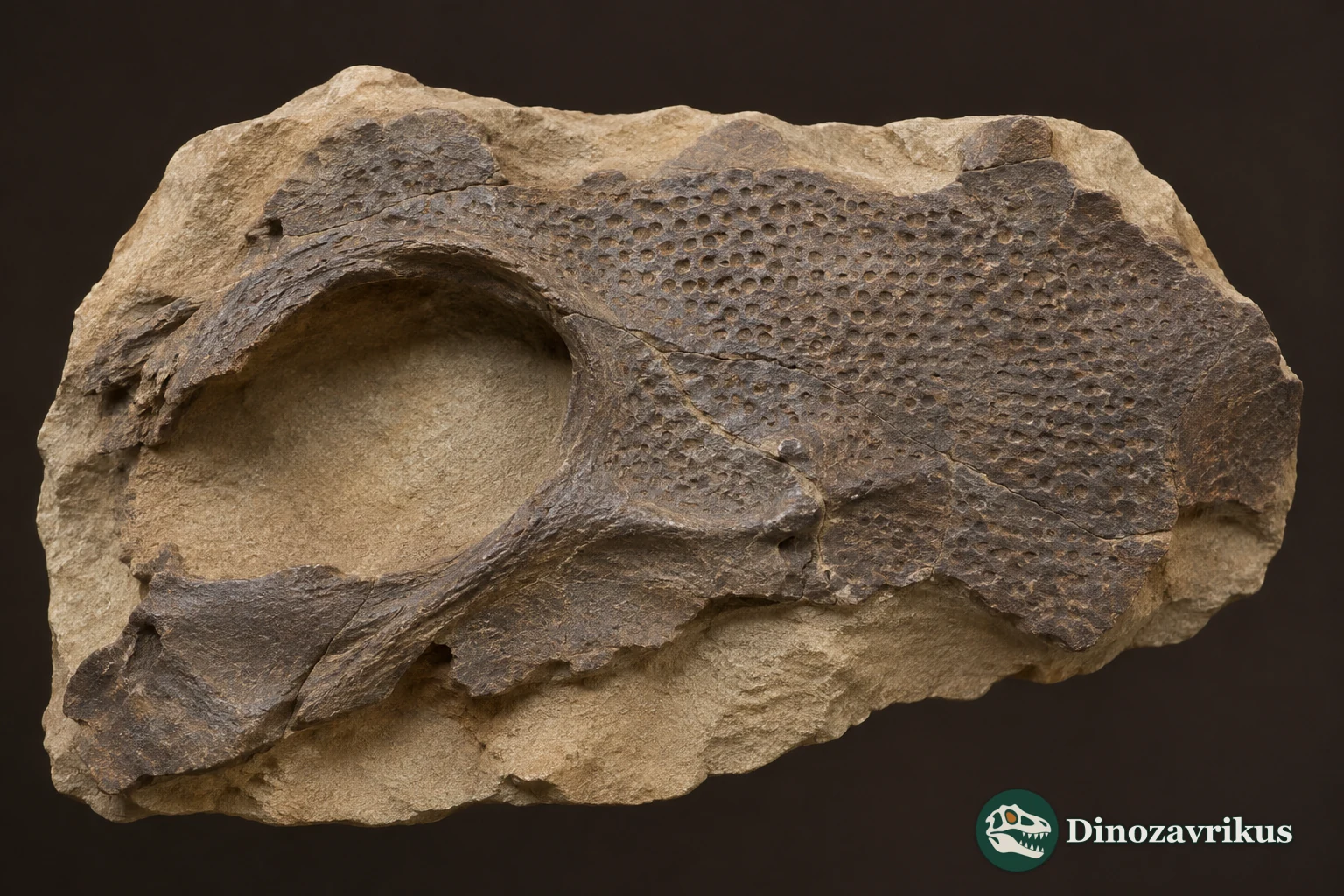
Otto Jaekel described Plagiosaurus depressus in 1914. Fossils securely identified as this species come from Norian deposits at Halberstadt, Germany. The name is anchored to lectotype MB.Am.637, a fragment from the rear and side of the skull held by the Museum für Naturkunde in Berlin. Other specimens preserve parts of the lower jaw and shoulder girdle.
How the eye socket was framed
In many temnospondyls, the postorbital bone borders the rear of the eye socket and meets the postfrontal above. In Plagiosaurus the postfrontal is absent, which brings the parietal to the rear inner margin of the socket. The parietal meets the postorbital along a broad contact. Different members of the family lost skull bones independently, so the whole pattern of contacts matters when identifying fragments.
The head and forelimb
Plagiosaurus had a relatively deeper, narrower skull than Gerrothorax. Both had a low shoulder girdle with sturdy, box-like sides and a short, robust humerus. Fossil material also includes pieces of bony plates from the skin, called osteoderms. Small bumps cover their outer surfaces, but the broken edges leave the complete shape of the plates uncertain.
Which fossils belong to the genus?
Palaeontologists once used Plagiosaurus for a wider range of fossils. They now place the species once called P. pulcherrimus in Gerrothorax. Plagiosternum represents a different branch of the same family and shows how much the shape of the skull could vary among plagiosaurids. Such comparisons are useful when much of the snout is missing, as in Plagiosaurus.
Frequently asked questions
Where was Plagiosaurus found?
Securely identified specimens come from Halberstadt, Germany.
When did Plagiosaurus live?
The known specimens are from the Norian stage of the Late Triassic.
What was unusual about its eye socket?
The postfrontal bone is absent. The parietal reaches the rear inner margin of the socket.
How long was Plagiosaurus?
Its overall length is uncertain. The preserved skull and shoulder bones establish only some of its proportions.