

Plagiosuchus pustuliferus was a plagiosaurid temnospondyl in Middle Triassic freshwater habitats of what is now Germany. It was an extinct amphibian, not a crocodile. Its skull carries immense openings around the eye and temporal region, reduced marginal tooth rows and unusually developed jaw-muscle spaces. Together these features led researchers to propose directed suction when seizing prey.
The fossil anatomy makes it a distinctive member of the ancient amphibian catalogue. Suction feeding is a tested functional interpretation, whereas the exact prey, colour and swimming posture remain unknown.
Quick facts
| Scientific name | Plagiosuchus pustuliferus |
|---|---|
| Group | Plagiosauridae, an extinct temnospondyl branch |
| Age | Middle Triassic |
| Locality | Southern Germany, Lettenkeuper deposits |
| Evidence | Skulls, jaws and postcranial skeletal material |
| Illustrated skull | SMNS 57921 in later anatomical works |
| Branchial evidence | Ossified elements and denticles indicate open gill slits |
| Feeding model | Directed suction inferred from skull and jaw mechanics |
What can the fossils tell us?
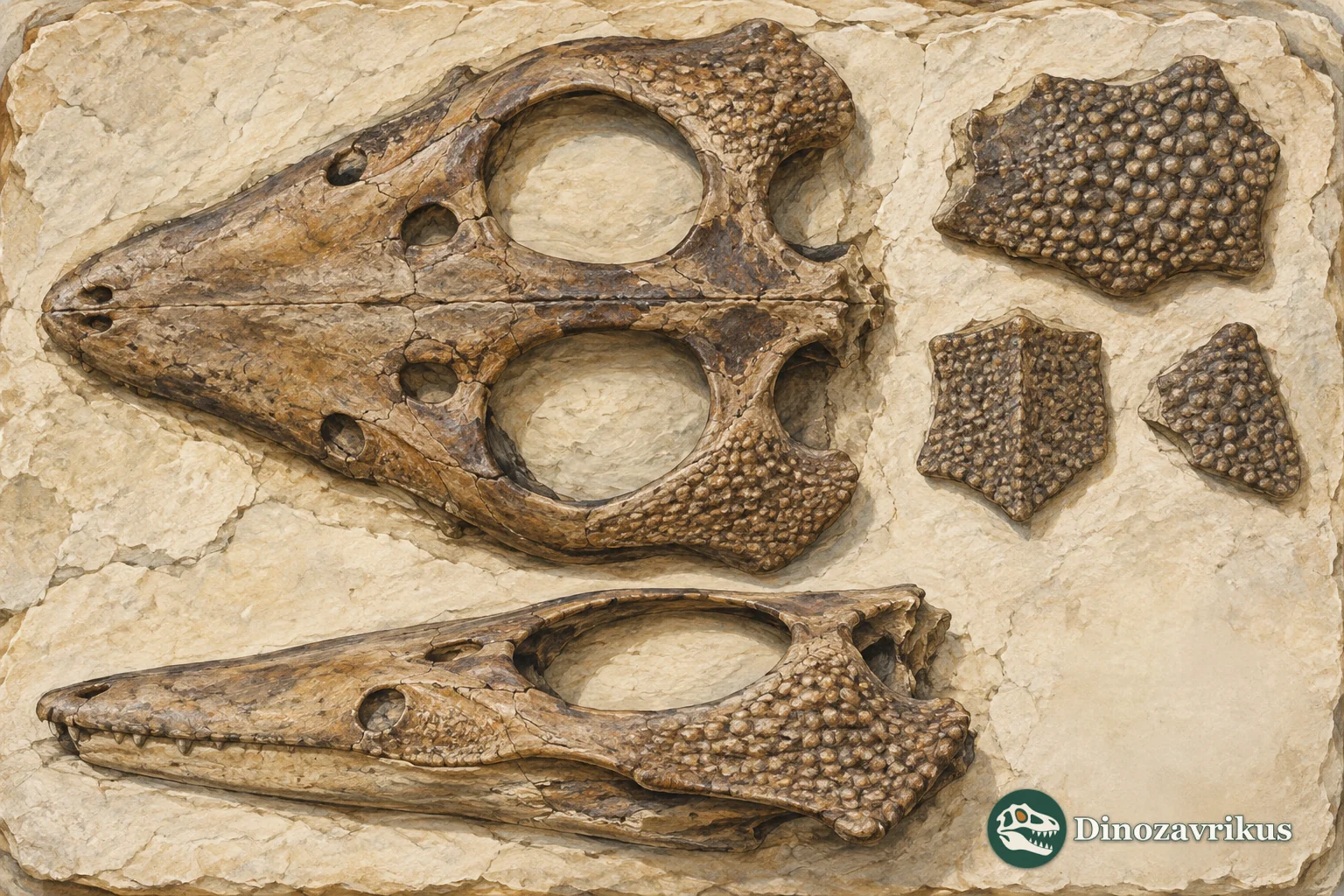
A three-dimensionally preserved skull reveals enormous orbitotemporal openings and a greatly expanded jugal. These identify its unusual anatomy; an eye's exact soft-tissue diameter cannot be read straight from the opening.
The marginal teeth occupy only a short part of the skull and jaw. Along with expanded muscle spaces, that supports a directed-suction model, although no fossil records the feeding event.
Ossified possible ceratobranchials and branchial denticles indicate open gill slits. Their exact soft-tissue shape and colour are unknown.
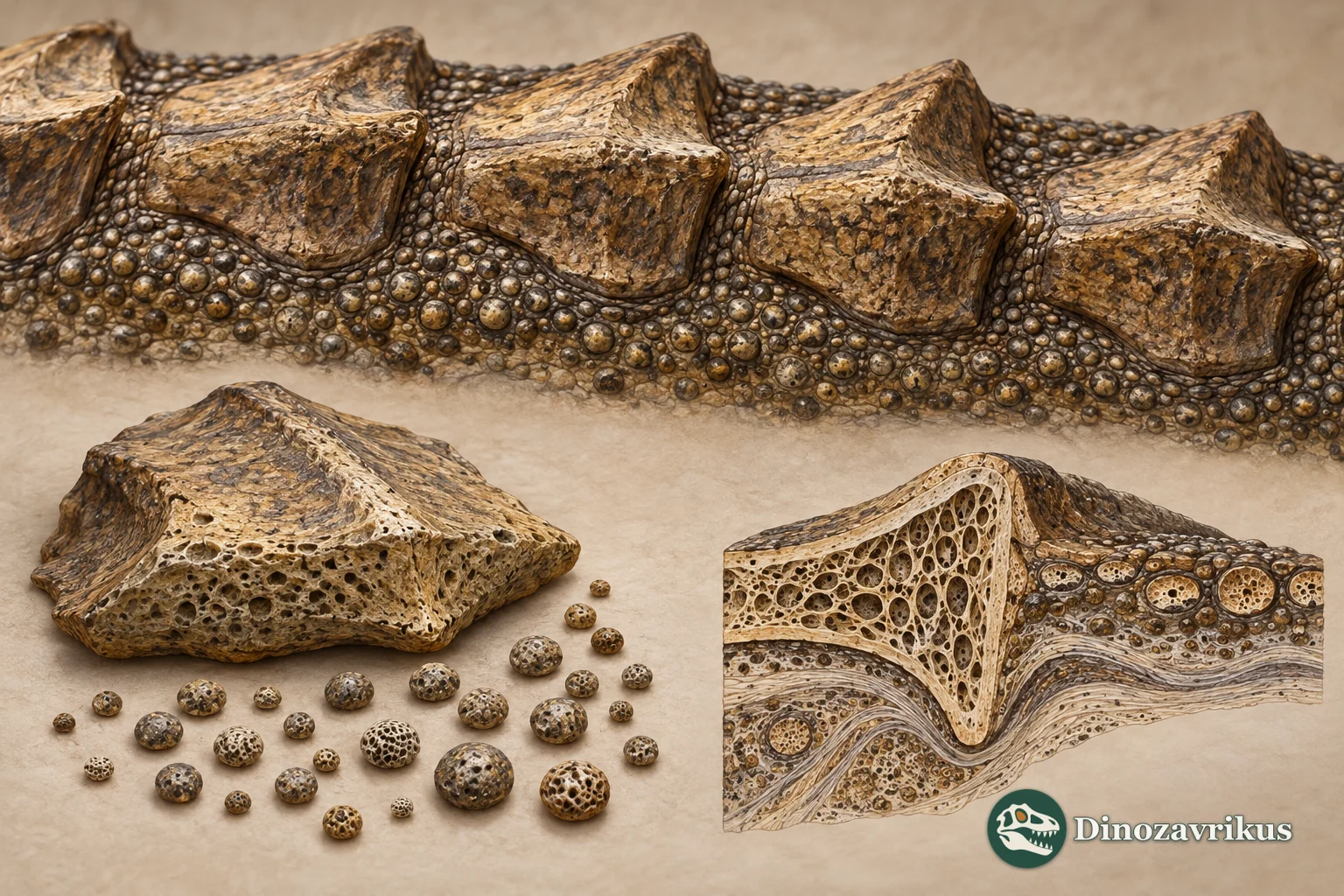
A single row of large dorsal osteoderms and many small mineralised skin ossicles are reported. Their arrangement in a living skin surface is reconstructed rather than directly photographed.
From an old species name to a new skull
Eberhard Fraas introduced the species in 1896 under a different plagiosaurid genus. Friedrich von Huene later separated the genus Plagiosuchus. The changing generic combination reflects comparison of fossils, not two separately observed animals. A substantially preserved skull and jaw material later allowed Ross Damiani and colleagues to redescribe the anatomy in 2009.
The skull has enormous orbitotemporal fenestrae, reduced bones around those openings and a jugal that occupies much of the side margin. It is not a normal crocodilian skull with a long, powerful tooth row. Later comparisons with other plagiosaurids, including Gerrothorax, show variation within the family rather than a single standard flat-headed body plan.
Why suction feeding was proposed
The marginal dentition is relatively weak and confined to the front portion of skull and mandible. Long openings beneath the skull correspond with an elongated chamber for jaw adductor muscles. The describing authors connected this combination and the branchial skeleton to a directed-suction mechanism: a rapid change in the mouth and throat could draw water and prey inward.
That model does not identify a particular fish or invertebrate as a recorded meal. Ossified possible ceratobranchials and branchial denticles support open gill slits and a strongly aquatic life, but do not preserve the colour or outline of all soft gill tissue. A cinematic attack scene would add details that no specimen provides.
One row of back plates and many smaller ossicles
Postcranial material adds a separate line of evidence. Plagiosuchus had a single row of large dorsal osteoderms and numerous small mineralised spheroids in the trunk skin. These are not a modern crocodile's uniform armor pattern. Comparative work also finds a higher skull and body than in some more flattened plagiosaurid forms, although the shape of living soft tissues remains reconstructed.
The fossils belong to the Triassic Period. Plants and sediments in the cover suggest a plausible freshwater setting, but they are not a documentary view of a particular German locality. The bones establish the unusual skull, gill apparatus and dermal elements; the living appearance is still a cautious piece of paleoart.
Frequently asked questions
Was Plagiosuchus a crocodile?
No. It belonged to the extinct temnospondyl amphibians. An aquatic life and bony armor do not place it in the crocodile lineage.
Why is a long row of large teeth misleading?
The studied skull and jaws have short, relatively weak marginal tooth rows. A crocodile-like grin extending far back would contradict the described fossils.
Is suction feeding directly proved?
It is a functional hypothesis supported by skull, jaw and branchial anatomy. No fossil captures a feeding event or an exact prey list.
Did it have gills?
Ossified branchial elements and denticles support open gill slits in the studied animal, although the appearance of the soft parts remains unknown.