

Plateosauravus cullingworthi was an early sauropodomorph from the lower Elliot Formation. Its name is associated with a group of bones found near Herschel in eastern South Africa. The fossils include unusually long upper arm bones and vertebrae with tall spines. Several individuals are present, and it is difficult to tell which features occurred together in the same animal.
Quick facts
| Group | Sauropodomorphs |
|---|---|
| Age | Late Triassic |
| Region | Africa (Eastern Cape, South Africa) |
| Diet | No direct evidence |
| Type species | Plateosauravus cullingworthi |
| Geological unit | Lower Elliot Formation |
| Preserved material | Vertebrae, girdle elements and limb bones from several individuals |
What can the fossils tell us?
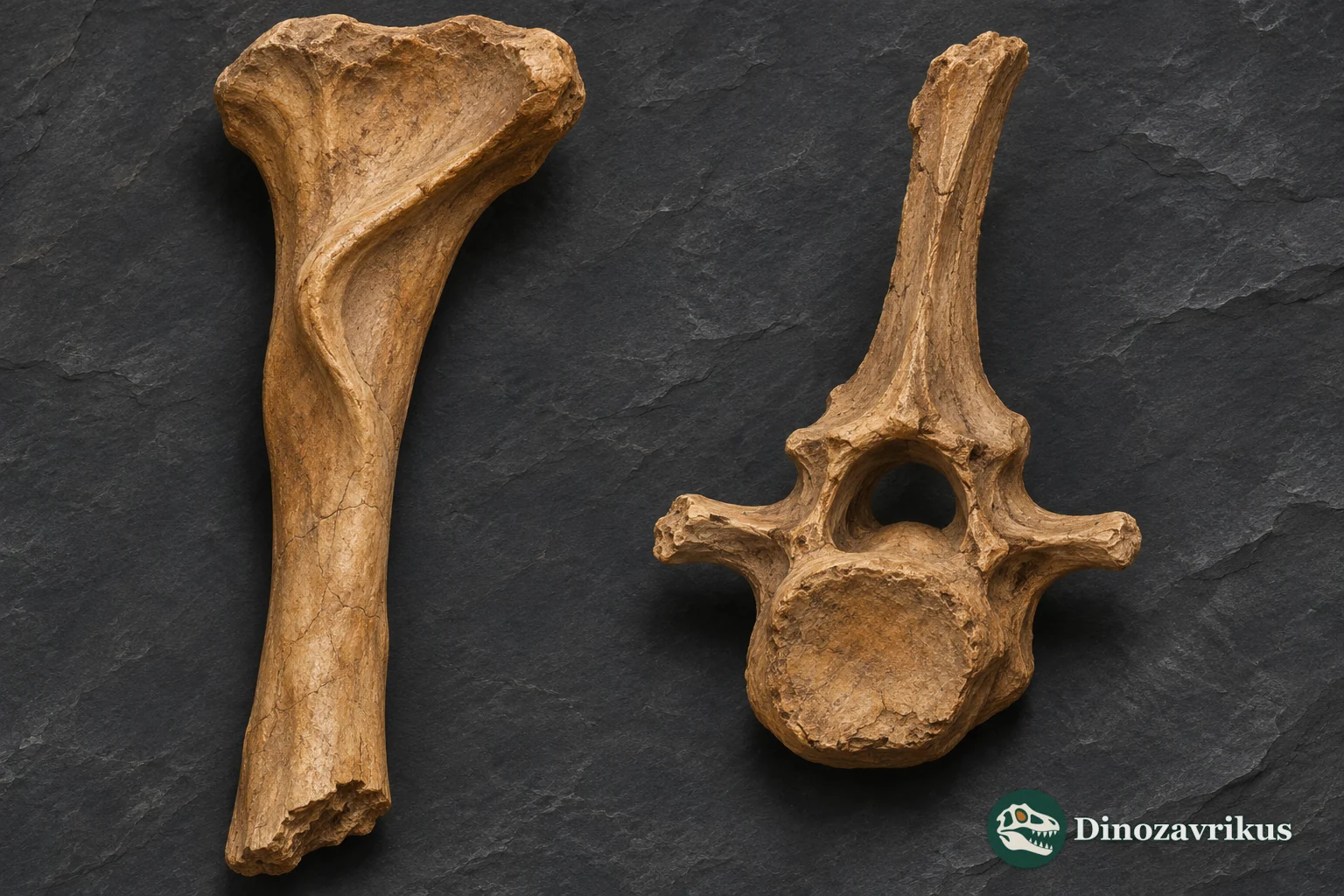
The upper arm bore a sinuous crest for muscle attachment. It is confined to the upper half of the humerus.
In some vertebrae the spine rises well above the fore-to-aft length of its base. Comparisons take account of where along the back the bone lay and which individual it belongs to.
The assemblage includes at least three moderately sized animals and some bones of a larger individual. The identification of that larger material remains in question.
How the collection acquired its name
The main collection was recovered in 1918 near Herschel in what is now the Eastern Cape. Sidney Haughton named Plateosaurus cullingworthi in 1924. Friedrich von Huene assigned the species to its own genus in 1932. The name recalls Plateosaurus, the European genus with which the South African material was first compared.
The South African Museum collection includes vertebrae, bones of the shoulder and pelvic girdles, and limb elements. Several stout vertebrae and a nearly complete pair of ischia from a larger individual were originally named Euskelosaurus africanus by Haughton. Combining them with the other Plateosauravus specimens raises a question about whether the assemblage contains another species or a broader range of sizes within one species.
What the bones can establish
A comparison of lower Elliot sauropodomorphs highlighted the winding deltopectoral crest on the upper half of the humerus. The neural spines in the rear part of the back reach more than one and a half times the fore-to-aft length of their bases. The tops of some spines farther forward expand to the sides.
The catalogue of comparative features gives a humerus-to-femur ratio of about 0.77 for the material referred to Plateosauravus. A long upper arm bears on the question of forelimb support. Individual skeletons with which to check the ratio and infer habitual posture are still needed.
Comparisons within the Elliot Formation
The early sauropodomorphs of the lower Elliot Formation varied in limb proportions and pelvic anatomy. The lower leg and thigh of Plateosauravus share features with Eucnemesaurus, another sauropodomorph of these strata. The shoulder bones provide further points of comparison. Articulated skeletons would help show which limb proportions, vertebral characters and pelvic shapes belonged together.
Frequently asked questions
When did Plateosauravus live?
Its fossils are from the Late Triassic lower Elliot Formation of South Africa.
Was it a species of Plateosaurus?
Haughton originally described it that way. Von Huene subsequently gave the South African animal its own genus.
Did it usually walk on four legs?
The relatively long humerus makes forelimb support a possibility. The known material leaves its normal posture unresolved.
Can its body length be established?
No complete skeleton has been measured. A length estimate from isolated bones depends on their identification and on the proportions used for comparison.