

Plesiosuchus manselii was a large marine crocodylomorph in the Late Jurassic seas of southern England. Two Dorset specimens preserve lower jaws more than a metre long. Comparisons of their jaws and teeth help explain how Plesiosuchus might have handled prey alongside other marine crocodylomorphs.
Quick facts
| Type species | Plesiosuchus manselii |
|---|---|
| Family | Metriorhynchidae |
| Age of Dorset specimens | Late Kimmeridgian to early Tithonian |
| Holotype | NHMUK PV OR40103 and OR40103a |
| Type locality | Kimmeridge Bay, Dorset, England |
| Estimated lengths of two individuals | About 5.4 and 6.8 m |
What can the fossils tell us?
The type jaw is about 111 cm long, compared with 132.2 cm in NHMUK PV R1089. Whole-body lengths were estimated using proportions of related animals.
Their size and form help distinguish these crowns from those of other marine crocodylomorphs. Assigning particular prey takes other evidence.
The model compares the angle at which several teeth would meet a prey item. It estimates an aspect of jaw function, with no direct record of an actual meal.
A name from Kimmeridge Bay
John Clavell Mansel-Pleydell found the material named Steneosaurus manselii by John Hulke in 1870. Richard Owen subsequently named the genus Plesiosuchus. The species was long placed in Dakosaurus, until a 2012 study of the skulls and teeth reinstated Owen’s genus.
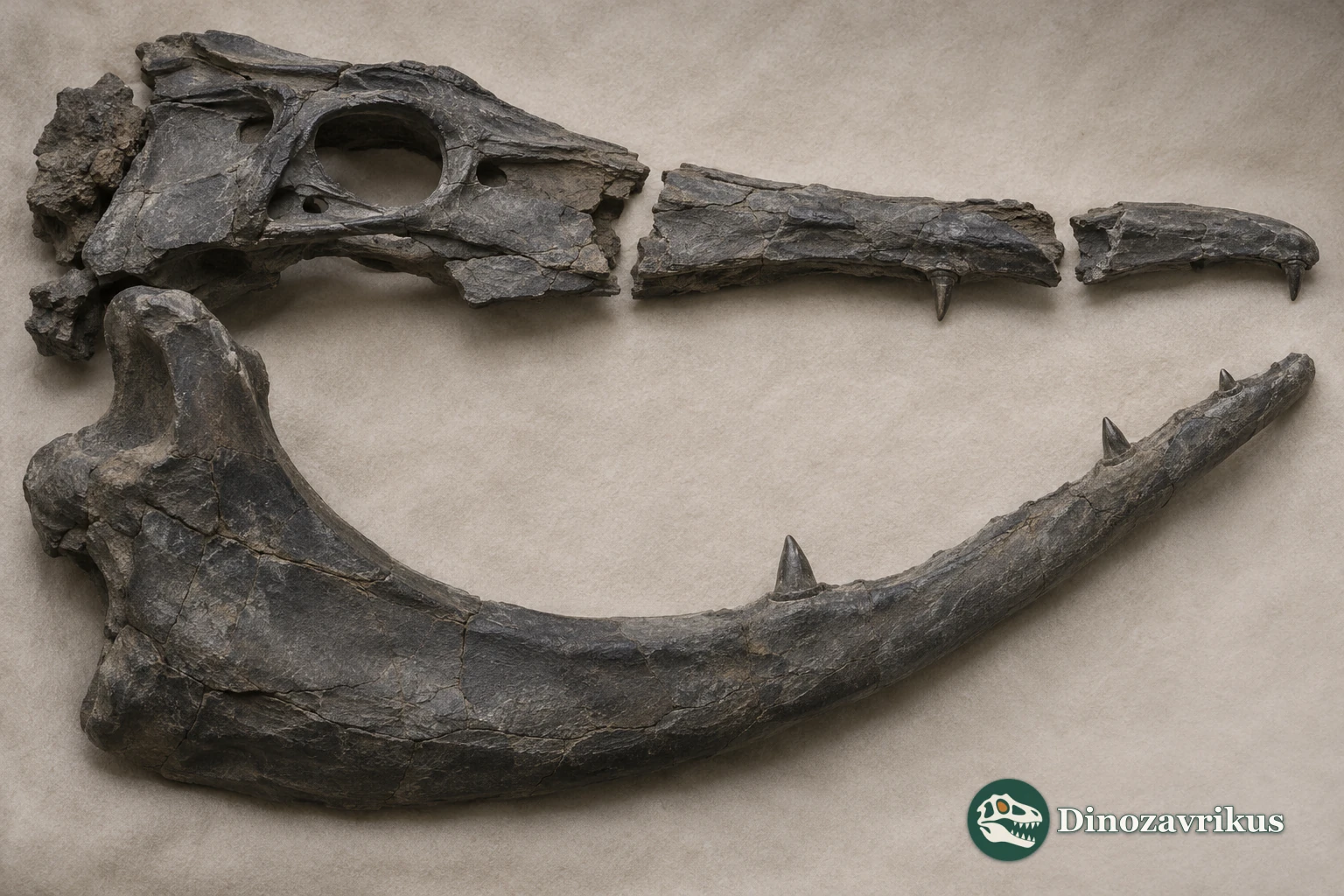
The type from Kimmeridge Bay is held by the Natural History Museum in London. Disconnected skull pieces survive alongside the lower jaw and several bones from the rest of the skeleton. A second Dorset specimen, NHMUK PV R1089, has a partial braincase and a larger jaw. Ammonite zones place the two specimens in the late Kimmeridgian and early Tithonian, respectively.
From jaw length to body length
The lower jaws measure about 111 cm in the type and 132.2 cm in the larger individual. The 2012 team estimated the lengths of their incomplete skulls and used a metriorhynchid skull-to-body relationship to obtain about 5.4 and 6.8 m. An earlier estimate mixed the remains of these two animals. The preserved vertebrae leave their maturity uncertain.
A ridged palate and finely serrated teeth
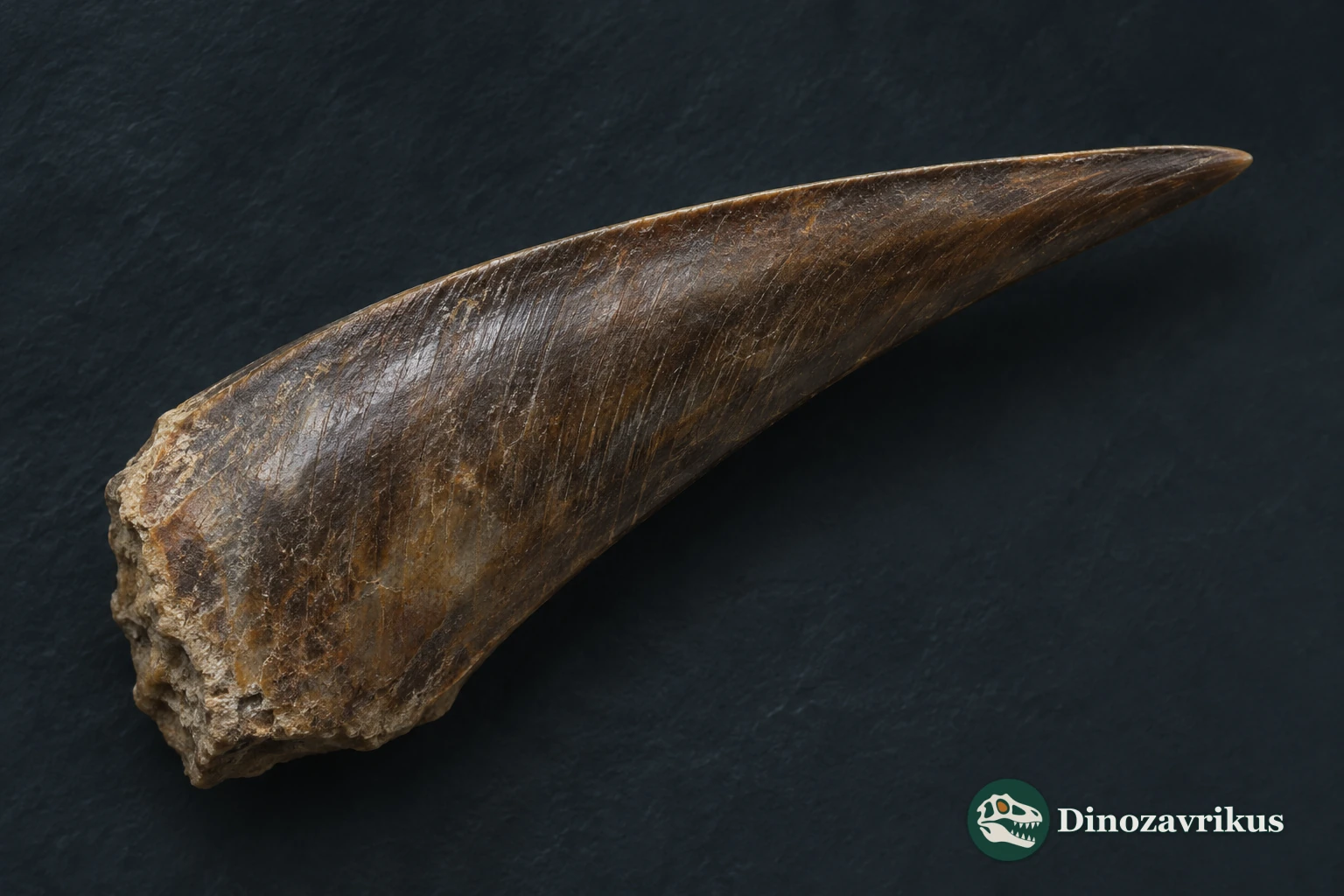
The palate bulged down along a distinct midline ridge. Nine of the thirteen lower tooth positions lay alongside the joined region of the two halves of the lower jaw. The strong, flattened crowns carried low enamel ridges and microscopic denticles along the cutting edges.
The study found no marked tip wear like that documented in Dakosaurus. The comparison helps distinguish their feeding adaptations, although wear cannot establish the identity of the prey.
What a wide gape could achieve
At a standardised jaw length, Plesiosuchus had a larger estimated optimum prey depth than Dakosaurus maximus. That value corresponds to the point at which multiple teeth would engage a prey item. Together with the larger body-size estimates, it prompted the hypothesis that Plesiosuchus could take larger marine vertebrates. The model leaves the details of occlusion and the animal’s usual prey uncertain.
The submerged body shape in the reconstruction draws on more complete skeletons of other metriorhynchids. The Dorset remains chiefly document the head and parts of the skeleton.
Frequently asked questions
Who was the species named after?
John Clavell Mansel-Pleydell, who found the original material.
Why is it treated as a separate genus?
The reanalysis of skull and tooth traits found insufficient support for placing it in the same genus as Dakosaurus maximus.
Has it been found outside England?
A single tooth from Spain has been tentatively associated with it. The secure material used to describe the species is from England.
Was a 6.8 m skeleton found?
The larger jaw and parts of the skull survive. The whole-body length was calculated from comparisons with related animals.