

Polycotylus is a genus of short-necked plesiosaurs in the family Polycotylidae. Its record spans fragmentary type bones from Kansas, a nearly complete skeleton from South Dakota, an adult fossil containing a fetus, and a second recognised species from Russia’s southern Urals. Plesiosaurs were marine reptiles, not dinosaurs.
The genus appears in the marine reptile catalogue beside other plesiosaur lineages. Its fossils tell different stories: SDSM 23020 improves anatomical diagnosis, while LACM 129639 provides direct evidence for live birth in a plesiosaur.
Quick facts
| Scientific name | Polycotylus latipinnis; P. sopozkoi |
|---|---|
| Type species | Polycotylus latipinnis |
| Group | Plesiosauria, Polycotylidae |
| Age | Late Cretaceous; Santonian and Campanian records |
| Range | North America and the southern Urals |
| Nearly complete skeleton | SDSM 23020, upper Niobrara Formation, South Dakota |
| Reproductive specimen | LACM 129639, adult with one fetus |
| Recognised species | P. latipinnis and P. sopozkoi |
| Catalogue | Marine reptile catalogue |
What can the fossils tell us?
The early Campanian specimen preserves much more than the fragmentary type material. Vertebral counts, pelvic anatomy and paddle bones help diagnose Polycotylus, while some proportions and variation still require comparison.
O’Keefe and Chiappe interpreted the associated bones as an unborn young within an adult polycotylid. The specimen supports plesiosaur viviparity; sociality and parental care remain hypotheses rather than fossil observations.
The revision rejected several earlier proposed characters as misinterpretations but retained the species based on confirmed and newly observed features of its partial skeleton.
Length and mass depend on reconstructed proportions, while teeth and marine habitat do not provide a complete prey list. One reproductive fossil cannot establish behaviour for every species.
A name founded on fragmentary bones
Edward Drinker Cope named Polycotylus latipinnis in 1869 from a small collection of incomplete bones from Kansas. The holotype material is divided between collections, including USNM 27678 at the Smithsonian and AMNH 1735. Vertebrae and limb elements anchor the name, but the original specimen does not provide a complete picture of the animal.
Samuel Williston’s work on another skeleton, YPM 1125, later supplied a more informative comparison and was formalised as a paratype. In 2015, Bruce Schumacher and James Martin described SDSM 23020, a nearly complete specimen from South Dakota. Together these fossils made it possible to test the genus against a wider set of cranial and postcranial characters.
The South Dakota skeleton
SDSM 23020 comes from the upper Niobrara Formation in southwestern South Dakota and is dated to the early Campanian. Unlike the scattered type elements, it preserves much of the skeleton in anatomical association. The description documented vertebral features, chevron facets, unusually shaped ilia and highly modified paddles with multiple ossifications and increased phalangeal counts.
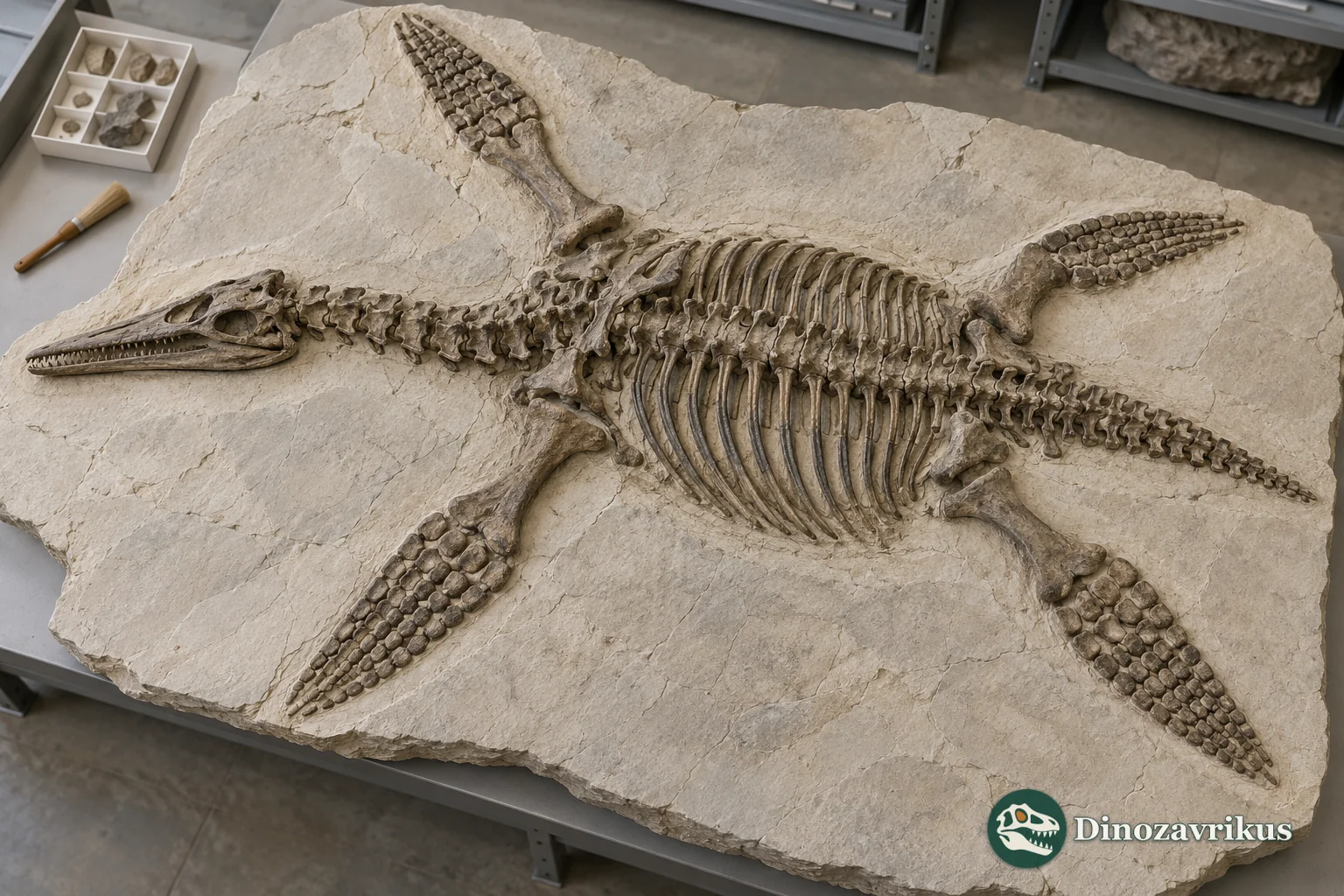
These anatomical features help distinguish Polycotylus from other polycotylids. The interpretation of pelvic shape remains careful: variation can reflect multiple biological and taphonomic factors, and a single difference should not be turned automatically into a species boundary or a sex marker.
Two species and the southern Urals
P. latipinnis is the type species, known from several North American records. The nearly complete South Dakota skeleton comes from an early Campanian level, whereas type material and other specimens have their own locality and stratigraphic histories. The genus should not be reduced to one exact horizon or one regional population.
Polycotylus sopozkoi was named from a partial skeleton from the Izhberda quarry in Russia’s Orenburg region. Zverkov and colleagues revised its holotype in 2024. They found that many features used in its original diagnosis were misread, but additional observations and a confirmed distinctive character still support the species within Polycotylus.
The North American and Russian records show a broad late Cretaceous distribution. They do not demonstrate that both species were one population or lived in identical ecosystems. Their distinction is based on comparative anatomy and geological context.
An adult with a fetus
LACM 129639 from the Campanian Pierre Shale of Kansas preserves the skeleton of an adult polycotylid with a cluster of bones from one large fetus within the body region. O’Keefe and Chiappe identified the adult as Polycotylus latipinnis and interpreted the association as a pregnant individual. It became the first direct fossil evidence for live birth in plesiosaurs.
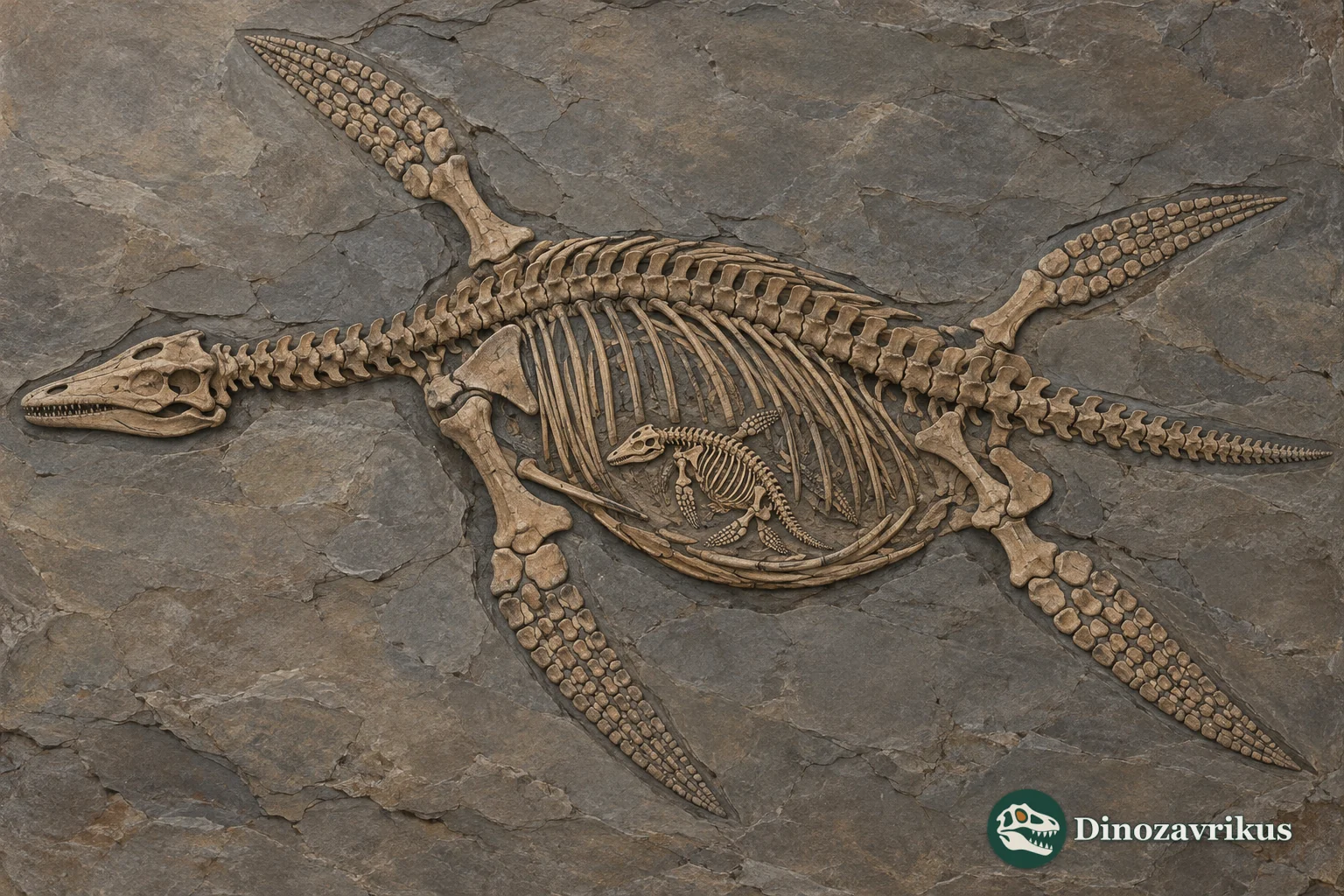
The fetus was large relative to the adult, leading the authors to infer that plesiosaurs gave birth to few, comparatively large offspring. That is a life-history interpretation based on body proportions and comparisons. The fossil records a fetus inside an adult; it does not show social groups, a birth event or parental care after birth.
Swimming anatomy, food and size
The vertebral column, girdles and four paddles establish a marine animal with a compact neck and broad head. Biomechanical interpretations of four-flipper swimming can model thrust and manoeuvring, but the exact stroke sequence is not preserved. Teeth and jaw shape are compatible with seizing animal prey, yet no complete diet is established by the specimens discussed here.
Length estimates vary with the specimen and the reconstructed missing portions. A nearly complete skeleton improves proportions, but no single number should be treated as a precise genus-wide measurement. Colour, soft-tissue outline, speed, social life and everyday hunting behaviour are not fossil observations.
Frequently asked questions
Was Polycotylus a dinosaur?
No. It was a plesiosaur, a marine reptile outside Dinosauria.
Which species are recognised?
The type species is Polycotylus latipinnis. A 2024 revision upheld the southern Ural species P. sopozkoi.
What does LACM 129639 show?
It preserves an adult polycotylid with one large fetus and is interpreted as direct evidence of live birth in plesiosaurs.
Did Polycotylus care for its young?
The adult-and-fetus fossil does not record behaviour after birth. Parental care and sociality remain hypotheses.