

Praemegaceros is a name used for several extinct deer, including large mainland animals and smaller island forms. Antler branching, skulls, teeth and bones allow comparison, while the exact membership of the genus still differs between taxonomic studies. An impressive pair of antlers alone does not identify a species.
These deer belong in the ice-age animal catalogue. The Sardinian record overlaps geographically with the island Prolagus, although the two lineages have separate fossil histories.
Quick facts
| Type species | Praemegaceros dawkinsi (Newton, 1882) |
|---|---|
| Genus introduced | Portis, 1920 |
| Family | Cervidae |
| Main age | Pleistocene |
| Type material | Shed left antler from England |
| Island lineage | P. cazioti in Sardinia and Corsica |
What can the fossils tell us?
Newton separated the species from an antler previously treated as a young P. verticornis. A single shed antler fixes the name but cannot show the entire range of adult variation.
P. verticornis material includes antlers and cranial remains. Broken tips and variable flattening complicate attempts to assign every branch form to a subspecies.
Sardinian P. cazioti skeletons and cave dates show a smaller late deer. One dated individual does not establish every island population's age or extinction cause.
The small antler that fixes the genus
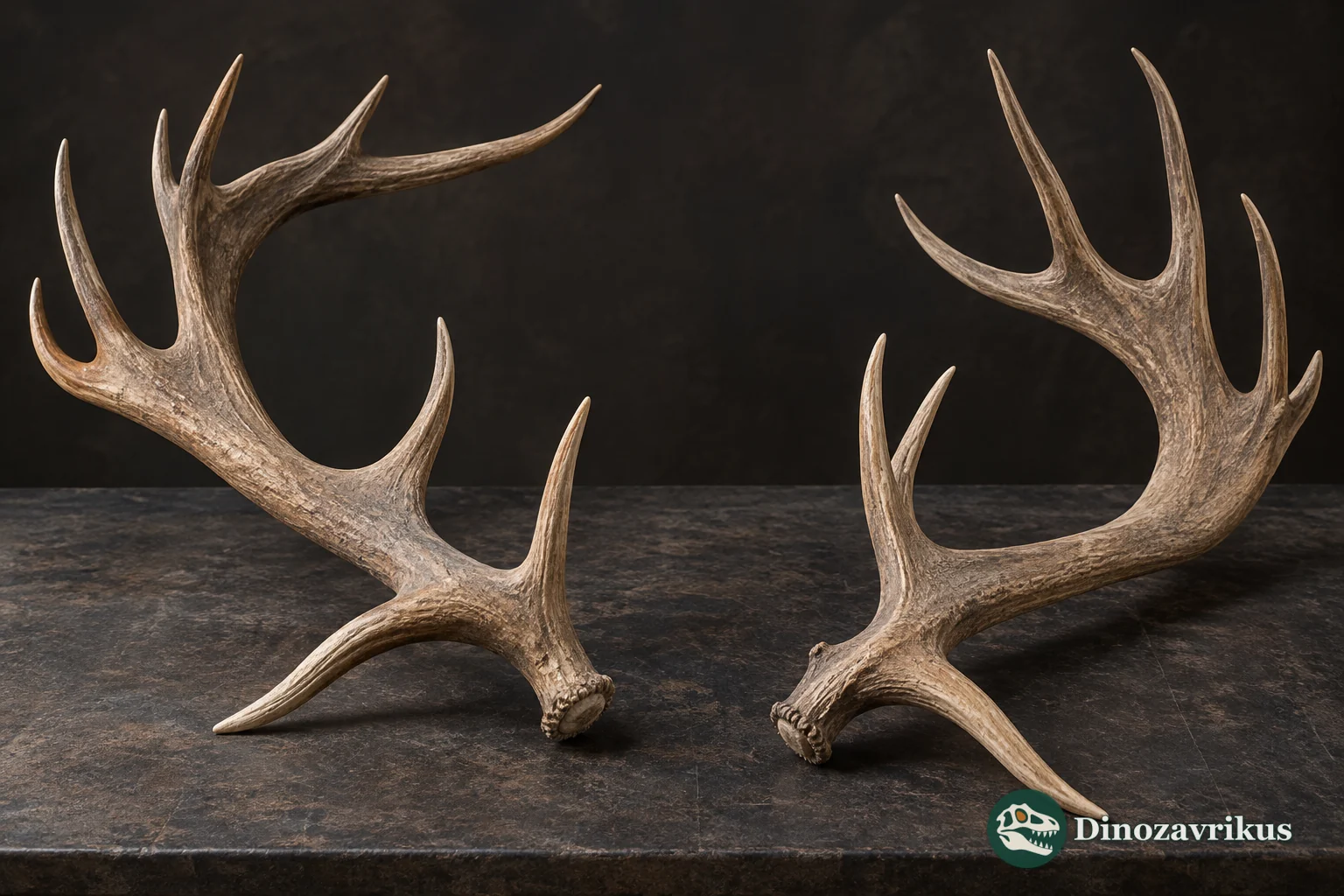
William Boyd Dawkins illustrated an antler in 1872 and regarded it as a young Cervus verticornis. Edwin Newton recognized it as a separate species, Cervus dawkinsi, in 1882. Portis established Praemegaceros as a subgenus in 1920. Its type species is P. dawkinsi, not the more familiar P. verticornis.
The type is a shed left antler from the Cromer Forest-bed deposits of Norfolk, England. The orientation of the beam and development of lower tines are useful, but these features change with growth and vary among individuals. An isolated broken upper branch may not be identifiable to species.
Continental species and uncertain boundaries
P. verticornis is a large deer recorded from middle Pleistocene localities across Europe. One revision places the material it examined in a broad interval of about 0.8 to 0.4 million years ago. This range summarizes several deposits rather than dating every antler. Some upper branches are narrow, others expanded and flattened; the type has lost its tip, limiting direct comparison.
The earlier P. obscurus and other forms have moved among Praemegaceros, Megaloceros and Megaceroides in different revisions. Their relationships may make a broad Praemegaceros paraphyletic. A taxonomic label is therefore a working interpretation, not proof that all listed deer form one exclusive branch.
Body-mass estimates must be tied to identified skeletal parts. A revision derived about 220 kg for P. dawkinsi from attributed jaws, whereas estimates of roughly 300–500 kg concern some larger forms and other methods. These are not one shared mass for the genus.
Sardinian fossils reach the Holocene
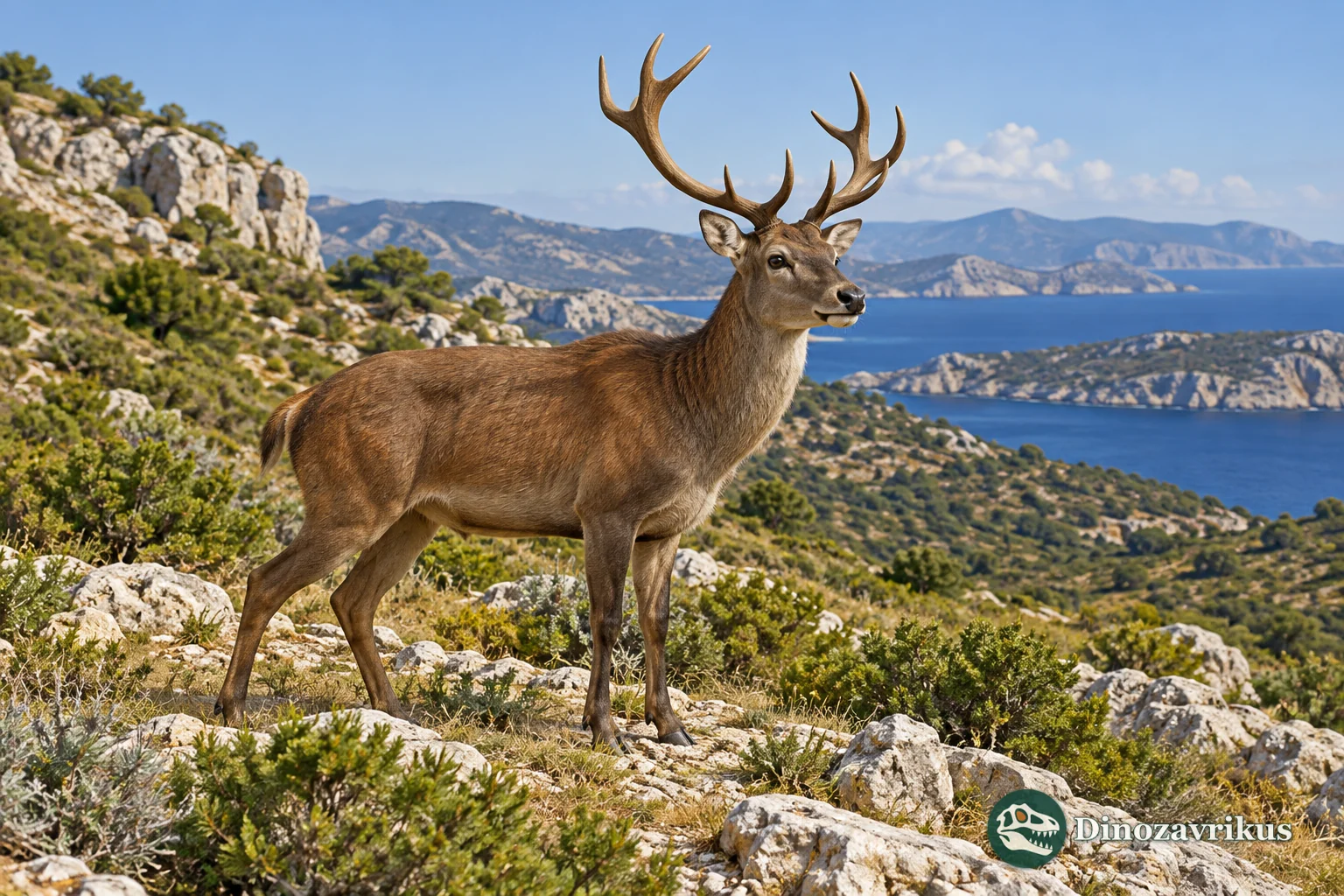
The smaller P. cazioti lived on Sardinia and Corsica. A larger island form, P. sardus, has also been distinguished and estimated as about 25–40% larger in a comparative study. Whether one was a direct descendant of the other depends on the chosen taxonomy and the available sequence of remains.
A nearly complete P. cazioti skeleton from Grotta Juntu in Sardinia was examined with radiocarbon and uranium-series methods. The result is close to 7,500 years before present, within the Holocene. It dates that specimen, not every deer on both islands, and does not identify a single extinction cause.
Teeth establish herbivory; antlers and limbs reveal body structure. Coat pattern, herd size, mating display and the precise diet of each population are not preserved. The cover shows a large continental deer; the island landscape illustration depicts the smaller P. cazioti instead.
Frequently asked questions
Which species is the type of Praemegaceros?
P. dawkinsi is the type. Newton named it in 1882 from a shed left antler formerly interpreted as a young P. verticornis.
Were all Praemegaceros giant deer?
No. Some continental forms were very large, while the island P. cazioti was smaller.
How late did P. cazioti survive?
A nearly complete skeleton from Grotta Juntu in Sardinia was dated to about 7,500 years before present, in the Holocene.
Why do older papers use different genus names?
Revisions differ in how they weigh antler variation and evolutionary relationships. Some species were assigned to Megaloceros or Megaceroides.