

Praeovibos is a fossil ovibovine, a close relative of the muskox, described from Pleistocene Eurasian and northwestern North American material. Skull and horn-core differences supported a separate genus, yet an ancient-DNA study found a much closer genetic relationship with living Ovibos than the names imply.
The cover reconstructs an animal rather than documenting a fossilized exterior. Bones do not preserve the length or color of its coat, and a modern Arctic muskox is an uncertain model for every ancient population.
Quick facts
| Group | Bovidae, Ovibovini |
|---|---|
| Named species | Praeovibos priscus Staudinger, 1908 |
| Age | Early to middle Pleistocene in several assigned records |
| Range | Eurasia and reported northwestern North America |
| North Sea fossils | Three large mineralized vertebrae recovered by trawl |
| Molecular evidence | Mitochondrial DNA nests studied Praeovibos within Ovibos diversity |
| Evidence limit | Coat length and exact behavior are not fossilized |
What can the fossils tell us?
Cranial and horn-core form led researchers to name separate fossil forms. Their resemblance to living muskoxen also motivated molecular comparison.
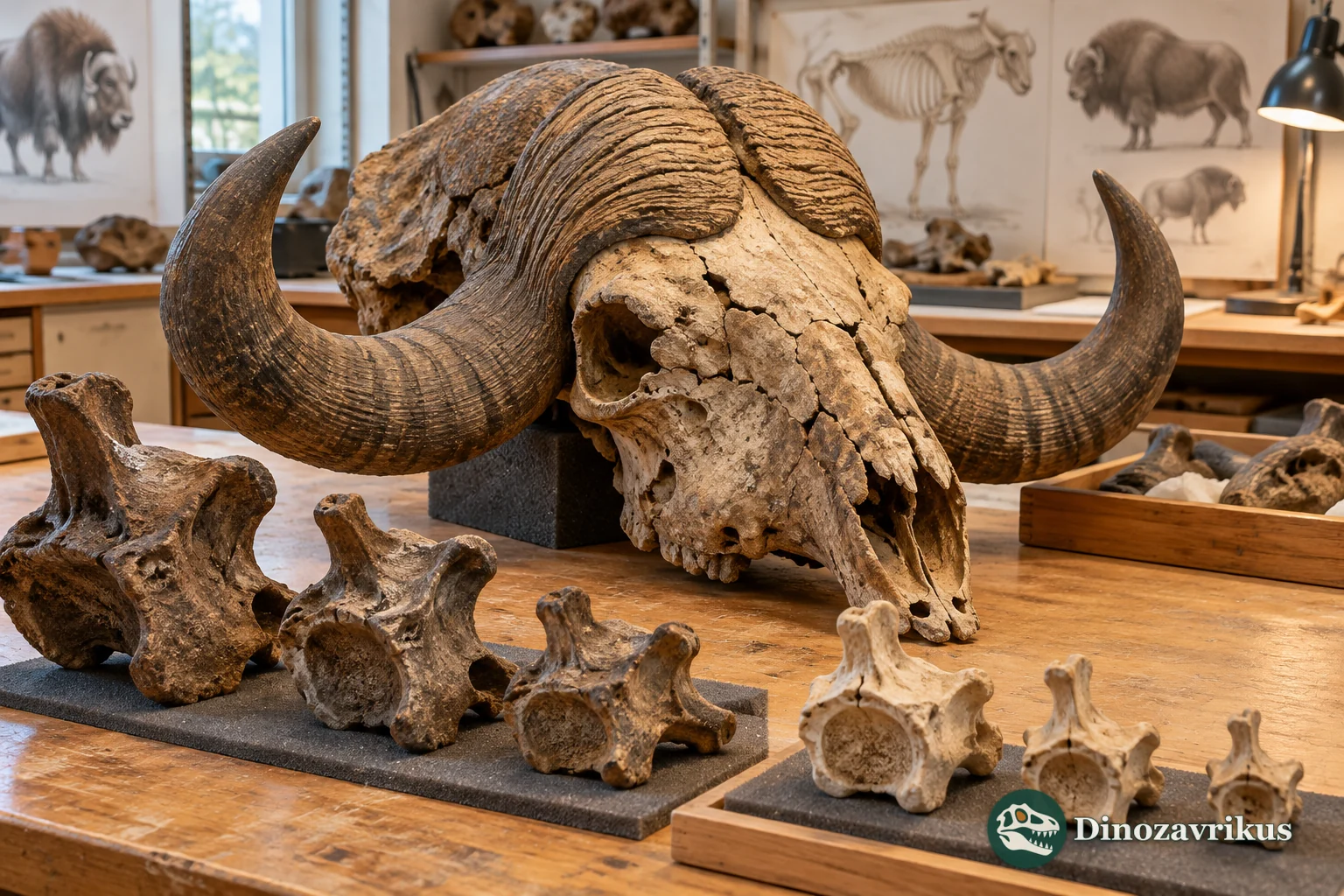
A trawl recovered three vertebrae between Britain and the Netherlands. Size and mineralization support assignment to P. priscus, but their precise original sedimentary positions are unknown.
A 2010 mitochondrial study placed an identified Praeovibos within living Ovibos diversity. That invites taxonomic reassessment without proving every fossil belongs to the modern species.
Names grounded in skull material
Friedrich Staudinger described P. priscus in 1908. A Smithsonian collection record identifies a cast of the German type skull as a plastoholotype. It is a cast, not the original fossil. Cranial and horn-core anatomy formed the basis of comparisons with living muskoxen and other extinct ovibovines.
A Mediterranean form has also been named P. mediterraneus. Material from Quibas in Spain has been assigned at varying levels, from tentative genus to that species. A 2022 study emphasized limited comparative material, so a precise species label on isolated remains should not be treated as universal agreement.
Vertebrae from a former land surface
Dick Mol, John de Vos and Jelle Reumer described three large, heavily mineralized vertebrae trawled from the North Sea between the Netherlands and England. They attributed them to P. priscus and inferred a late Early or Middle Pleistocene age. The sea floor had once been dry land, but trawling removed the bones from their exact layers. Their individual ages were not measured directly.
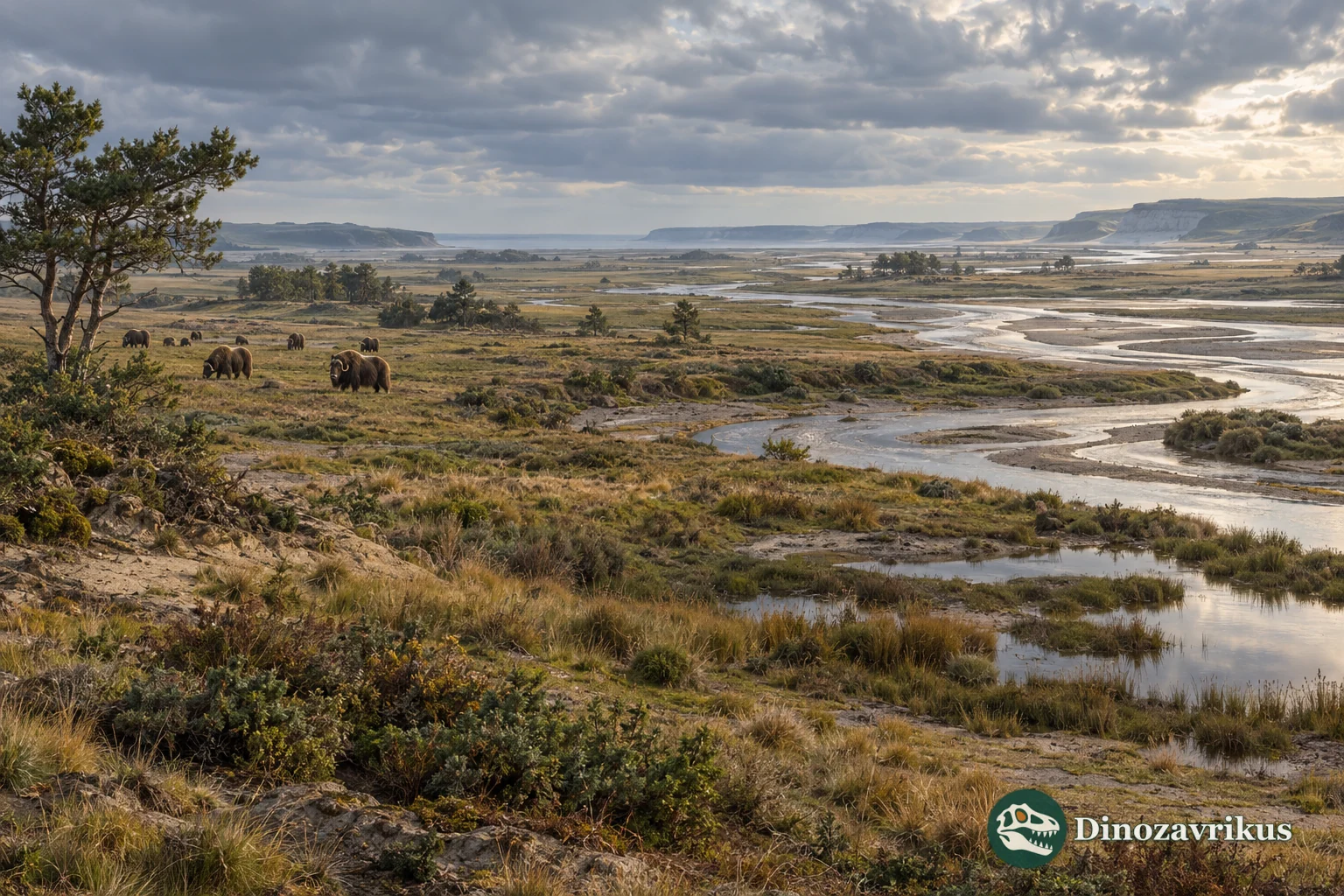
Associated fauna suggested a setting unlike the coldest mammoth steppe. The authors even proposed shorter hair than on a living muskox. Both habitat and pelage are inferences; neither a vertebra nor a trawl location records a coat. The lowland picture below is an artistic interpretation of a possible environment.
Ancient molecules and the Ovibos question
Paula Campos and colleagues analyzed ancient molecules from extinct ovibovines. Their mitochondrial tree placed an identified Praeovibos within the diversity of living Ovibos, allowing the possibility that it is an earlier morphotype of the modern lineage. In contrast, Bootherium and Euceratherium appeared more distinct in that analysis.
Mitochondrial DNA traces one maternal lineage, not every feature of a whole genome. The result challenges a simple separation based only on skull shape; it does not assign every fossil called Praeovibos to the living species. Each site across the Quaternary also needs independent dating.
Limits of a life reconstruction
Horn cores provide the bony base of horns but not a complete outer sheath. Vertebrae help compare body size, not exact mass, herd structure or coat color. Comparisons with mammoth faunas require locality-specific evidence rather than a generic ice-age setting.
Frequently asked questions
Was Praeovibos the same animal as today's muskox?
Mitochondrial evidence suggests a very close connection and possible taxonomic revision. The fossil form was described from differing bones, so the boundary remains a research question.
Is the German type skull preserved at the Smithsonian?
The Smithsonian record concerns a cast of the type skull, identified as a plastoholotype, not the original fossil bone.
Were the North Sea vertebrae directly dated?
No. Trawling lost their precise layers, and researchers inferred an age from preservation and associated fauna.
Did it have the living muskox's long coat?
Coat length is not preserved. Some researchers inferred that at least certain European populations may have had shorter hair.