

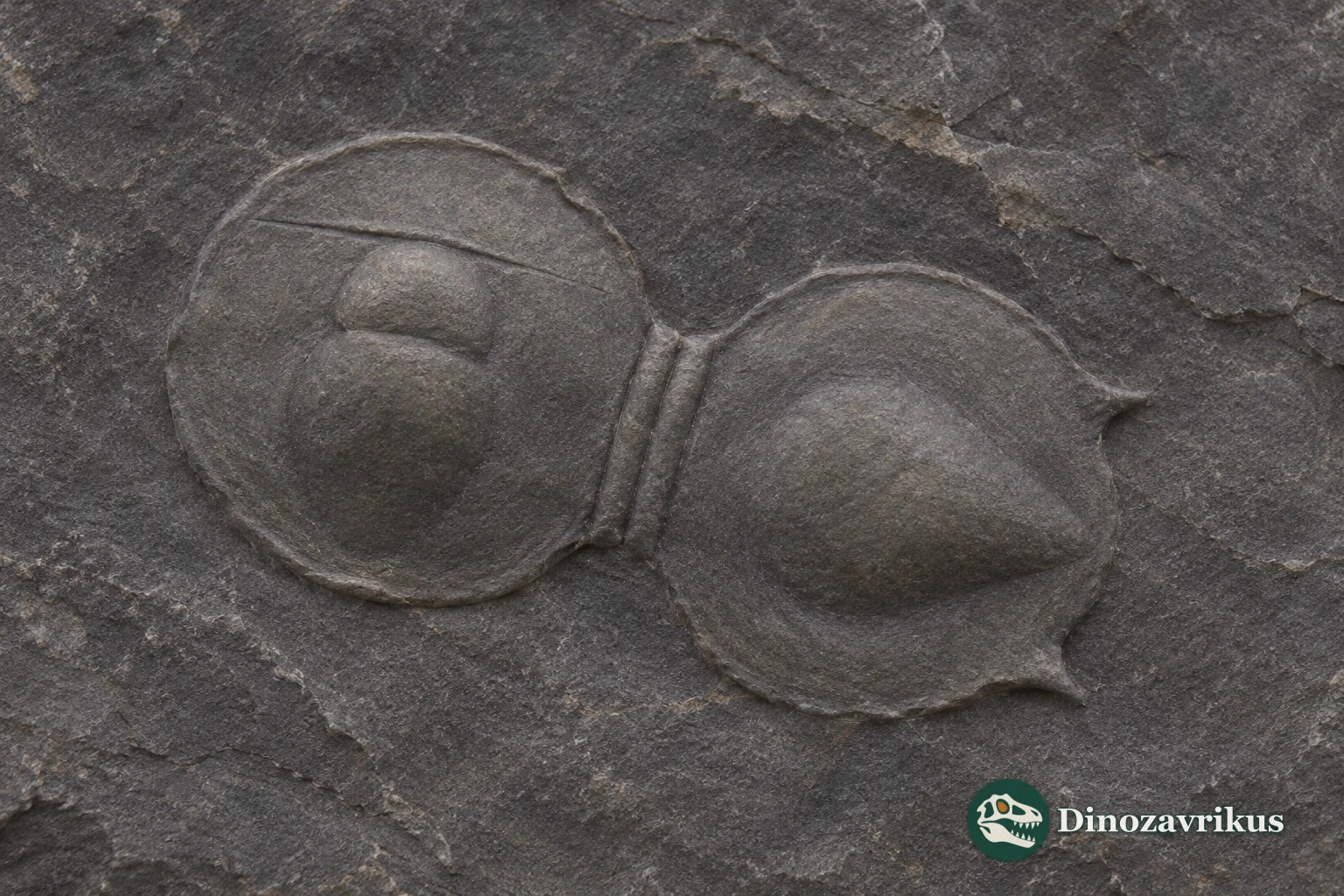
Proagnostus had a broad axial lobe that occupies much of its tail shield, leaving narrow fields along the sides. An articulated specimen from Alabama preserves the arrangement of the shell. Finds of the type species in Hunan gave their name to a Cambrian fossil zone.
Quick facts
| Group | Agnostids |
|---|---|
| Age | Cambrian |
| Named by | Charles Butts, 1926 |
| Type species | Proagnostus bulbus |
| Lectotype | USNM 94867, Alabama |
| Type species shell | Two thoracic segments and two tail spines |
What can the fossils tell us?
The shell was flattened in shale. A displaced segment left a mark at the front of the tail axis.
Some other species have a median spine as well. The outline of the axis and its grooves help distinguish the species.
The zone helps correlate rock sections. Its local boundaries do not establish the species’ lifetime everywhere.
How the type specimen was chosen
In 1926 Charles Butts illustrated two different specimens under the name Proagnostus bulbus, an isolated tail shield and an articulated shell. Charles Resser later called a third specimen the holotype, though it had not appeared in Butts’s work. In 1988 Richard Robison fixed the application of the name by choosing the articulated specimen as lectotype.
Specimen USNM 94867 comes from shale of the Conasauga Formation near Cedar Bluff, Alabama. It is held by the US National Museum of Natural History. Compression appears to have shifted the second segment onto the tail shield. The resulting transverse mark is therefore unreliable as a character of the tail axis itself.
The head groove and expanded tail axis
A transverse furrow divides the raised centre of the head, or glabella, in P. bulbus. A deep groove runs forward from it towards the rim. The cheeks on either side are smooth.
The long tail axis is broadest in its rear part and has faint ring furrows near the front. Two small spines project near the rear corners. P. securiger also has a central spine between them. Robison’s Greenland material of the type species included 13 head shields and five tail shields, providing isolated fossils to compare with the Alabama shell.
A fossil zone in Hunan
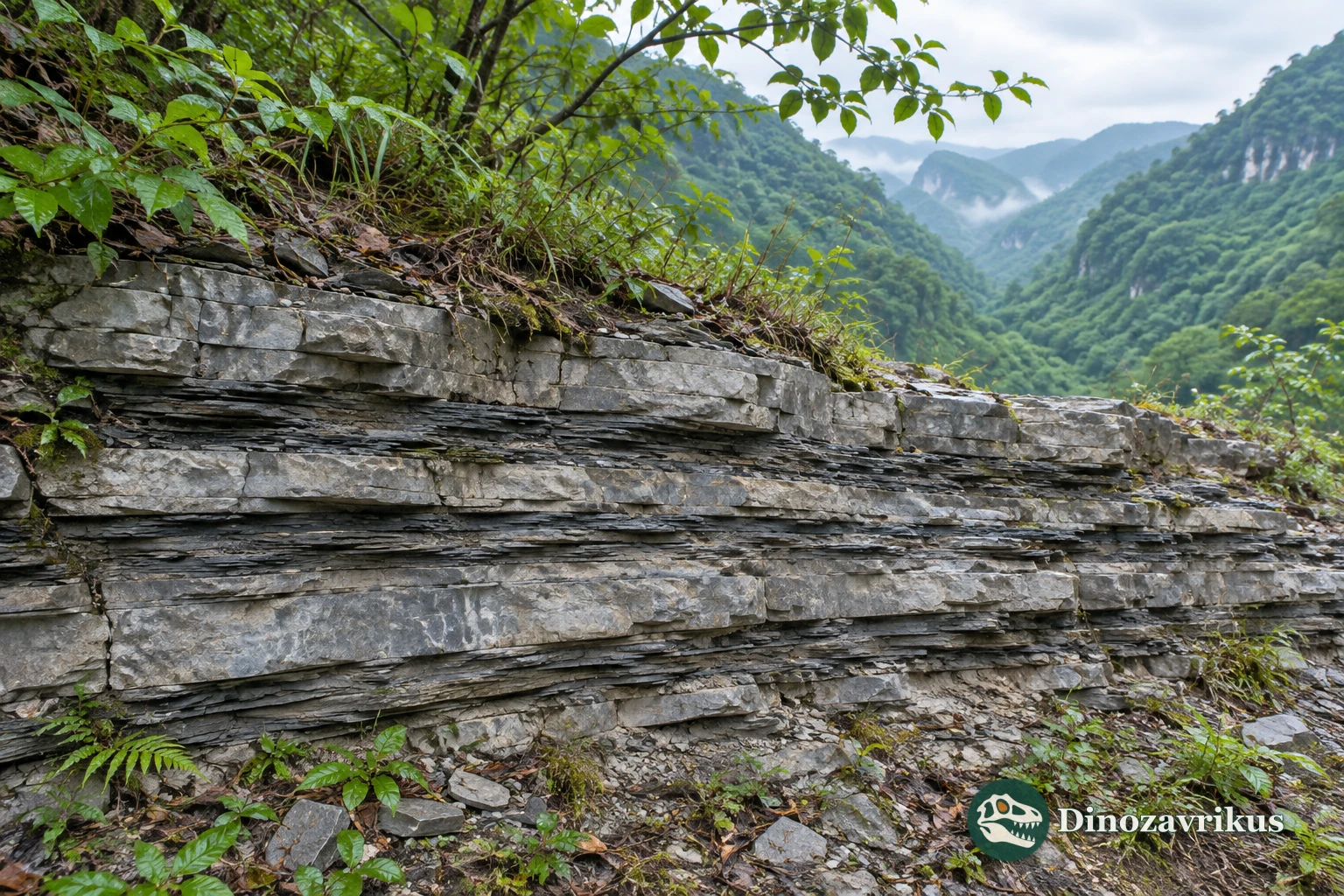
In northwestern Hunan, P. bulbus occurs in the Huaqiao Formation. Its zone lies above the zone named for Lejopyge and below the Linguagnostus reconditus Zone in the local succession. Comparable shields are known from Greenland and Australia, including a Guzhangian assemblage at Riana in northwestern Tasmania.
Coarse phosphate on the underside of head shields from the Paibi section roughly indicates the position of a ventral plate and appendages. The traces do not preserve enough detail to reconstruct individual limbs or establish what the animal ate.
Frequently asked questions
Which specimen fixes the identity of Proagnostus?
Lectotype USNM 94867 is the articulated Alabama shell illustrated by Butts in 1926. It comes from the Conasauga Formation.
How many tail spines did the type species have?
It had two short spines near the rear corners. A median spine is also present in some other species.
What is the Proagnostus fossil zone used for?
The occurrence of the type species and its place in the sequence of fossil groups help correlate Cambrian beds.
Do the fossils preserve appendages?
Phosphatic material on Paibi specimens roughly marks their positions. The individual appendages remain poorly resolved.