

Procerberus is a genus of small extinct mammals known mainly from teeth and jaw fragments in the western part of North America. Its fossils matter because they help document mammal communities around the Cretaceous–Paleogene mass extinction, about 66 million years ago. The record is uneven: some occurrences are latest Cretaceous, while the best-defined species samples come from early Paleocene assemblages.
The genus can be described more confidently from its teeth than from its body. The type species is represented by part of a lower jaw, and many other specimens are isolated teeth. A small jaw fragment should not be turned into a supposedly known skeleton. Other extinct mammals are gathered in the ancient mammal catalogue.
Quick facts
| Scientific name | Procerberus Sloan & Van Valen, 1965 |
|---|---|
| Type species | P. formicarum Sloan & Van Valen, 1965 |
| Group | Mammalia; Cimolestidae in current treatments |
| Age | Latest Cretaceous to earliest Paleocene records |
| Range | Northern Western Interior of North America, including Montana |
| Best-known material | A lower jaw fragment with p3, p4 and m1 |
| Key caution | A complete skeleton and reliable body-mass estimate are unknown |
What can the fossils tell us?
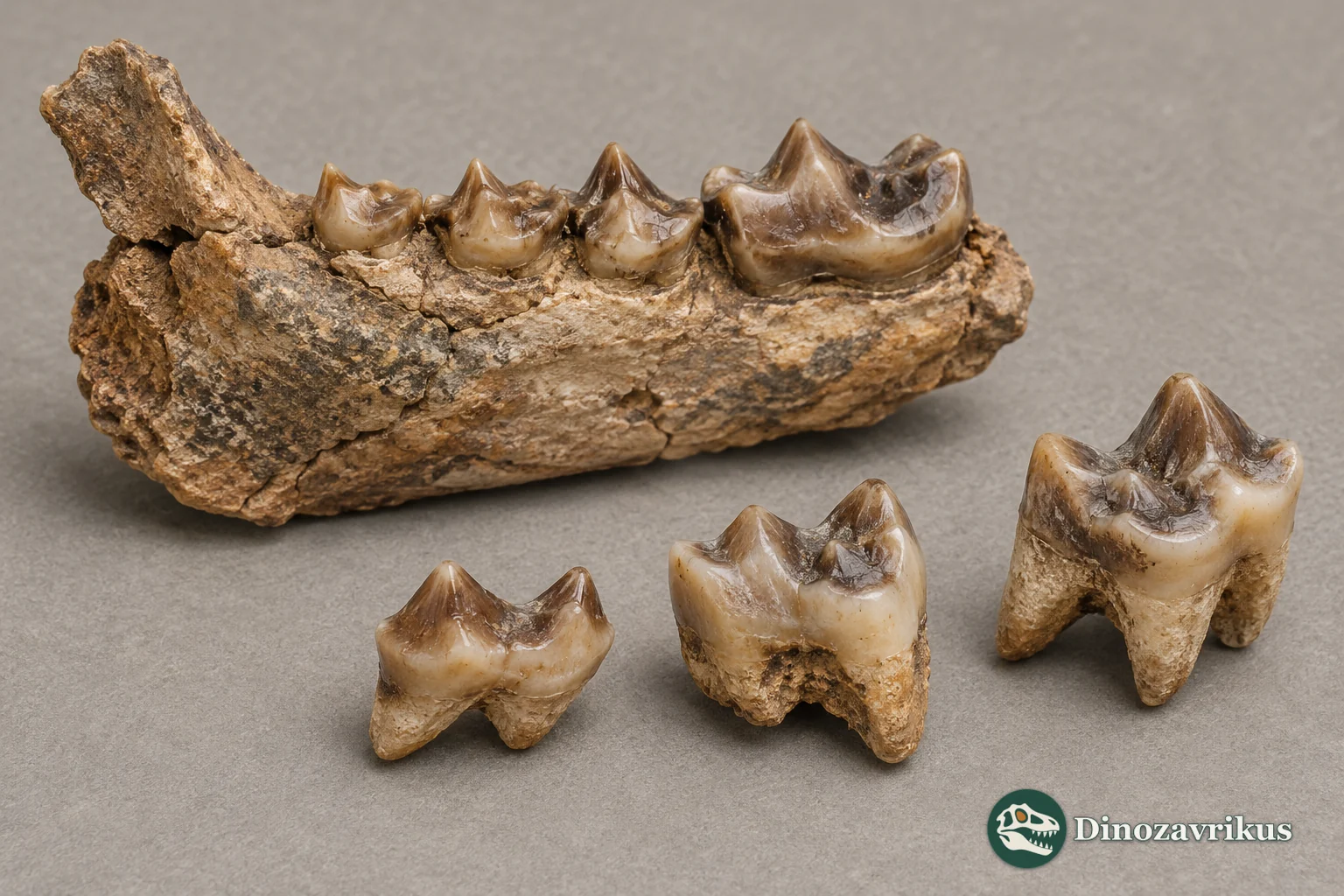
The holotype of P. formicarum is a jaw fragment with p3, p4 and m1. A later topotypic sample helped estimate variation in its postcanine teeth, but an isolated tooth may not establish a species by itself.
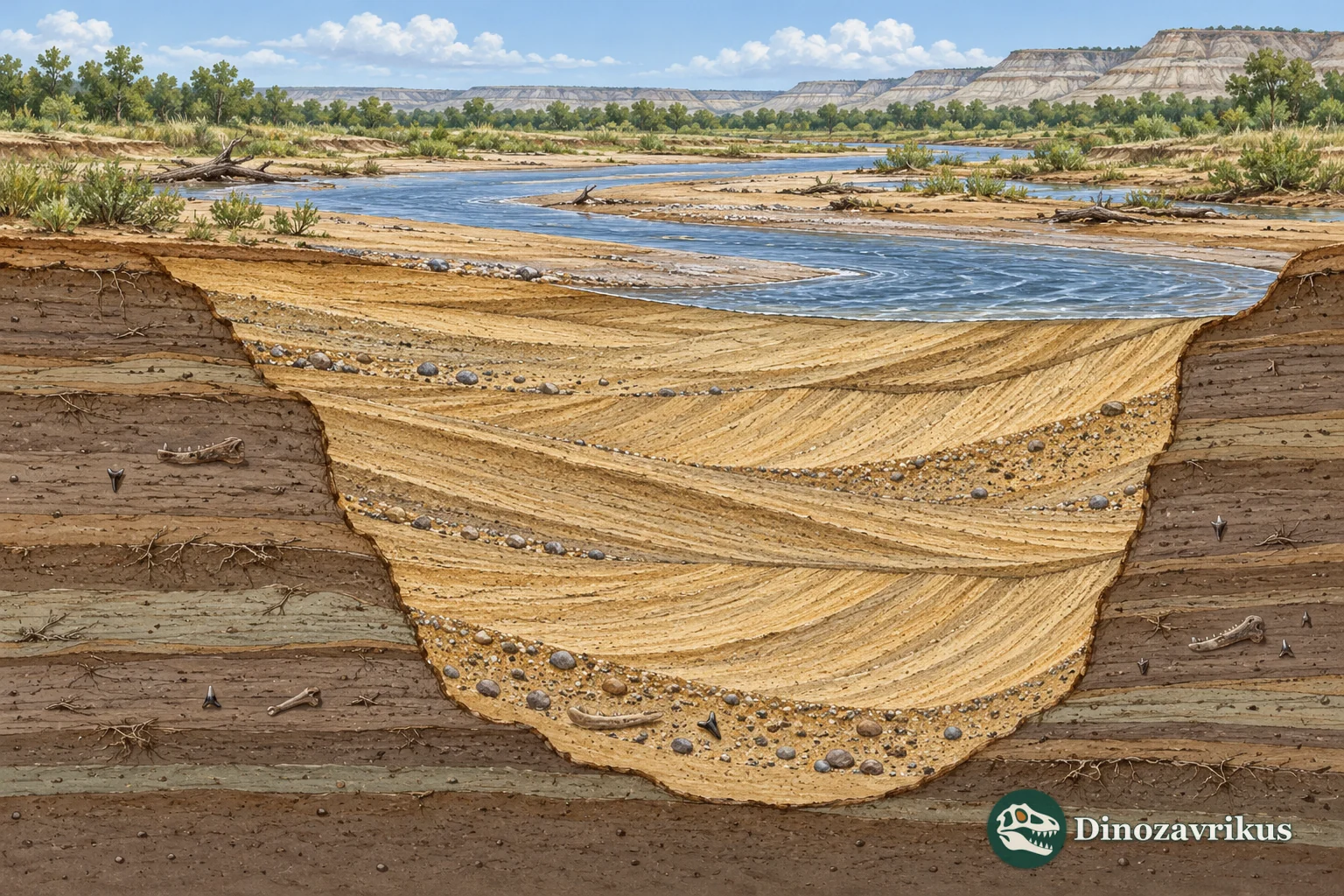
The type locality lies in a cross-bedded sandstone channel fill in northeastern Montana. Thousands of small vertebrate remains were collected there, and the assemblage's stratigraphic complexity means association must be demonstrated rather than assumed.
William A. Clemens recognized P. formicarum, P. andesiticus and P. grandis in the northern Western Interior. All three occur in Puercan 1 interval-zone faunas in that region, while other occurrences suggest the genus originated earlier.
Dental shape can inform functional comparisons, but no securely associated skeleton establishes body length, mass or gait. Neither the name formicarum nor the locality name proves an ant-based diet.
The name and its history
Richard Sloan and Leigh Van Valen named Procerberus in 1965 in a paper on mammals from Montana's latest Cretaceous deposits. The authors described several new genera while discussing similarities between some Cretaceous faunas and younger assemblages. The classification of early placentals and their close relatives has since changed; Procerberus is usually treated as a cimolestid in current accounts.
The species epithet formicarum and the place name Bug Creek Anthills can suggest a diet of ants. Neither a name nor a locality is dietary evidence. Clemens's 2017 revision discusses dental morphology and diversity, but does not report gut contents, coprolites or another direct trace of feeding.
The type jaw and the dental record
The holotype of P. formicarum is UMVP 1460, a lower-jaw fragment preserving p3, p4 and m1. It is not a skull or skeleton. Sloan and Van Valen also figured isolated upper and lower cheek teeth from the collections of the State Museum of Pennsylvania. Those teeth show crown details, but they cannot automatically be treated as parts of one individual or as the holotype itself.
In 2017, William A. Clemens described a new topotypic sample from Bug Creek Anthills and estimated the range of variation in the postcanine teeth of P. formicarum. For an animal known largely from scattered elements, this matters: before naming a new species, researchers need to understand how tooth shape varies within a species and during growth. The larger comparison improved that basis while leaving uncertainty around isolated teeth.
Species and systematic boundaries
Clemens's 2017 revision recognized three species in the northern Western Interior: P. formicarum, P. andesiticus and P. grandis. He compared them with material from several localities and noted that rare occurrences and faunal-list records could indicate more diversity than the available specimens allow researchers to name.
The evolutionary significance of that diversity remains a hypothesis. P. grandis, or a closely related form, may be the sister group of primitive taeniodonts. This is a proposed relationship based on character comparisons, not proof that taeniodonts descended from Procerberus.
Age and geological setting
The type locality of P. formicarum is Bug Creek Anthills in McCone County, northeastern Montana. It includes a cross-bedded sandstone fill of an ancient river channel. Sloan and Van Valen described the collecting site as exceptionally fossiliferous: during the first ten weeks of fieldwork the team collected tens of thousands of mammal teeth and many jaw fragments. Small isolated elements are easier to recover and identify in such assemblages than fragile parts of a skeleton.
The age of some rich localities near the Cretaceous–Paleogene boundary has been debated because fossils may be mixed and the depositional history is complex. Clemens placed all three species he recognized in the Puercan 1 (Pu1) interval zone in the region, while also discussing two occurrences that indicate an origin and initial diversification before the boundary. The most defensible summary is therefore a latest Cretaceous to earliest Paleocene genus whose clearest species record is early Paleocene, rather than assigning every tooth one exact date.
Anatomy, size and way of life
The available anatomical evidence is concentrated in teeth and small parts of jaws. These remains allow comparisons of crowns, cusps and tooth-row proportions, but they do not preserve the limbs, spine, tail or a complete skull. A reliable body length or mass has not been established. Estimating it from another mammal of similar tooth size would be an inference, not a measurement of Procerberus.
The absence of associated skeletons also limits claims about locomotion. Small teeth and jaws are consistent with a small-bodied animal, but do not distinguish a terrestrial, arboreal or burrowing lifestyle. The known material does not provide evidence about reproduction, social behaviour, pathology or age structure.
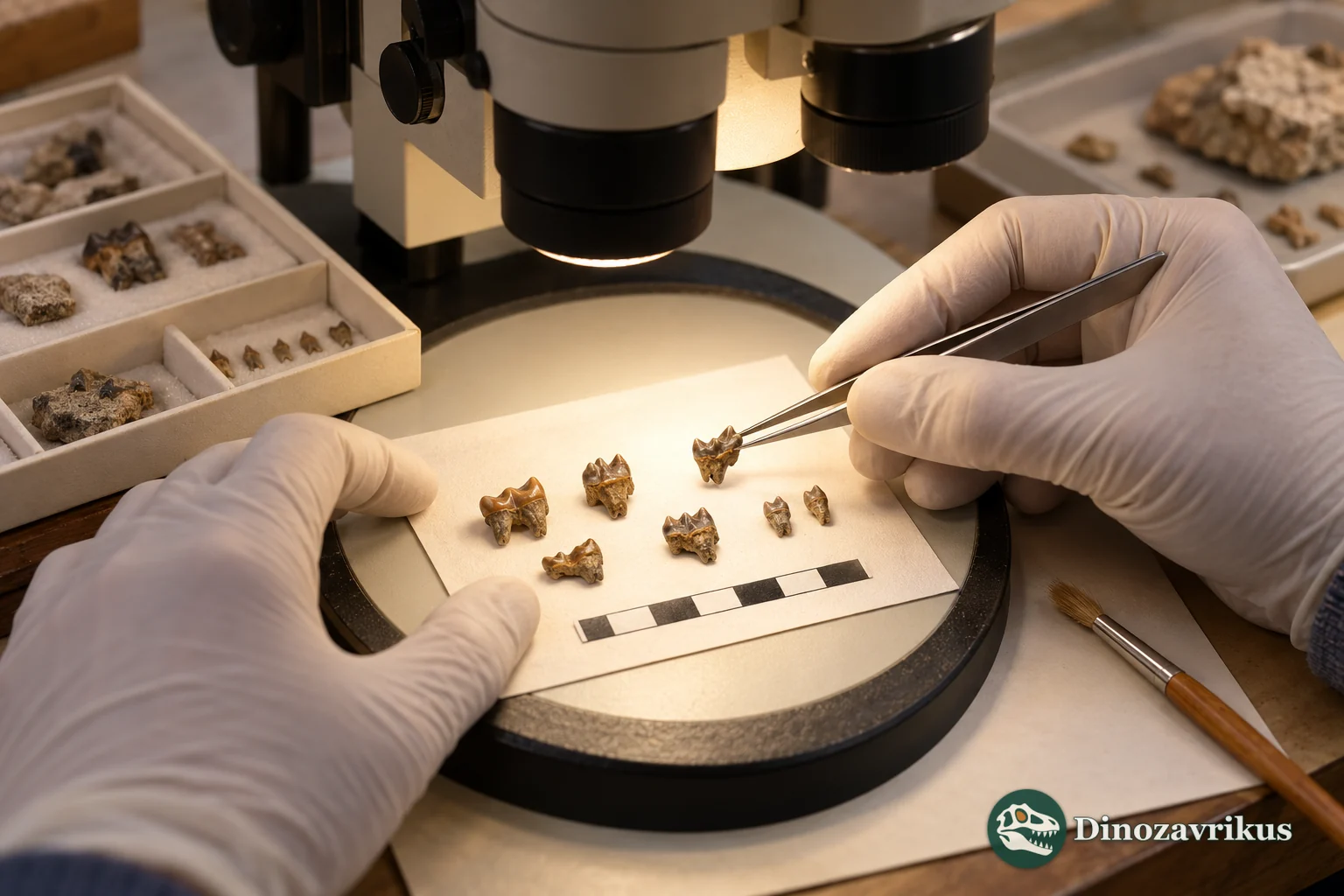
Diet requires the same restraint. Cheek teeth can help evaluate chewing mechanics when their positions and variation are well understood. But the words “anthill” and formicarum do not prove specialized ant-eating. Direct evidence for that behaviour is not available for the genus.
What can be reconstructed
A small terrestrial mammal is a reasonable broad reconstruction, but even that description goes beyond what teeth alone directly record. The cover image shows one possible small furry animal among vegetation and soil. Its body size, fur, ears, tail and limb posture are inferred by comparison with other small mammals; none of those features is preserved in the known Procerberus fossils.
The fossils directly preserve jaw fragments and teeth. The recognition of several species rests on comparative diagnosis. The external appearance remains artistic. Keeping those categories separate prevents an evocative illustration from being mistaken for fossil evidence.
Frequently asked questions
When did Procerberus live?
The genus is discussed across the latest Cretaceous and earliest Paleocene. The three species recognized by Clemens in 2017 occur in the early Paleocene Puercan 1 interval zone in the northern Western Interior; a few occurrences suggest an earlier origin.
What is the holotype of Procerberus formicarum?
It is lower-jaw fragment UMVP 1460, preserving p3, p4 and m1. The isolated teeth figured in the original description are not the holotype itself.
How many Procerberus species are recognized?
Clemens's 2017 revision recognized P. formicarum, P. andesiticus and P. grandis in the region he studied. Rare and uncertain records may represent additional diversity that cannot yet be named confidently.
Does the name mean Procerberus ate ants?
No. The epithet formicarum and the locality name Bug Creek Anthills are not feeding evidence. The published fossil record does not provide direct proof of an ant-based diet.