

Proegernia was a Late Oligocene skink from South Australia. The first species was named from the Etadunna Formation. The Namba Formation yielded a second species, with several jaw and palate bones that allowed researchers to reconstruct much of its lower jaw.
Quick facts
| Group | Skinks (Scincidae), egerniines |
|---|---|
| Age | Late Oligocene, about 25.5–25.7 million years ago |
| Region | Australia, South Australia |
| Type species | Proegernia palankarinnensis |
| Scientific name | Proegernia |
| Diet | No direct evidence |
What can the fossils tell us?
The type species comes from the Etadunna Formation. The Namba Formation yielded jaw and palate bones of the second species.
The dentary resembles those of egerniine skinks. One analysis placed both fossil species outside the group formed by living Australian egerniines.
One analysis recovered the two species as closest relatives, with weak support. More bones are needed to test that result.
The discovery of Proegernia
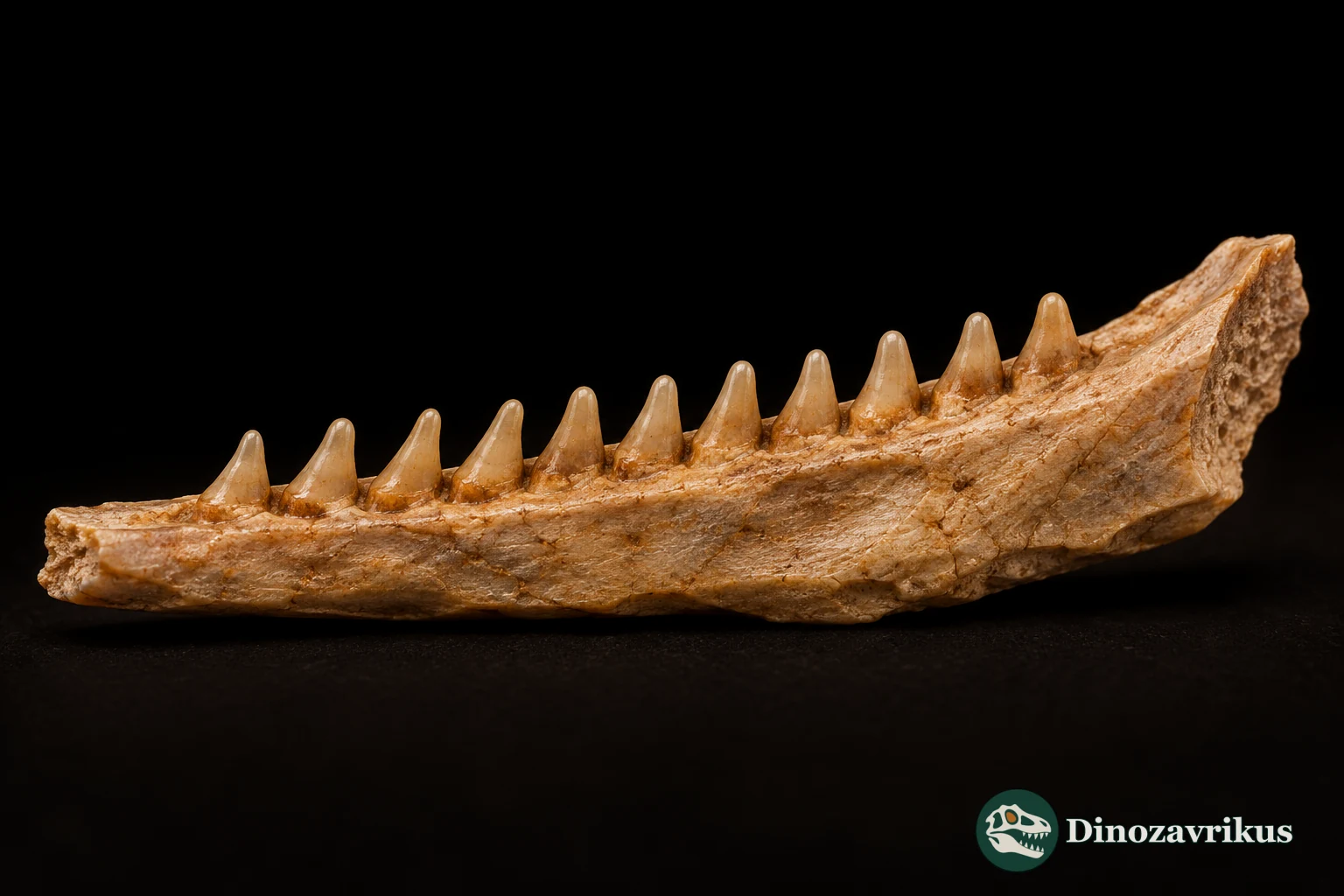
James Martin and colleagues described Proegernia palankarinnensis in 2004 from the lower Etadunna Formation near Lake Palankarinna. In 2021, Kailah Thorn and colleagues described Proegernia mikebulli from the Namba Formation. Its holotype, SAM P57502, is a nearly complete right dentary from Billeroo Creek. Other bones of the species were found near Lake Pinpa. Correlation between the fossil assemblages places the deposits at about 25.5–25.7 million years old.
What the dentary preserves
The holotype of the second species has 27 tooth positions and preserves fourteen teeth. A channel on the inner side of the dentary is closed along almost its entire length. The position of the notch for an adjoining bone, the shape of the channel and the structure of the tooth crowns helped connect the fossil with living skinks. Jaw joints and tooth shape also inform comparisons of other extinct lizards such as Paracontogenys.
What these fossils tell us about Australian skinks
The researchers compared the bones with living egerniines, including relatives of blue-tongued skinks. Their analysis placed Proegernia on an early branch outside the group formed by living Australian egerniines. The fossils show that this part of the skink tree was present in Australia by the Late Oligocene. The arrival date of its ancestors remains unresolved.
Frequently asked questions
Where was the type species found?
It comes from the lower part of the Etadunna Formation near Lake Palankarinna in South Australia.
What other bones are known in the second species?
In addition to lower jaw bones, the authors described maxillary fragments, a premaxilla and a pterygoid.
How many teeth are preserved in the holotype of the second species?
Fourteen teeth survive in a nearly complete right dentary with 27 tooth positions.
How do the two species differ in the lower jaw?
The second species has more tooth positions, a more strongly curved front tip, and lacks the outer tooth striations described in the type species.