

Prothoosuchus was an Early Triassic temnospondyl from European Russia. Its flattened skull reached about seven centimetres in length in the known material. Rows of teeth extended between the larger palatal fangs, with even smaller denticles covering patches of bone beside them.
Quick facts
| Group | Temnospondyls, trematosaurids |
|---|---|
| Age | Early Triassic |
| Region | Europe (Samara and Orenburg regions, Russia) |
| Type species | Prothoosuchus blomi |
| Scientific name | Prothoosuchus |
| Diet | Exact prey is unknown |
What can the fossils tell us?
The type preserves part of a skeleton with the skull. Other fossils from the same locality include skull and jaw fragments and parts of the shoulder girdle.
Grooves in the outer skull bones are interpreted as traces of the lateral line, a sensory system that detects water movement in living aquatic vertebrates.
Large teeth alternate with rows of smaller teeth and patches of tiny denticles on the palate. They provide no direct evidence of a particular prey species.
Fossils from the Obshchy Syrt
S. N. Getmanov named the genus in 1989. The type of Prothoosuchus blomi, PIN 2423/1, comes from Novaya Tavolzhanka in the Buzuluk district of Orenburg. A jaw, part of a shoulder girdle and vertebrae associated with ribs were also found there. An incomplete skull from Korneevka II in the Samara region, PIN 3997/1, is the type of the other named species.
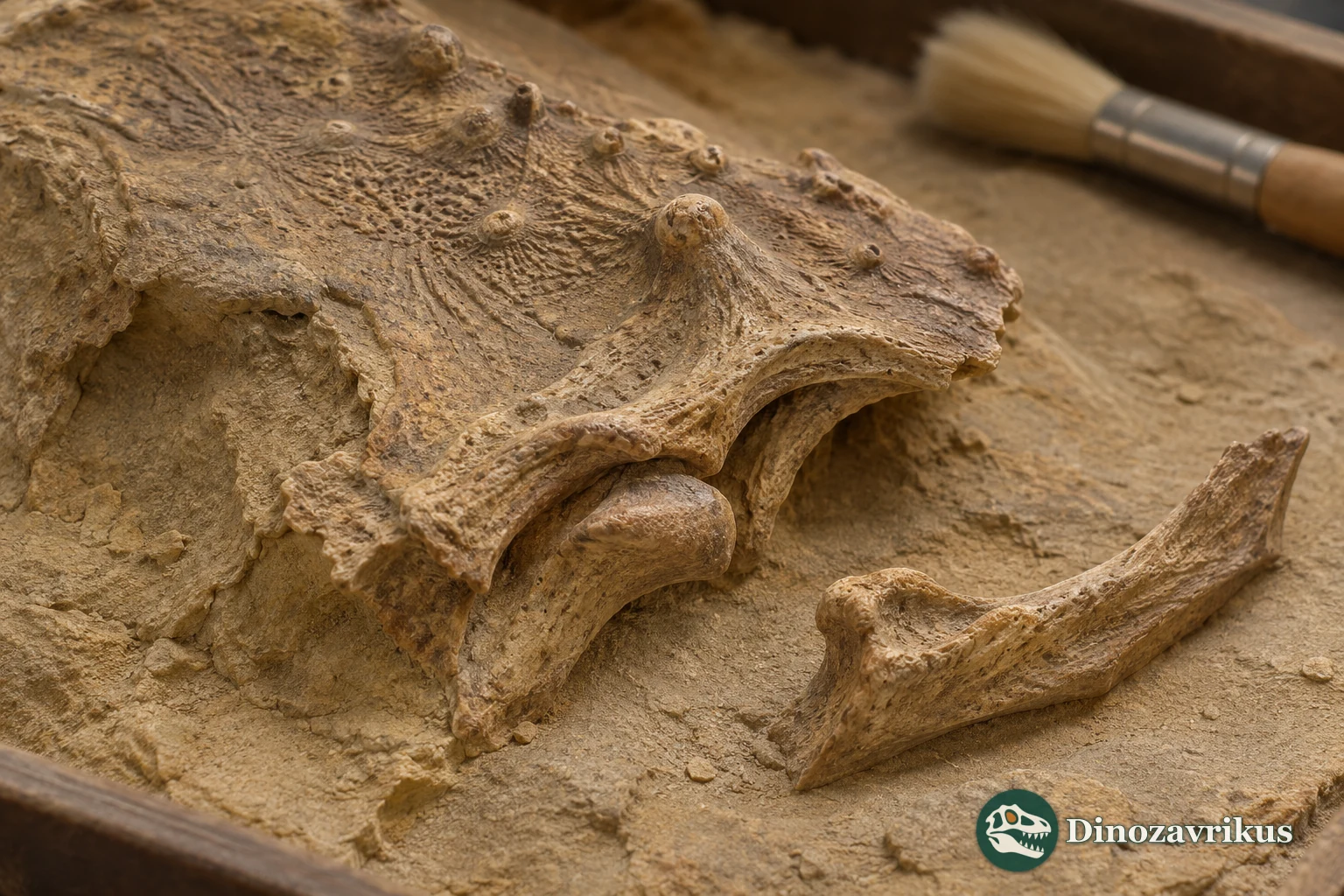
A short, flattened skull
At least twelve teeth intervene between the fangs on the palatine and ectopterygoid. Small denticles also cover the underside of the broad parasphenoid at the base of the skull. The genus has been placed among trematosaurids, a group that also includes Angusaurus from the Early Triassic of eastern Europe. Its skulls are proportionately longer than those assigned to Prothoosuchus.
Comparing the two species
Igor Novikov’s revision retained P. blomi and P. samariensis. In the former, the jaw joints are roughly level with the joints at the rear of the skull that connect it to the backbone. In the latter, the jaw joints lie farther back and the eyes are more widely spaced. The sensory groove on the cheek also follows a different course.
Frequently asked questions
Where was Prothoosuchus found?
The type of the genus comes from the Orenburg region. The other named species was found in the neighbouring Samara region.
How long was its skull?
The known skulls reach about seven centimetres in length. The fossil material does not provide a direct measurement of total body length.
What do the grooves on the skull represent?
They are traces of the lateral-line system. In living aquatic vertebrates, this system responds to movement in the surrounding water.
How are the species distinguished?
Features used in comparison include the position of jaw joints and eye sockets, palatal structures and the course of the sensory groove on the cheek.