

Protocaiman peligrensis is known from a partial skull found in the early Palaeocene rocks of Argentine Patagonia. The skull roof preserves features that link it with caimanines. Analyses disagree about where among those relatives its lineage diverged.
Quick facts
| Group | Alligatoridae, caimanine lineage |
|---|---|
| Age | Late Danian, early Palaeocene |
| Locality | Punta Peligro, Chubut Province, Argentina |
| Rock unit | Upper Salamanca Formation |
| Holotype | MLP 80-X-10-1, partial skull |
| Collection | Museo de La Plata |
What can the fossils tell us?
The shape of the supratemporal openings and the small medial parietal foramina provide characters for comparisons with other caimans. They reveal little about the shape of the snout.
The quadrate is the cranial side of the joint. Its articular surface tapers towards the midline, unlike the nearly parallel margins in Necrosuchus.
The fossil locality is Punta Peligro, where the fossil-bearing horizon is assigned to the late Danian.
The Punta Peligro specimen
Paula Bona, Martín Ezcurra, Francisco Barrios and María Victoria Fernández Blanco described Protocaiman in 2018. The species epithet peligrensis refers to Punta Peligro, on the coast of Chubut. The Museo de La Plata holds the holotype as MLP 80-X-10-1.
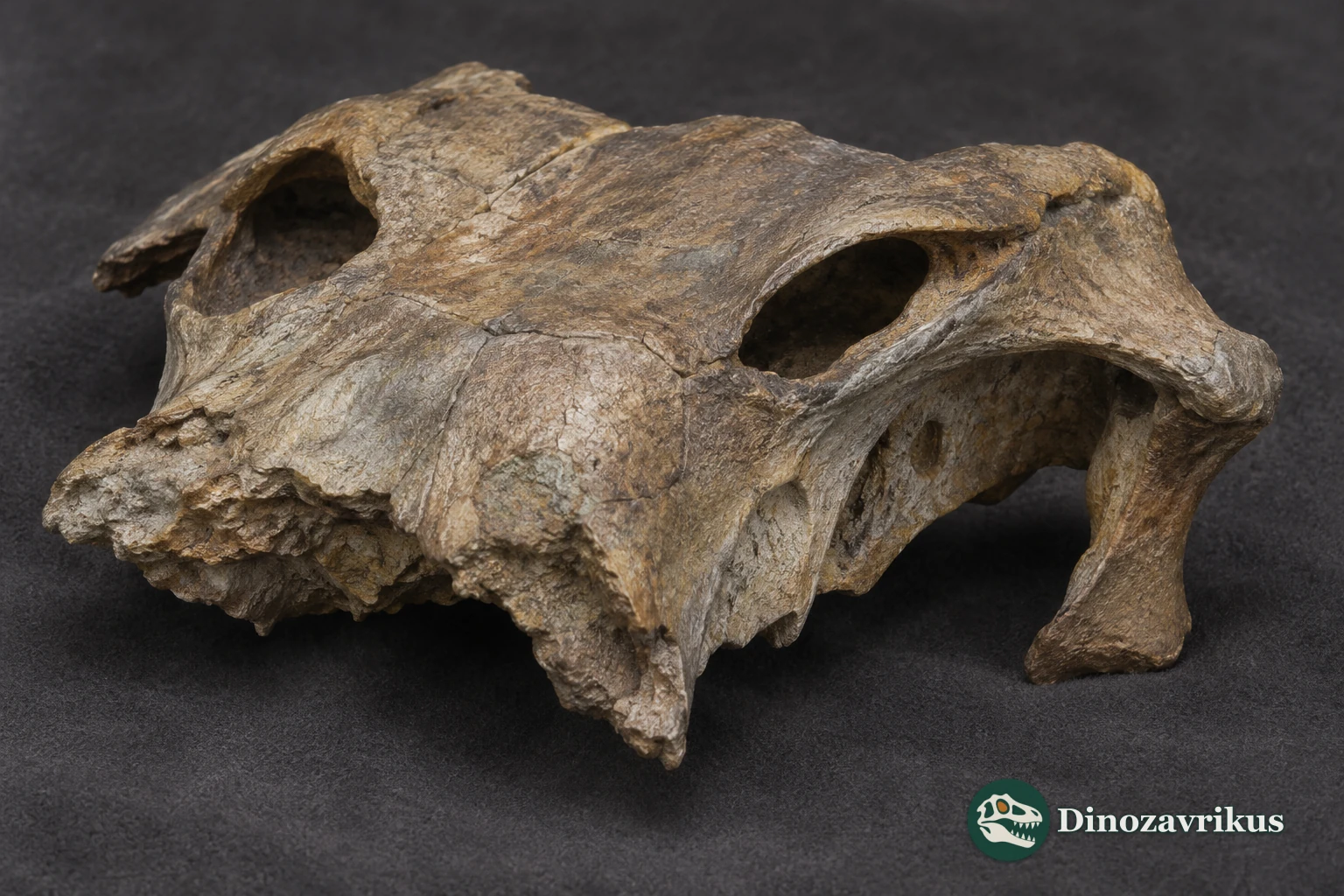
It preserves the skull table, walls of the braincase, much of the occiput and the left quadrate. The front of the skull, the lower jaw and the teeth are missing. The material leaves both body length and diet uncertain.
What the skull roof shows
Bone overhangs parts of the supratemporal openings. Small foramina are visible on the parietal near the midline. In more than one analysis, these characters supported its association with other caimanines.
The same formation yielded an early species of Eocaiman. Much of its diagnostic material comes from different parts of the head, limiting direct comparison. The quadrate condyle can be compared between Protocaiman and Necrosuchus. It narrows medially in Protocaiman, while the upper and lower edges are nearly parallel in Necrosuchus.
An early fossil and two family trees
The original description recovered Protocaiman as the first branch to diverge within a largely South American caimanine group. A subsequent study placed it deeper in the tree alongside Patagonia’s Necrosuchus and the North American Bottosaurus. The branching order among those three species was unresolved in that result.
The skull establishes the presence of the caiman lineage in Patagonia soon after the Cretaceous–Palaeogene boundary. Its exact position within the lineage depends in part on how researchers describe and compare the skull characters.

Frequently asked questions
What does the name Protocaiman mean?
It combines a Greek word for first with caiman. The species name peligrensis refers to the Punta Peligro locality.
How old is the skull?
It dates to the late Danian stage of the early Palaeocene and comes from the upper Salamanca Formation.
Do we know what its snout looked like?
The front of the only described skull is missing, so the length and width of the snout are unknown.
Was it the direct ancestor of living caimans?
The fossils support caimanine affinities. Different analyses place the species on different branches, and no direct line from it to living caimans has been established.