

Protoplatyrhina is an extinct ray identified chiefly from small isolated teeth. Its type species, P. renae, was named from the Late Cretaceous of North America. The animal pictured on the cover is a cautious artistic possibility, because no associated skeleton verifies its disc and tail proportions.
Quick facts
| Type species | Protoplatyrhina renae |
|---|---|
| Named by | Gerard Case, 1978 |
| Type locality | Judith River Formation, Montana |
| Fox Hills sample | 42 separate teeth |
| Group | Batoid ray; family uncertain |
| Body size | Not established from the teeth |
What can the fossils tell us?
Case described P. renae from the Campanian Judith River Formation. Its diagnostic material is dental, not a body skeleton.
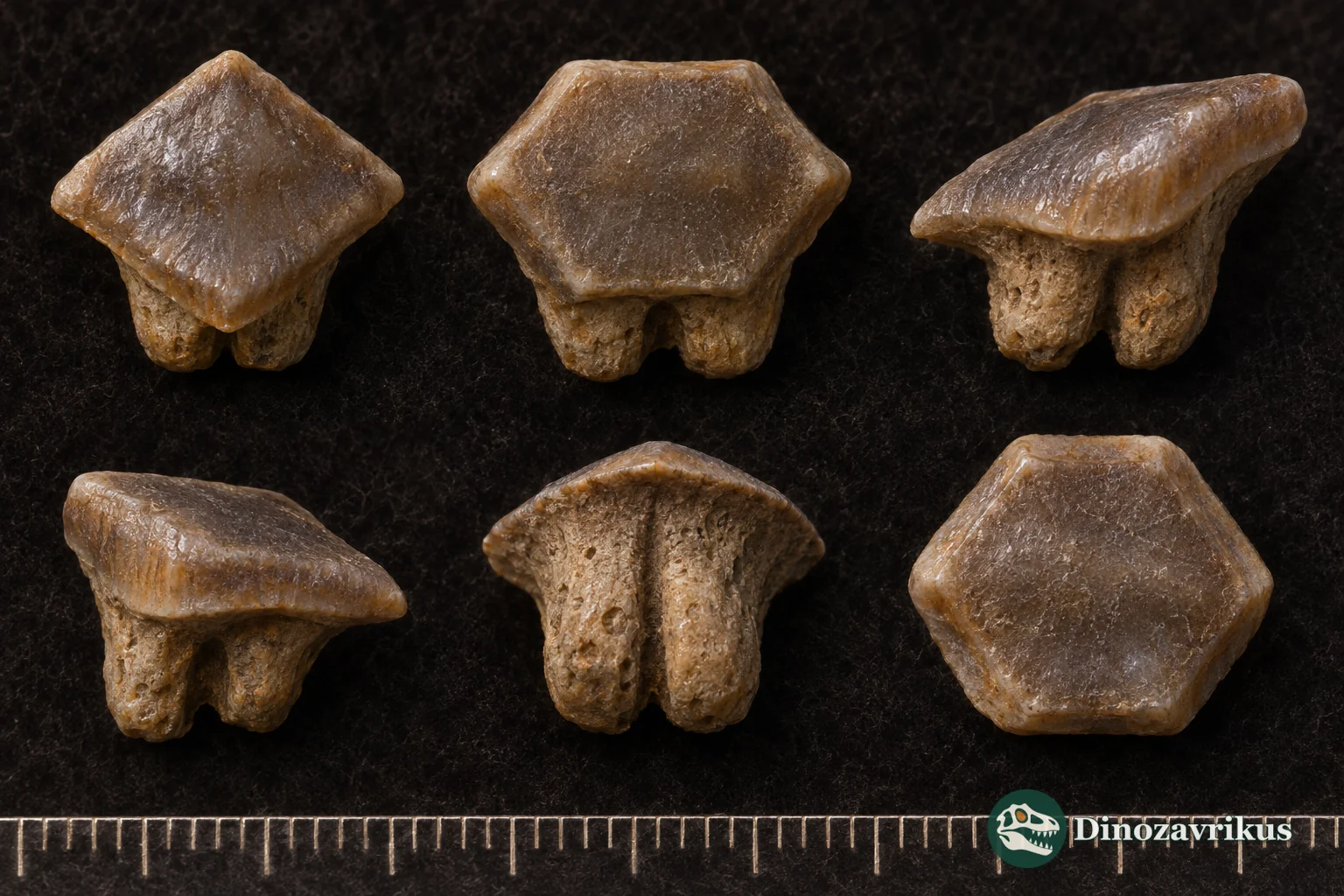
A 2019 study described 42 separate teeth with thick crowns, two root lobes and a central groove. They do not constitute one jaw.
Later authors question placement in Platyrhinidae. Tooth measurements do not establish disc width, tail length or colour.
Naming and classification
Gerard Case established Protoplatyrhina renae in 1978 from the Campanian Judith River Formation of Montana. Although the name resembles that of living Platyrhina, the resemblance cannot establish membership in the modern thornback ray family. Subsequent work has explicitly questioned that assignment for a fossil known from isolated teeth.
The Fox Hills study left the family uncertain while placing the animal among batoid rays. Pseudohypolophus also occurs among the rays examined there, but sharing an assemblage does not identify their closest relatives.
What the teeth show
The Fox Hills study described 42 P. renae teeth. The crowns are thick and smooth with rounded edges, and their upper outlines range from approximately hexagonal to rectangular. Each crown overhangs a root divided into two lobes by a broad groove. Some teeth have worn crown aprons.
An illustrated tooth, ND 94-38.22, measures 2.7 mm wide; the widest tooth in that collection is reported at 5.5 mm. These are individual dental measurements, not body-length estimates. Variation may reflect jaw position, age or individuals, which an assemblage of isolated teeth cannot fully disentangle.
Coastal occurrences
The type species was described from Montana's Judith River Formation. The Fox Hills sample comes from later coastal deposits in North Dakota. The 2019 authors also reviewed reports from other Western Interior localities and Maastrichtian deposits farther east; similar isolated teeth need careful identification before every record is treated as the same species.
The Fox Hills fish assemblage and sediments indicate a nearshore setting. Other rays such as Myledaphus and sharks such as Cretodus illustrate the diversity of these waters. Thick dental crowns are compatible with processing hard food on or near the bottom, but no stomach contents identify particular prey for this ray.
Limits of the reconstruction
Teeth are direct evidence; dermal denticles have been tentatively attributed by comparison, without an articulated body to settle the attribution. The animal's disc width, tail length and colour cannot be measured from those finds. The cover uses a generalized ray outline and a coastal scene as an explicitly artistic reconstruction.
Frequently asked questions
Was Protoplatyrhina a shark or a ray?
Dental anatomy places it among rays, although its exact family remains uncertain.
Where was the type species first described?
Protoplatyrhina renae was described from Montana's Campanian Judith River Formation in 1978.
Do the 42 Fox Hills teeth represent 42 rays?
No. They are 42 separate teeth in a studied sample, not a count of individual animals.
Is the ray's body size known?
No reliable full-body length or disc width follows from the published isolated teeth.