

Prozaedyus was an extinct genus of small armadillos from South America. Its record is built chiefly from osteoderms, the bony plates that formed the carapace, together with a few skulls. These kinds of fossils reveal different features and often do not belong to the same species or individual.
Florentino Ameghino named the genus in 1891. Its type species is P. proximus, first described as Euphractus proximus. Later revisions disagreed about whether subtle differences justify keeping P. exilis separate. New skulls and larger osteoderm samples have repeatedly changed the picture. This profile is part of the ancient mammal catalogue.
Quick facts
| Scientific name | Prozaedyus Ameghino, 1891 |
|---|---|
| Type species | P. proximus (Ameghino, 1887) |
| Group | Cingulata; Chlamyphoridae |
| Age | Late Oligocene to early Pliocene records |
| Range | South America, with key records from Argentina |
| Evidence | Skulls and fixed or movable carapace osteoderms |
| Key caution | Some species and fragmentary records remain disputed |
What can the fossils tell us?
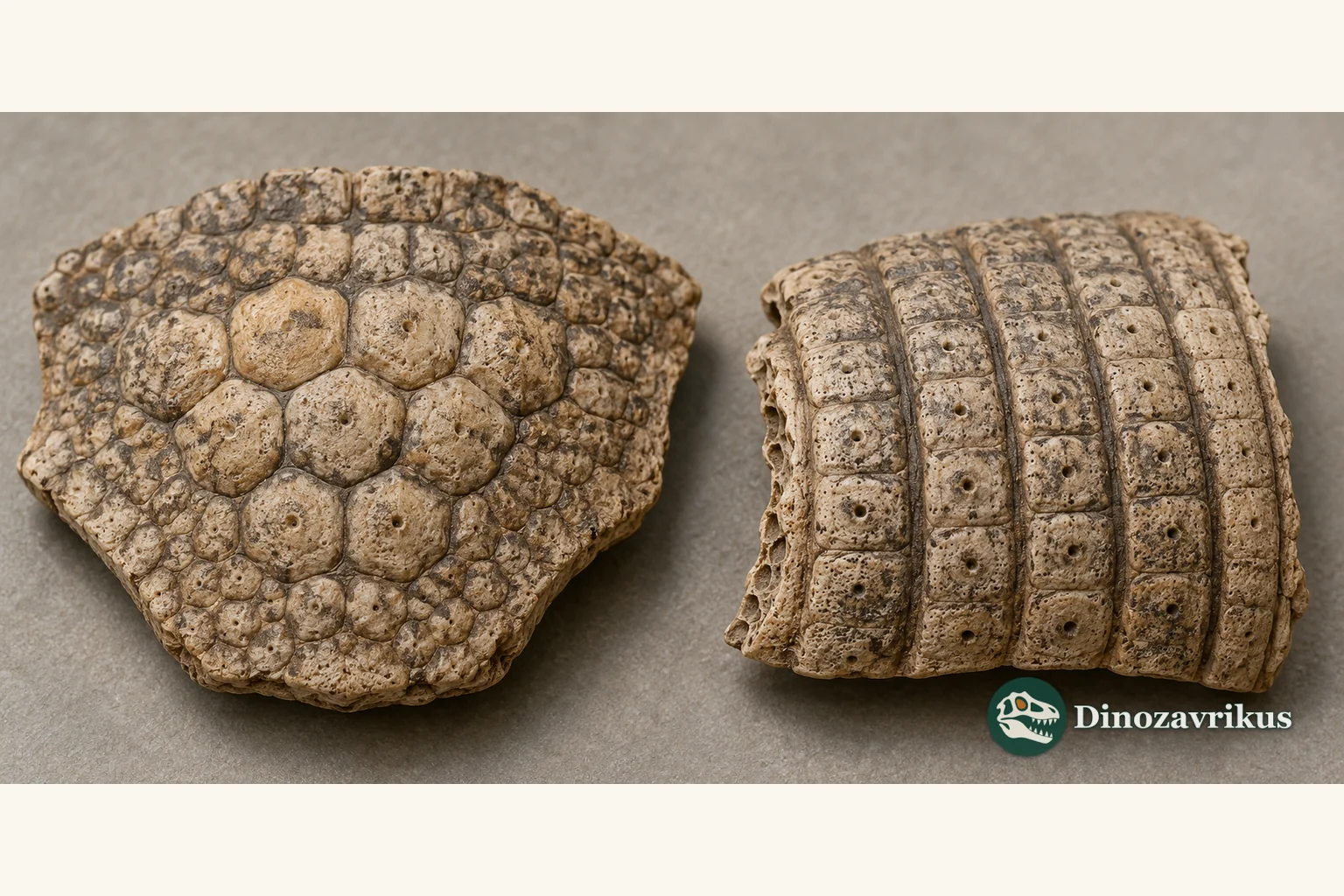
Fixed and movable plates preserve a central figure, grooves and foramina. Their morphology helps recognize the genus, but an isolated plate may not reveal its exact carapace position or species.
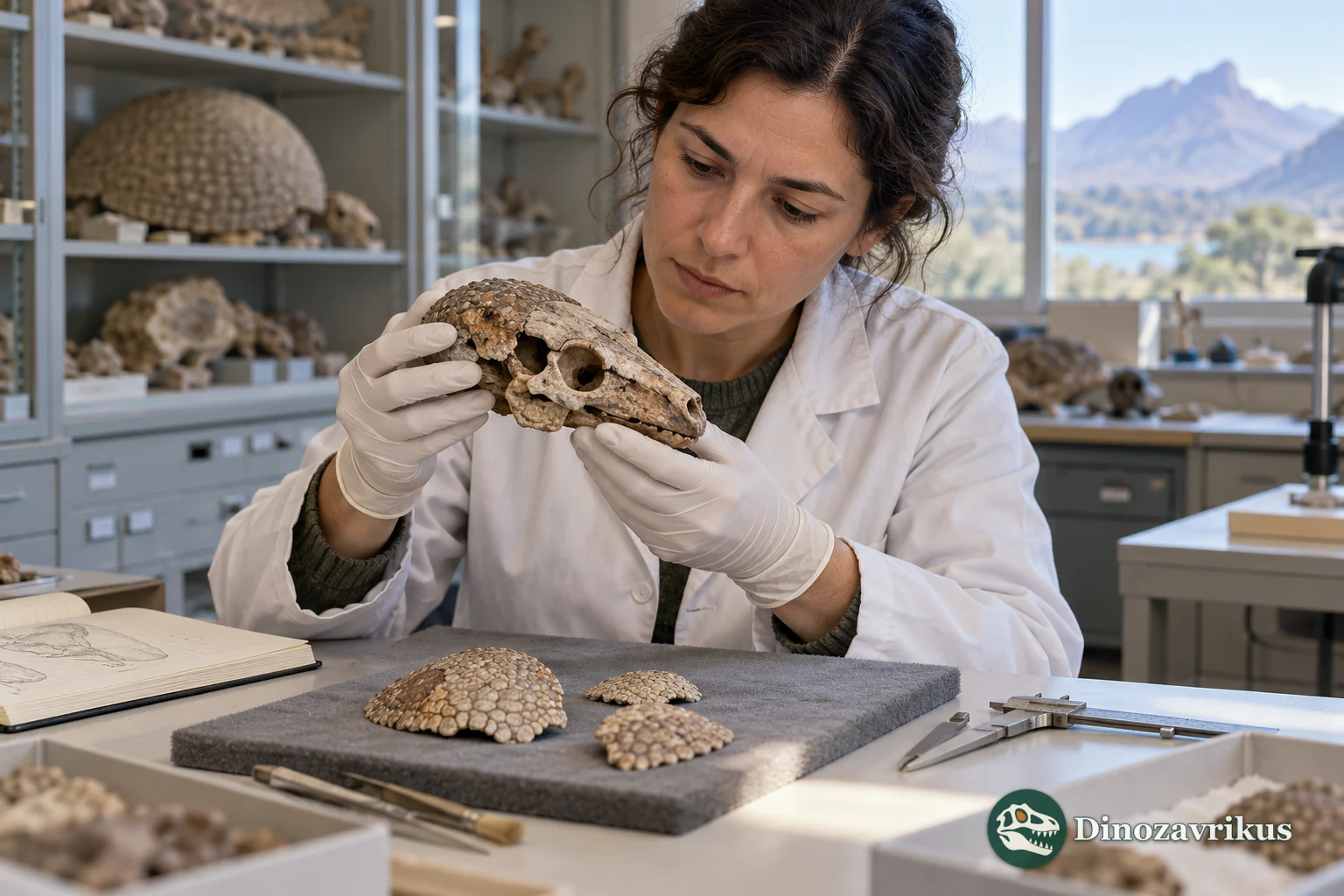
The nearly complete skull and associated armor of P. scillatoyanei added cranial characters that cannot be read from isolated plates. This helped test the genus diagnosis without resolving every older species name.
Some revisions treat slight differences between the Santacrucian species as variation and retain P. proximus alone. Other works list P. exilis separately. These are competing taxonomic treatments rather than a settled synonym list.
Prozaedyus sp. osteoderms from the Toro Negro Formation in La Rioja were described in 2023. Their beds are dated to the late Miocene–early Pliocene, but the material was not identified to species.
The genus and its type species
Florentino Ameghino established Prozaedyus in 1891. The type species is P. proximus, a species Ameghino had named in 1887 as Euphractus proximus. A type species anchors the genus name; it need not be the most complete or best-known species.
Older literature includes spellings such as Prozaedius and Prozaëdius. These are historical orthographic forms, not separate modern genera. Species combinations and interpretations also shifted. The name P. impressus has, in some treatments, been connected with P. planus; that synonymy depends on which taxonomic revision is followed.
Today the genus is placed among cingulate xenarthrans, in Chlamyphoridae and often Euphractinae or Euphractini. The internal classification of living and fossil armadillos has changed with morphological and molecular analyses. These higher-level labels provide a practical framework, while relationships among some traditional subgroups remain under review.
What an osteoderm preserves
An armadillo carapace is built from many osteoderms joined by skin. Plates in flexible bands overlap and allow bending; plates in other regions form firmer shields. Researchers compare their outline and surface pattern, including the central figure, grooves, peripheral figures and piliferous foramina.
Small osteoderms referred to Prozaedyus have been described with a narrow, straight-sided central figure and a row of piliferous openings near the posterior margin. Combined traits help distinguish the genus from some other cingulates. Yet a fixed dorsal plate and a movable band plate differ because they came from different parts of the carapace. Position matters when two fossils are compared.
Osteoderms may identify a genus without identifying a species. The diagnostic features of several Prozaedyus species are strongest in the skull. A handful of plates can therefore support a cautious genus-level assignment while leaving the species open.
Skulls changed the species picture
A nearly complete skull, parts of the carapace and isolated osteoderms supported the description of P. scillatoyanei in 2020. The material came from late Miocene strata of the Loma de las Tapias Formation in San Juan Province, Argentina. Cranial features could be compared alongside plate morphology, extending the record beyond the better-known Oligocene and early-to-middle Miocene fossils.
The status of P. proximus and P. exilis illustrates how species boundaries can change. A 2019 revision of cingulates from the Santa Cruz Formation argued that the metric and morphological differences used to separate the two were slight and within the variation of living armadillos; it recognized only P. proximus there. The 2020 description of P. scillatoyanei still listed P. exilis among the included species. This difference between revisions should be reported rather than hidden behind one permanent checklist.
Material of P. impressus and P. planus has also been treated together in some literature. Such name histories require checking the studied specimens and the author’s species concept. A label in an old collection may preserve a historical determination rather than a current consensus.
Where and when it lived
Published records place Prozaedyus in several parts of South America, with well-studied material from Argentina and records also discussed from Bolivia and Chile. The late Miocene species P. scillatoyanei comes from San Juan Province. Each occurrence has its own stratigraphic context and should not be treated as if all specimens lived at the same time.
In 2023, Diego Brandoni, Daniel Barasoain and Laureano González Ruiz described cingulate fossils from Quebrada de Las Torrecillas in La Rioja. The material assigned to Prozaedyus consists of isolated fixed and movable osteoderms and was left as Prozaedyus sp. The fossils came from upper levels of the lower member of the Toro Negro Formation, dated to the late Miocene–early Pliocene. The formation contains changing sedimentary environments, including sandstones, mudstones, breccias and conglomerates.
This record extends the known age context into younger strata but does not identify a new species or demonstrate uninterrupted survival across the full interval. Formation-wide age limits are also broader than the particular fossil-bearing beds. A precise age belongs to a specimen’s level, not automatically to every member of its genus.
Body size, diet and movement
Osteoderms directly show that the back and flanks were protected by bony armor. Their small size indicates an animal much more compact than giant glyptodonts, but a reliable body-mass estimate for the genus is lacking. A skull or plate can be measured; the total length and mass of a body with missing limbs and vertebrae require reconstruction.
Modern euphractine armadillos eat varied foods, and comparisons with them can generate hypotheses about an extinct relative. For Prozaedyus, however, there is no confidently attributed stomach content, coprolite or diagnostic wear study that fixes the proportions of insects, roots or plants in its diet. Burrowing ability is also not demonstrated by the carapace alone.
The skull of P. scillatoyanei and the shape of its plates improve anatomical comparisons, but they do not preserve skin, colour, reproductive biology or daily behaviour. The cover illustration is a reconstruction based broadly on small armadillos and the fossil evidence; it is not a portrait of one specimen.
Reading the genus through separate evidence
Prozaedyus shows why palaeontologists distinguish a fossil’s preservation from the story built around it. A plate records armor morphology. A skull can sharpen the diagnosis of a species. A layer supplies a geological age. Comparisons with living animals can suggest diet or movement but remain inference.
The published record includes changing species lists and fragments that cannot be named beyond the genus. Rather than forcing those records into one tidy range, it is more accurate to keep the specimen-level uncertainty visible. Related and unrelated forms are gathered in the ancient mammal catalogue, while the classification of each should follow its own evidence.
Frequently asked questions
When did Prozaedyus live?
Published material ranges from at least the late Oligocene to the early Pliocene. The younger Toro Negro fossils are isolated plates assigned to the genus, not a named species.
What is the type species?
The type species is Prozaedyus proximus, originally described as Euphractus proximus. Later revisions treated some other species differently.
Why are some fossils identified only to genus?
Osteoderms preserve useful armor characters, but species diagnoses may rely on cranial features. Isolated plates without a skull often cannot support a reliable species identification.
Was Prozaedyus a tiny armadillo?
It was small compared with giant fossil armadillos, based on the dimensions of known plates and skulls. A reliable whole-body mass estimate has not been established.