

Pseudeumeces was a European fossil lacertid with strikingly different teeth at the front and back of its jaws. Specimens from the Quercy phosphorites in France preserve the jaws of several species, revealing differences in the arrangement of their tooth rows.
Quick facts
| Group | Lacertoids, lacertid lizards (Lacertidae) |
|---|---|
| Age | Oligocene and Early Miocene |
| Region | Europe, France |
| Type species | Pseudeumeces cadurcensis |
| Scientific name | Pseudeumeces |
| Diet | Exact prey is unknown |
What can the fossils tell us?
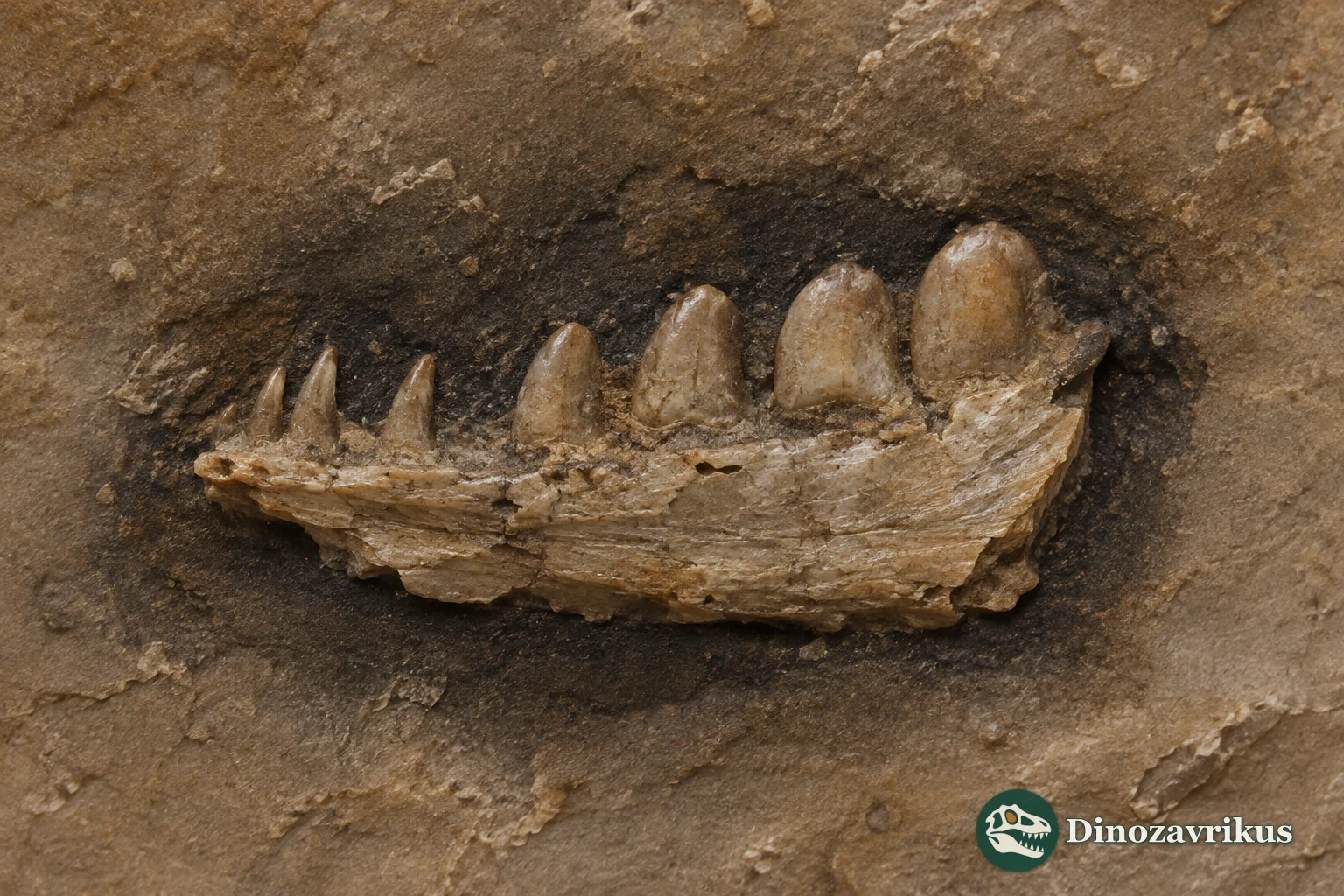
The type species has narrow front teeth and broad, robust posterior crowns.
The broad crowns and sturdy jaws would have helped to crush hard food.
Tooth shape provides little basis for identifying specific foods or how often the lizard crushed them.
From an old species name to a new genus
Henri Filhol described the type species in 1877 as Plestiodon cadurcense. Robert Hoffstetter erected the genus Pseudeumeces for it in 1944. The early material came from the Quercy phosphorites. Younger jaw bones from Gannat record the genus in France near the beginning of the Miocene.
What the broad crowns could do
Enlarged posterior teeth occur in both the upper and lower jaws of P. cadurcensis. Their blunt crowns suit loading and crushing, suggesting the lizard could handle hard components of its diet. The teeth by themselves give little information on which foods it ate. The Eocene Pseudolacerta shows a different arrangement of specialised front and back teeth.
A jaw scanned at sixteen millimetres
In 2021 researchers named P. kyrillomethodicus from an old collection in Vienna. Its holotype, NHMW 2019/0051/0001, is a short, robust left dentary measuring 16 mm. CT scans show 15 tooth positions. The form of the jaw and the surfaces where adjoining bones attached distinguish it from the type species.
A mainland relative of Canary Island lizards
Phylogenetic comparisons place Pseudeumeces near the lineage of the living Canary Island lizards, Gallotia. These French fossils record ancient relatives on the European mainland. Its broad crushing teeth help characterise the fossil genus, while other features of the jaws inform its placement within the family.
Frequently asked questions
Which is the type species?
Pseudeumeces cadurcensis, first named Plestiodon cadurcense in 1877.
Which teeth were the broadest?
The enlarged back teeth in the upper and lower jaws. The front teeth were narrower.
What did the CT scan reveal?
The 16 mm dentary in Vienna has 15 positions where teeth grew.
Which living lizards is it related to?
Phylogenetic work links it to the lineage of the Canary Island lacertids, Gallotia.