

Pseudoplohophorus was a glyptodont, a heavily armoured relative of living armadillos, in what is now Uruguay during the Late Miocene. Its best documented record is not a complete skeleton: a partial individual from Arazatí preserves a skull and jaw, vertebrae, part of the carapace, a tail tube and limb bones. These remains give a much firmer picture of its armour than of its soft tissues or behaviour.
The genus also has a complicated taxonomic history. Its type species, P. orientalis, was named from material that is now lost, while P. absolutus is represented by a more informative associated sample. This profile is part of the ancient mammal catalogue; the catalogue link groups the profile with other fossil mammals without implying that all glyptodonts were built alike.
Quick facts
| Scientific name | Pseudoplohophorus Castellanos, 1926 |
|---|---|
| Recognised species | P. orientalis and P. absolutus; assignments need caution |
| Group | Glyptodontidae, within Cingulata |
| Age | Late Miocene, Camacho Formation |
| Best documented locality | Arazatí, San José Department, Uruguay |
| Key specimen | FC-DPV-475 and FC-DPV-595, associated parts of one individual |
| Carapace estimate | About 0.95–1.0 m for the incomplete preserved portion |
| Main uncertainty | The type material of P. orientalis is lost |
What can the fossils tell us?
FC-DPV-475 and FC-DPV-595 include a skull, lower jaw, vertebrae, broad parts of the carapace, a tail tube and limb elements. The pieces collected in different years fit without duplicated matching bones and were interpreted as one individual. Missing regions still prevent a complete anatomical reconstruction.
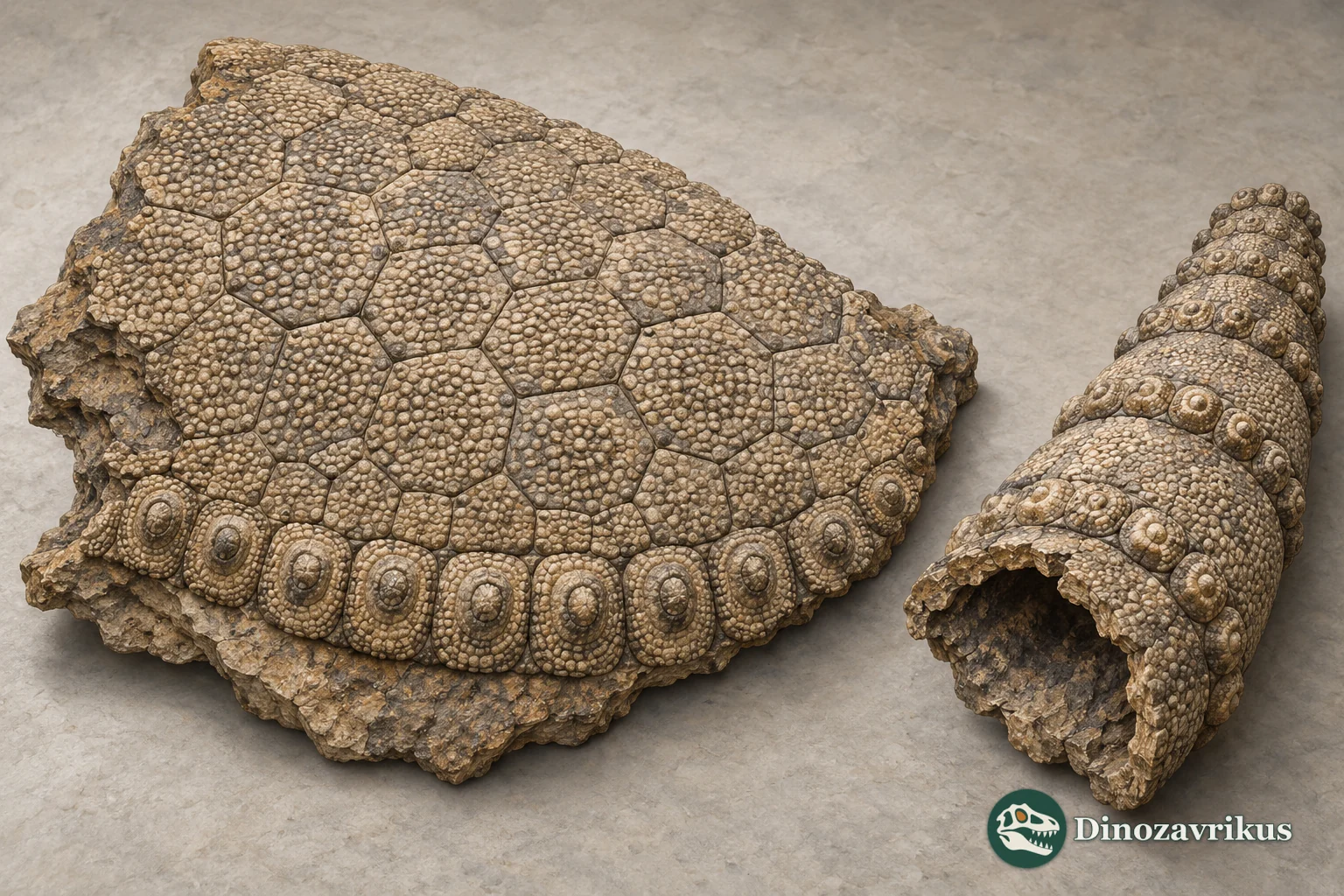
The described osteoderms range from about 15.5 mm near the front to 43.5 mm in the lumbar region. Their position and sculpturing help compare glyptodont armour, but the preserved section is incomplete and cannot establish the exact outline of the entire carapace.
The caudal tube is about 34 cm long and carries a pattern of scutes that can be compared with related glyptodonts. A defensive role is plausible in an armoured mammal, but the fossil does not show how often it was used, whether it struck rivals, or how the animal moved its tail in life.
The genus was established for P. orientalis, whose original type material is now lost; a cast, MACN-A 745, has been cited in later reviews. P. absolutus is based on better associated Uruguayan remains. Classifications based on isolated tail tubes and fragmentary material have changed, so species lists should not be treated as equally secure.
A genus named from fragmentary material
Ángel Cabrera Castellanos erected Pseudoplohophorus in 1926 for a glyptodont from Uruguay. The type species, P. orientalis, had first been named by Florentino Ameghino in 1889. Its original material is considered lost. Later authors have referred to a cast, MACN-A 745, but a cast cannot restore observations that were never recorded from the missing original. This makes comparisons with the type species less direct than comparisons based on a surviving, well-documented skeleton.
The species P. absolutus was described from Arazatí in the department of San José. Daniel Perea’s 2005 study treated the material as evidence for a distinct species and added it to the genus. The broader record is messier: several South American glyptodont names were erected from isolated tail tubes or limited armour, and later revisions have questioned or reclassified some of them. Similarity in one conspicuous structure is useful for generating a comparison, but it does not by itself demonstrate that two animals belong to the same species.
Modern glyptodont studies combine osteoderm pattern, skull and jaw anatomy, tail structures and other skeletal characters. Phylogenetic results depend on which specimens and characters can be scored. A 2023 analysis placed P. absolutus and P. benvenutti near a group containing species of Plohophorus; that is a result of a particular character matrix, not a direct observation or settled consensus about every species historically assigned to the genus.
What the Arazatí individual preserves
The principal specimen is catalogued as FC-DPV-475 and FC-DPV-595. Its parts were collected in 1986 and 1991 from the basal Camacho Formation at Arazatí. Perea argued that the pieces belong to one individual because they fit together and there are no duplicated bones that should be paired on the left and right sides. This association is important: it connects parts of the head, armour, tail and limbs that might otherwise have been assigned to separate animals.
The material includes a skull and mandible, the atlas and other vertebral fragments, a broad portion of the dorsal carapace, a cephalic shield, a caudal tube, a humerus and bones of the left hand, as well as fragments of the sacrum, pelvis and tail rings. It is a remarkable set for a fossil glyptodont, yet large areas remain absent. The specimen does not preserve a complete spine, all four limbs, the full shell or the soft tissues that joined its bony plates.
Armour, tail tube and measured size
Glyptodont carapaces were made of many tightly arranged osteoderms. In P. absolutus, the described plates differ in thickness across the preserved regions: examples range from roughly 15.5 millimetres anteriorly to about 43.5 millimetres in the lumbar portion. These figures describe measured plates, not a uniform thickness for the whole animal. The incomplete dorsal shell has been estimated at approximately 95 to 100 centimetres across its preserved extent. It is not a measurement of total body length.
The caudal tube is around 34 centimetres long. Its fused bony surface and scute pattern are among the features used to compare glyptodonts. Armour almost certainly provided physical protection, but a defensive function does not reveal the animal’s social life. Claims that glyptodonts routinely fought one another with their tails require evidence beyond the presence of a tail club or tube. No healed impact pattern in this individual demonstrates a particular fight.
The skull is about 228.7 millimetres long in the published measurement. It supports comparisons of the facial region, jaw and teeth, but not a complete estimate of body mass. No reliable total body length or mass follows from the incomplete carapace alone. Scaling an unpreserved skeleton from one plate or one skull would create a model-dependent number, so this profile does not present one as a measured fact.
Habitat and the limits of ecological reconstruction
The fossils come from the Camacho Formation, a Late Miocene succession along Uruguay’s southern coast. The formation contains marine and coastal deposits as well as terrestrial mammal remains; the exact depositional context must be considered for each locality and layer. Arazatí material places the animal in a landscape shaped by changing shorelines and nearby terrestrial environments. It does not mean the glyptodont lived in the sea or that every fossil at the site was deposited at the same time.
The bony shell, head and limbs constrain body construction more directly than they constrain diet or daily movement. Glyptodonts are generally interpreted as plant eaters from their teeth and comparisons within the group. For Pseudoplohophorus, however, the available associated material does not provide stomach contents or a direct record of a particular plant. Nor does a partial skeleton establish how quickly it walked, whether it dug, or how it behaved around other animals.
What a reconstruction can show
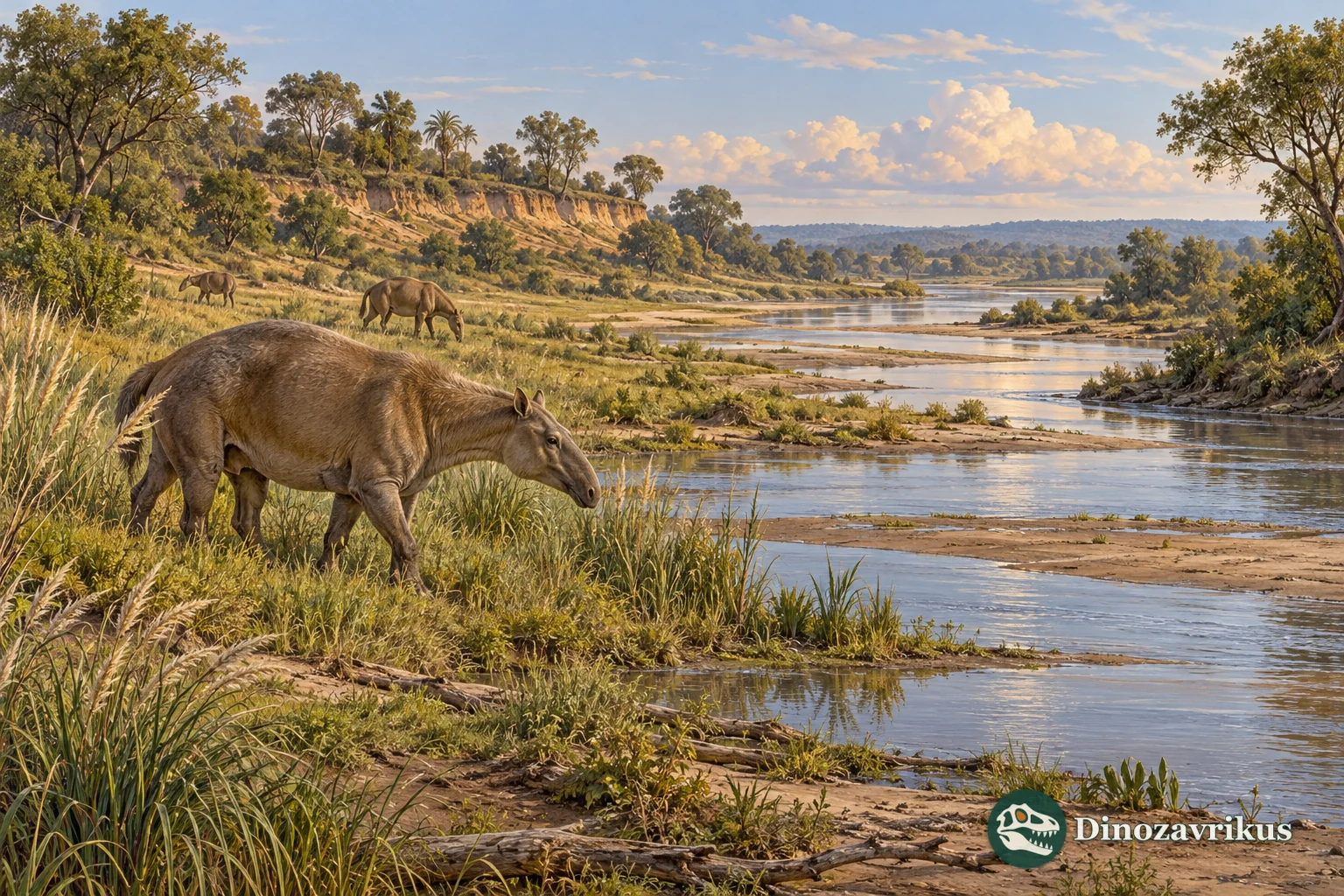
A defensible reconstruction can use the preserved skull, the measured section of carapace, the caudal tube and the known limb elements. It must make choices about missing regions, shell outline, body proportions and the connective tissue between osteoderms. Those choices should be treated as reconstruction rather than direct fossil evidence. The coat, skin colour, facial expression, exact gait and habitual use of the tail are not preserved.
The most useful summary of Pseudoplohophorus is therefore specific but incomplete: one Uruguayan individual preserves an unusually broad set of glyptodont body regions, while the name-bearing material of the type species is lost and other species assignments remain debated. The fossil record tells us much about its bony protection. It leaves the full outline and everyday life less certain.
Frequently asked questions
Was Pseudoplohophorus a dinosaur?
No. It was a mammal in Glyptodontidae, a group of armoured relatives of living armadillos.
Where was Pseudoplohophorus found?
The best documented material of P. absolutus comes from Arazatí in Uruguay’s San José Department, in the basal Camacho Formation.
How large was its shell?
The incomplete preserved carapace has been estimated at about 95–100 cm across its preserved extent. This is not the animal’s total body length.
Do scientists know how it used its tail tube?
The bony tube is preserved and can be compared with other glyptodonts, but its presence alone does not prove a particular defensive or fighting behaviour.