

The Eocene snake Pterosphenus is recognizable by tall vertebrae compressed from side to side. It belongs to the extinct family Palaeophiidae. Vertebrae from Alabama provided the basis for the type species, while a section of spine from western India reveals the variation within a single individual.
Quick facts
| Group | Snakes, palaeophiids (Palaeophiidae) |
|---|---|
| Age | Middle and Late Eocene |
| Region | North America, Asia and Africa |
| Type species | Pterosphenus schucherti |
| Scientific name | Pterosphenus |
| Diet | Exact prey is unknown |
What can the fossils tell us?
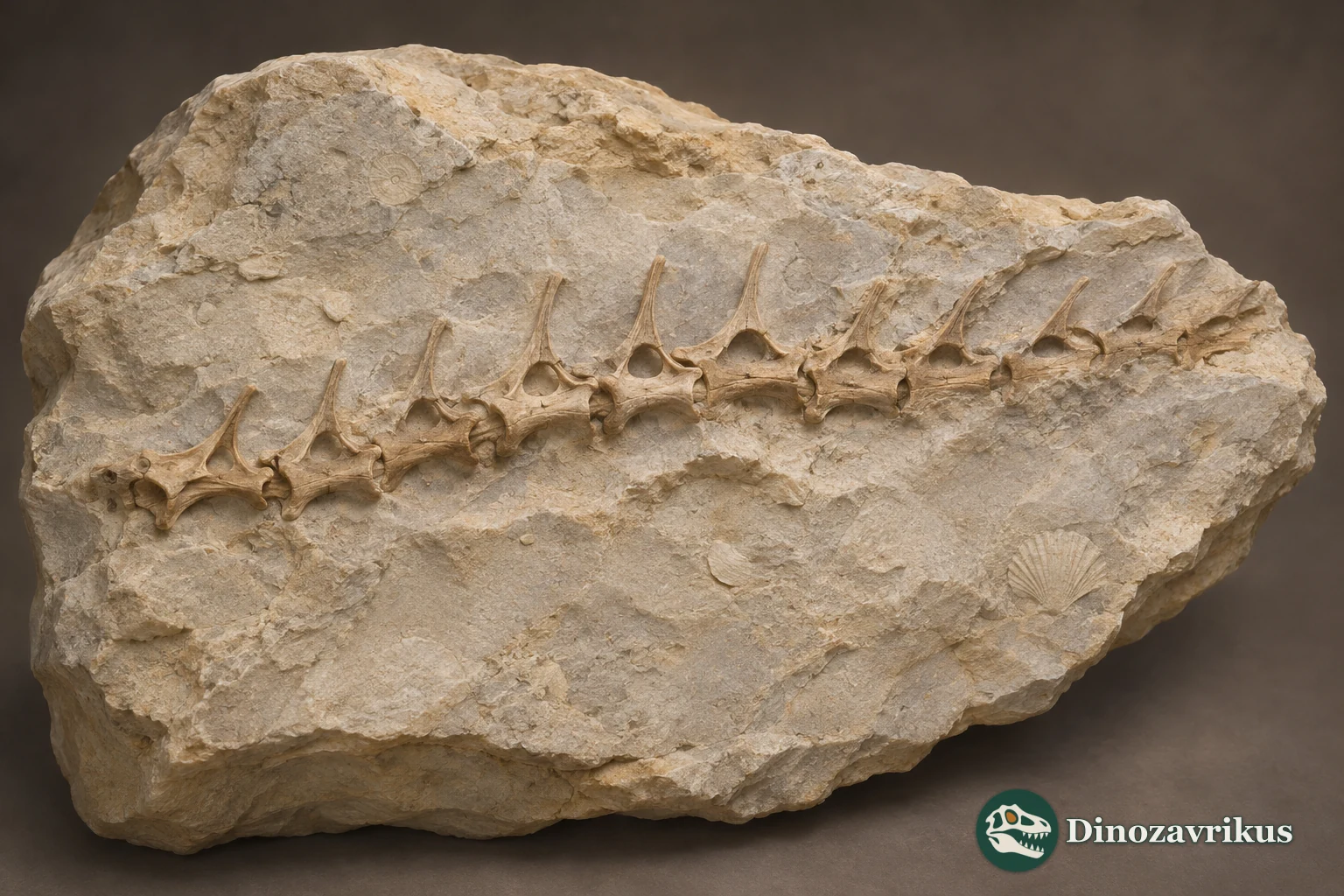
The type comes from Alabama. IITBR1 from India preserves 15 partly articulated vertebrae as well as separate elements.
IITBR1 reveals how far the shape and height of projections varied along the trunk of a single animal. Some features previously used to distinguish species overlap.
The material lacks a complete skeleton with head and tail. Body length is a model estimate, and no fossil in this material establishes prey.
The Alabama specimen
Frederic Lucas named Pterosphenus schucherti in 1898. Charles Schuchert collected the type material in what is now Choctaw County. Its vertebrae came from the Jackson Group. The Smithsonian's National Museum of Natural History holds them under the catalogue number USNM V 4047.
A section of spine from coastal India
The Harudi Formation in Kachchh, western India, preserves coastal deposits of Middle Eocene age. A shell-rich limestone yielded IITBR1, with 15 partly articulated vertebrae at the transition from the front to the middle of the trunk, an isolated vertebra and a further fragment. Some surfaces were still embedded, so the researchers used neutron tomography to view details inside the block. The bones show how the size and outline of vertebral projections changed along a single spine.
Species names under revision
Many vertebrae of Pterosphenus carry taller paired projections than those of Palaeophis, a related palaeophiid. Similar vertebrae occur in the Eocene beds of the Fayum in Egypt. In 2024 researchers proposed treating the Egyptian P. schweinfurthi and Indian P. biswasi as synonyms of the type species. In 2025 Debajit Datta and Sunil Bajpai retained P. biswasi on the basis of the shape of its projections and overall vertebral form. They also described the Indian P. rannensis, whose bones combine traits associated with both Pterosphenus and Palaeophis.
Length depends on the comparison
The 2024 study estimated a total length of about 6.7 m for IITBR1. Its authors compared the average length of vertebral centra from a known section of the trunk with measurements of living snakes. In a separate study of fossils from Georgia, a comparison with boas yielded estimates of 2.5–4.8 m, while a comparison with pythons produced a much wider range. The estimates describe different fossil samples and depend on the models used.

Frequently asked questions
Where were the first fossils found?
Charles Schuchert collected the type vertebrae in Choctaw County, Alabama.
What makes the Harudi specimen useful?
A sequence of vertebrae preserves changes in bone shape along the trunk of one individual.
What family did it belong to?
Palaeophiidae, an extinct family of aquatic snakes.
Why is there no single measured length?
The material preserves portions of the spine. Estimates depend on which bones are measured, their position along the body and the modern snakes used for comparison.