

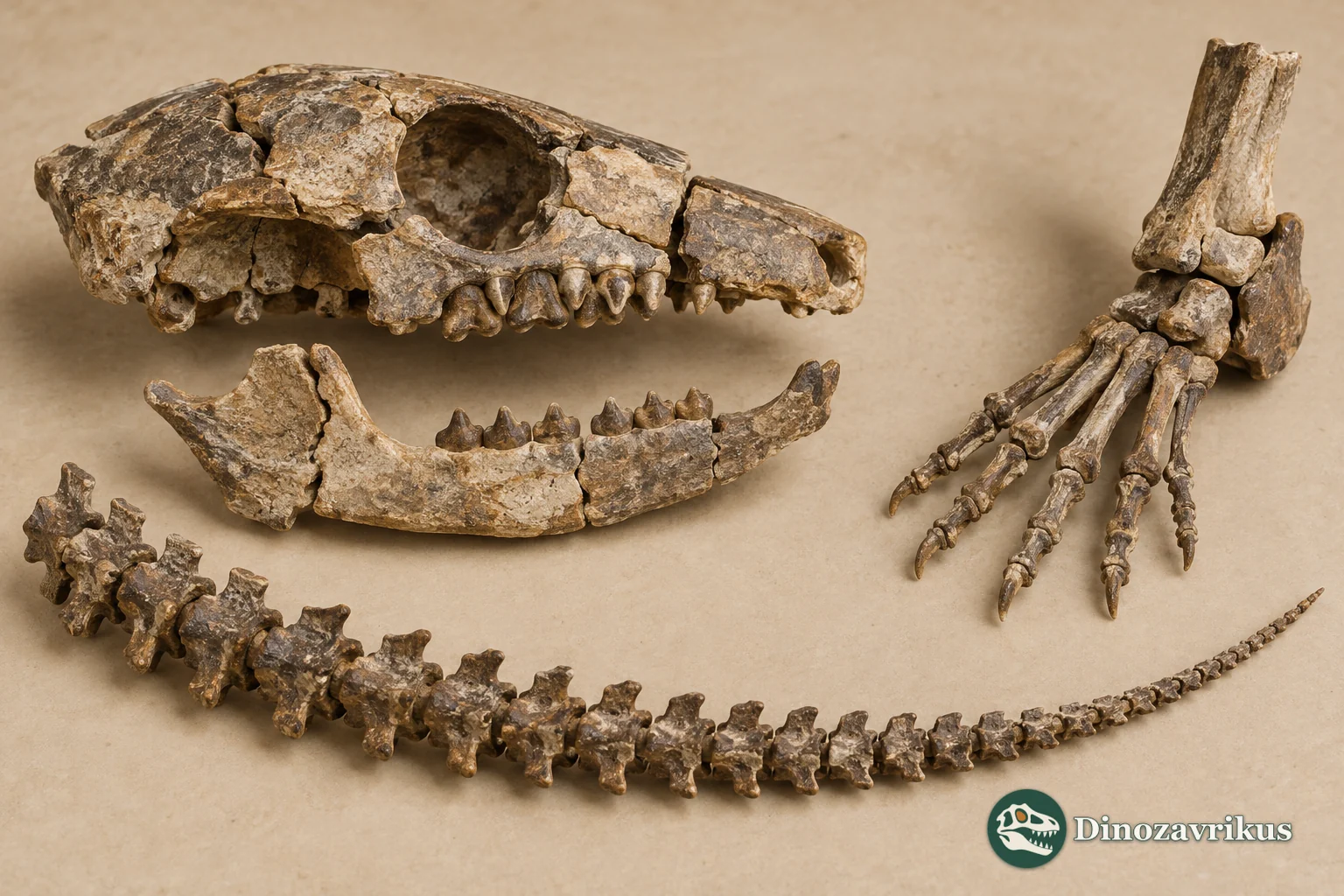
Ptilodus was a multituberculate mammal that lived in North America during the Paleocene, after the end-Cretaceous extinction. Its distinctive molars and enlarged lower premolar are more familiar to palaeontologists than a complete skeleton: most finds are teeth or jaws, while a small number of specimens preserve additional bones.
Multituberculates were an extinct mammal lineage with no living descendants. Their name refers to rows of small cusps on the molars. Ptilodus belonged to the family Ptilodontidae and is included with other fossil mammals in the ancient mammal catalogue. The fossils can test how its teeth worked and how its limbs may have moved, but they do not preserve fur, colour or a detailed daily routine.
Quick facts
| Scientific name | Ptilodus Cope, 1881 |
|---|---|
| Group | Multituberculata, family Ptilodontidae |
| Age | Paleocene of North America |
| Range | Western United States and southern Canada |
| Important specimen | USNM 6076 preserves a near-complete skull and partial skeleton |
| Type species | Ptilodus montanus; type material is fragmentary |
| Diet | Flexible feeding is supported by dental form and wear; exact foods are unknown |
| Locomotion | Ground use is supported; climbing and saltatory movement remain under study |
What can the fossils tell us?
The enlarged fourth lower premolar could cut, while the molars crushed and ground during a two-part chewing stroke. This describes dental mechanics. Tooth form and wear support varied feeding, but no particular meal is preserved.
The species record includes partial skeletons as well as jaws. UA 9001, assigned to P. kummae, preserves much of the postcranial skeleton but lacks the skull. It informs limb function without completing the anatomy of P. montanus.
Early functional work proposed substantial climbing. Later digital preparation and comparisons suggest that terrestrial movement and saltation may have been important, with climbing available but not necessarily dominant. These are biomechanical interpretations, not observed behaviour.
Ptilodus is a ptilodontid multituberculate. Older species assignments have been revised as researchers compared more teeth and skeletons. A specimen once named P. gracilis is now treated by some revisions as P. montanus; the genus-level placement is firmer than every species boundary.
A genus built from changing fossil assignments
Edward Drinker Cope introduced Ptilodus in 1881 from Paleocene material in New Mexico. The original record was fragmentary, as is common for small mammals: durable teeth survive in deposits where delicate bones are rarely recovered. Later collecting expanded the genus across western North America and added specimens with more of the skull and skeleton.
The name-bearing species is Ptilodus montanus. Its type material consists of a jaw fragment with a premolar and molar rather than a complete animal. A separate specimen, USNM 6076, was historically described under the name P. gracilis and preserves a near-complete skull, jaws and part of the skeleton. Subsequent revisions have treated P. gracilis as a synonym of P. montanus. The detailed specimen is therefore important anatomical evidence, although its history of naming should be kept clear.
Other species names have also been proposed from differences in teeth and isolated skeletal elements. Their status depends on comparisons across larger samples. Wear, tooth position, individual variation and the age of an animal can all change the shape that researchers measure, so an old species label is not automatically accepted in every revision.
How the teeth processed food
Ptilodontid multituberculates had an enlarged fourth lower premolar, often called P4, followed by molars with multiple cusps. In Ptilodus, the lower premolar could slice against the upper tooth row, while the molars crushed and ground food. The jaw did not simply close vertically: its motion included a forward component that brought the teeth into a second phase of contact.
Dental studies describe two chewing cycles. The premolar's shearing action could break or cut food, and the molars then processed it across their ridged surfaces. This arrangement is consistent with a varied diet. It does not demonstrate that every population ate the same foods, or identify a specific plant, insect or small animal in the absence of gut contents.
Microscopic wear and tooth geometry help compare Ptilodus with other mammals, but those clues have limits. A tooth surface records contact and use over time rather than a list of meals. The evidence supports flexibility more strongly than a narrow dietary label.
What the skeleton says about movement
For many small Paleocene mammals, locomotion has to be inferred from isolated limb bones or comparisons with living animals. The partial remains assigned to Ptilodus offer more information than teeth alone, but they do not form one complete skeleton. Different specimens also belong to different species or individuals, so their bones should not be assembled into a single idealised body without qualification.
Early functional work emphasised features interpreted as adaptations for climbing. The later digital study of ptilodontid anatomy examined the bones in three dimensions and compared their joint surfaces and proportions. Its interpretation gave greater weight to terrestrial movement and saltation, while allowing that the animals could climb. The debate reflects how locomotor conclusions depend on which features and modern comparisons are selected.
A useful distinction is between capability and typical behaviour. A grasping joint or strong limb may permit movement on branches without proving that most activity took place in trees. Current evidence supports a mixed picture, with ground use and jumping plausible; the exact balance is unresolved.
Rare skeletons and the limits of reconstruction
Specimen UA 9001, assigned to Ptilodus kummae, is a nearly complete postcranial skeleton from the Ravenscrag Formation of Saskatchewan. It lacks the skull, so it cannot directly connect every cranial measurement with that body's proportions. Its limb bones and vertebral column nonetheless provide a valuable view of parts rarely preserved in multituberculates.
The visual reconstruction on this page combines a fossil-informed body plan with artistic choices. The teeth and some limb structures are constrained by specimens; coat, colour, soft tissues and precise posture are not. The forest-floor setting suggests an environment rather than a documented moment in the animal's life.
Paleocene North America
Ptilodus lived in the ecosystems that developed after the end-Cretaceous extinction. Fossil-bearing formations in western North America record changing river plains, forests and other habitats through the Paleocene. These settings are reconstructed from sediments, plants and associated animal fossils rather than from one specimen of Ptilodus alone.
The genus's broad fossil range does not mean every species occupied the same habitat at the same time. Geological age and locality must be checked for each specimen. Paleocene deposits can also concentrate and transport remains, so a fossil assemblage is not always a snapshot of one living community.
What remains uncertain
The best-supported conclusions concern the teeth: their structure allowed cutting and grinding, and the wear evidence is compatible with flexible feeding. Some skeletal material allows researchers to test limb function, though interpretations of climbing, terrestrial movement and jumping continue to develop. The type species itself is not represented by a complete skeleton.
Body size estimates, exact diet and habitual movement are reconstructions from incomplete evidence. No known fossil establishes the animal's coat, colour, social behaviour or reproductive biology. New specimens and revised comparisons may refine the picture without turning those unknowns into direct observations.
Frequently asked questions
What kind of animal was Ptilodus?
It was a ptilodontid multituberculate mammal from the Paleocene. Multituberculates were an extinct lineage, not rodents or marsupials.
What did Ptilodus eat?
Its specialised teeth and wear support flexible feeding, but they do not reveal a precise menu. No direct stomach contents are known.
Could Ptilodus climb trees?
Climbing has been proposed from limb anatomy, while later analyses emphasise ground movement and possible saltation. It may have used more than one mode; typical behaviour remains uncertain.
Is a complete Ptilodus skeleton known?
No. Important finds preserve a near-complete skull with partial postcranial remains or substantial parts of the postcranial skeleton without a skull, but not a complete skeleton of the type species.