

Purbeckopus is a name for fossil tracks from Dorset in southern England. Three known slabs preserve large foot impressions and associated hand prints, but no bones of the animal are directly linked to them. In 1997, researchers argued that the traces were probably made by a pterosaur. A later review challenged both that attribution and the distinct status of the ichnotaxon. The most useful account therefore starts with the impressions themselves and keeps the animal behind them uncertain.
Quick facts
| Name | Purbeckopus pentadactylus Delair, 1963 |
|---|---|
| What is named | An ichnotaxon based on fossil traces, not a skeleton-based genus |
| Type slab | DORCM G.6664, with three pes prints and at least two manus impressions |
| Other main slabs | DORCM G.9481 and G.9482 |
| Place and rocks | Purbeck Limestone Formation, Dorset, southern England |
| Pes length | About 187–225 mm in the 1997 account |
| Trackmaker | Pterosaurian origin was argued for, but has been questioned |
What can the fossils tell us?
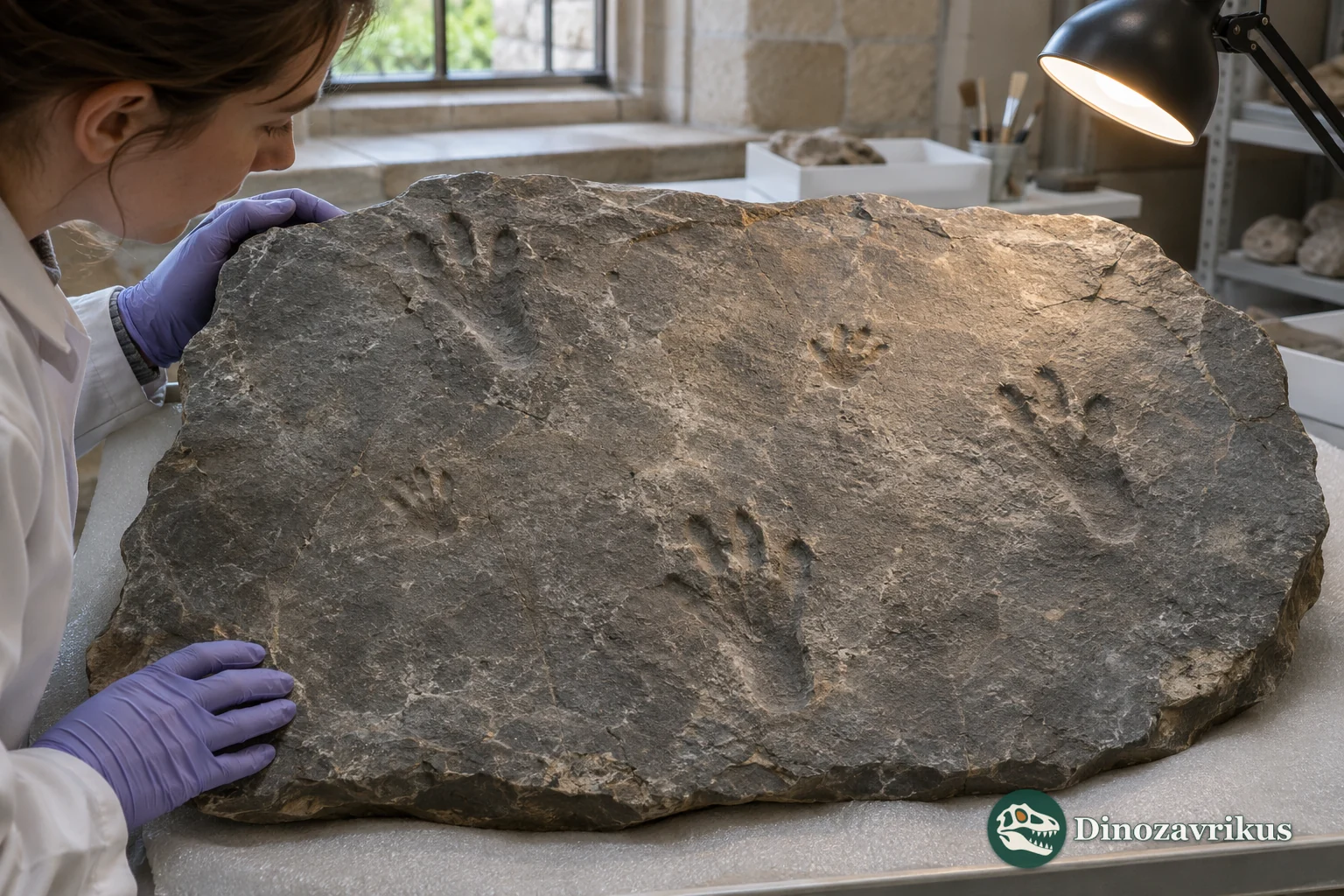
DORCM G.6664 bears three pes prints and at least two manus prints; two separate slabs preserve additional foot impressions. They do not form one complete trackway.
The published description records an elongate, four-toed pes and a three-toed manus. The unusual lateral position is a feature of the preserved slab, not proof of a repeated stride.
Comparisons with pterosaur tracks support the proposed identity, but no skeleton is associated with the slabs. A 2003 revision questioned the attribution and the taxon's distinctness.
Pes lengths of about 187–225 mm are measurements. A wingspan near six metres is an inference from assumed proportions, not a measurement of an animal preserved with the prints.
How three slabs entered collections
The slab now catalogued as DORCM G.6664 became available for close study after it was donated to the Dorset County Museum in 1983. Earlier accounts and drawings had recorded the unusual impressions, but the museum slab could be examined under better lighting. Two additional slabs were later recognized separately: one had been reused in a garden path, and another served as a dog's grave marker. Their unusual histories explain why the record grew in stages rather than through one planned excavation.
John Delair introduced the name Purbeckopus pentadactylus in 1963. In 1997, J. L. Wright, D. M. Unwin, M. G. Lockley and E. C. Rainforth compared the known material and argued that it was probably pterosaurian. They placed the tracks in the Purbeck Limestone Formation. Chinchen's Quarry near Langton Matravers has been suggested as the likely source, but the exact provenance of each slab is not equally secure.
What the impressions preserve
The three principal slabs are not pieces of a single continuous surface. DORCM G.6664 preserves three pes impressions and at least two manus prints. DORCM G.9481 has at least two foot prints and one hand print, while DORCM G.9482 bears a single pes impression. These records preserve contacts with sediment, not a complete route followed by one animal.
The 1997 paper gives pes lengths of approximately 187–225 millimetres. The foot impression is elongate and narrows toward the toes; the describers identified four digits. Manus prints are also elongate and can be similar in length to the pes, though their outlines vary. The shape of a track reflects both the limb and the sediment, so a print is not a perfect cast of the foot.
An unusual hand position and a debated identity
One notable feature of DORCM G.6664 is the distance between the manus and pes impressions. The hand print lies well outside the foot print, rather than close to the body's midline. That arrangement is unusual and may reflect posture, movement, or the way a limb entered and left the substrate. With only separate slabs and short sequences, it cannot establish a regular stride, direction of travel, or walking speed.
Wright and colleagues compared the digits and arrangement with tracks attributed to pterosaurs. The proposed quadrupedal interpretation also fits the broader evidence from pterosaur trackways. Pteraichnus provides a useful comparison because its names also describe traces rather than skeletons. Similarity is evidence for a broad trackmaker group, not a one-to-one match with a bone-based genus.
How far can a track identify its maker?
In 2003, Jean-Paul Billon-Bruyat and Jean-Michel Mazin set out stricter criteria for naming vertebrate tracks. They questioned the pterosaurian origin of Purbeckopus and discussed whether some track names might refer to forms already named elsewhere. Later authors continued to list the taxon among pterosaurian traces, so the disagreement remains part of its scientific history rather than a settled synonymy.
Even if a pterosaur made the tracks, the prints lack the skull, wing bones, or diagnostic anatomy needed to name a skeletal genus or species. The estimated wingspan of roughly six metres sometimes repeated in summaries is a model-based inference from assumed limb proportions. No complete wing or associated skeleton was measured. Haenamichnus shows how a longer sequence can reveal stride patterns, while still leaving the precise skeletal identity unresolved.
The tidal-flat setting and its limits
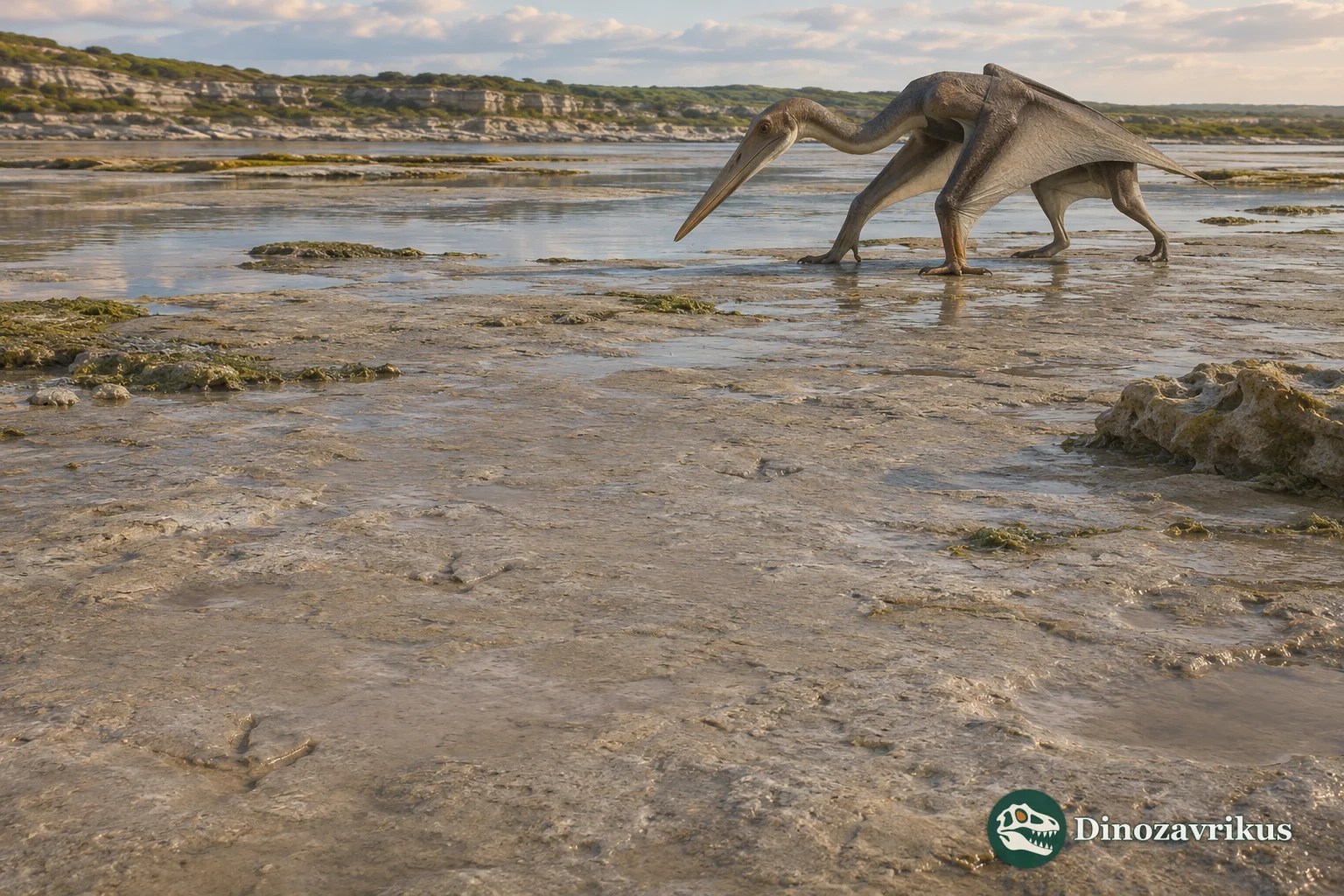
The track-bearing limestone was interpreted as having formed on intertidal to supratidal flats. Wet sediment can retain the outline of a limb, and burial can preserve it as the sediment hardens. That geological reading concerns the substrate and depositional setting. It does not show what the trackmaker ate, where it nested, or how often it returned.
The exact quarry source has been discussed but is not documented with equal certainty for every slab. The setting on the cover is therefore an artistic coastal reconstruction, not a photograph of the locality or an image of one named trackmaker. With trace fossils, a careful illustration can show the kind of surface that may preserve prints without inventing an animal whose bones are absent.
Frequently asked questions
Is Purbeckopus a genus known from a pterosaur skeleton?
No. It is an ichnotaxon, a name for a fossil trace. No bones of the animal are directly associated with the slabs.
How many principal slabs are known?
Three: DORCM G.6664, G.9481 and G.9482. They are separate surfaces, not parts of one complete trackway.
How large are the foot impressions?
The 1997 account gives pes lengths of about 187–225 mm. A wingspan near six metres is an inference, not a direct measurement.
Is a pterosaurian trackmaker certain?
Researchers have supported that interpretation from the print morphology, but a 2003 revision questioned it. The trackmaker has no associated skeleton.