

Pyrotherium was a large mammal of the Late Oligocene in South America. Its name, often translated as “fire beast”, reflects the volcanic character associated with some early fossil-bearing deposits; it does not mean that the animal lived beside active volcanoes. The best-known remains include incomplete skulls and jaws, tusk-like incisors, distinctive paired-ridge cheek teeth and scattered limb bones.
Two species are generally recognised: Patagonian P. romeroi and the smaller P. macfaddeni from Salla, Bolivia. Researchers have proposed different relationships for pyrotheres, and the often pictured trunk is not directly preserved. This profile is part of the ancient mammal catalogue, where its fossil record can be compared with other South American mammals without treating resemblance as proof of close ancestry.
Quick facts
| Scientific name | Pyrotherium Ameghino, 1889 |
|---|---|
| Recognised species | P. romeroi and P. macfaddeni |
| Group | Pyrotheria, an endemic South American mammal lineage |
| Age | Late Oligocene, Deseadan faunal interval |
| Fossil regions | Patagonia and Mendoza in Argentina; Salla in Bolivia |
| Best-known skull | ACM 3207, an incomplete skull of P. romeroi |
| Mass estimate | About 3.5 tonnes for P. romeroi in one tooth-length model |
| Major uncertainty | A trunk and exact phylogenetic placement are not established |
What can the fossils tell us?
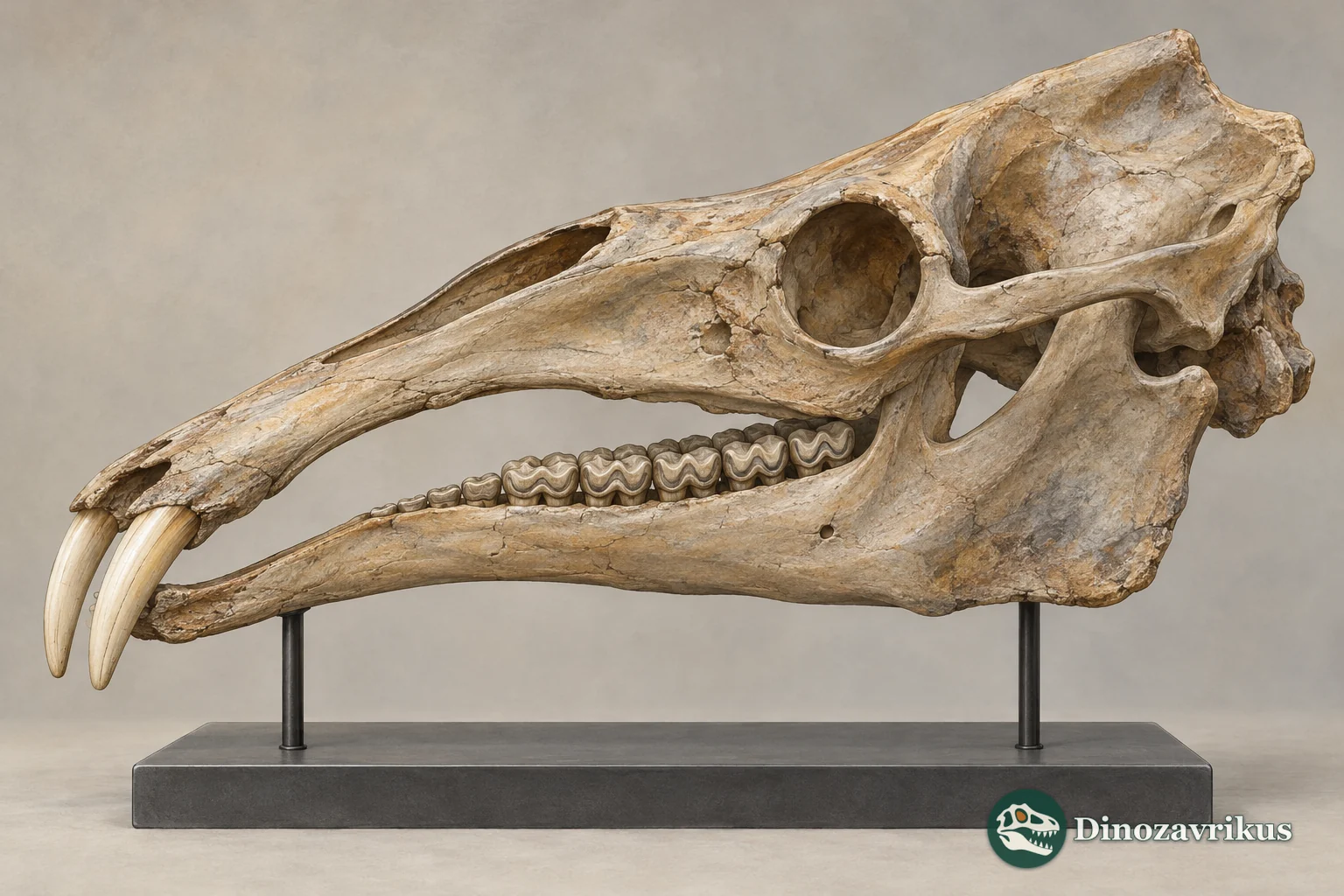
The best-known skull assigned to P. romeroi preserves important parts of the face and palate, but part of the skull roof and the lower jaw are missing. It permits comparisons of the rostrum, cheek teeth and ear region; it does not preserve a complete head outline or soft tissues.
The holotype of P. macfaddeni, YPM-VPPU 20693, is an upper jaw from Salla, Bolivia. Its cheek teeth are about two-thirds the linear dimensions of those of P. romeroi. Researchers also compare tooth details; the proportional difference is not a body-size measurement by itself.
Shockey and Anaya estimated about 750 kg for P. macfaddeni and about 3,500 kg for P. romeroi from first lower molar length. Models using tooth area produced larger values, which the authors regarded as inflated because Pyrotherium had unusually broad teeth.
A 2026 study compared mesowear angles in samples of P. romeroi and P. macfaddeni and proposed browsing for the former and mixed feeding for the latter. This is an interpretation of tooth wear, not preserved stomach contents or direct identification of the plants eaten.
A name from South American fossil beds
Florentino Ameghino established Pyrotherium in 1889 from material collected in Patagonia. The species P. romeroi honours Antonio Romero. Older publications sometimes printed the epithet as romeri, but recent treatments use romeroi. Early deposits associated with the genus helped define the Deseadan land-mammal interval, a classification built from recurring fossil assemblages rather than a single volcanic event.
The skull most often used to reconstruct the genus is ACM 3207, assigned to P. romeroi. It is more informative than isolated teeth, but still incomplete: part of the skull roof is absent and the lower jaw is fragmentary. Older drawings sometimes filled gaps through symmetry or comparison. Those reconstructions can be useful, but the restored outline should not be mistaken for preserved bone.
In 2004 Bruce Shockey and Federico Anaya named P. macfaddeni from material collected in the Salla beds of Bolivia. Its holotype, YPM-VPPU 20693 (formerly labelled PU 20693), is an upper jaw with a nearly complete cheek-tooth row. In 2017 Esperanza Cerdeño and Bárbara Vera described additional material from Quebrada Fiera in Mendoza, including associated portions of a skull and lower jaw. Some postcranial referrals were explicitly tentative because the comparative record is limited.
Two species and an uneven fossil record
Current reviews generally recognise P. romeroi and P. macfaddeni. Their records are not equivalent skeletons. Patagonian material includes skulls, jaws, isolated teeth and scattered limb bones; Salla adds upper jaws and the first described calcaneum, or heel bone, attributed to the genus. Comparisons must account for which anatomical parts are actually present in each sample.
Teeth of P. macfaddeni are about two-thirds the linear dimensions of corresponding cheek teeth in P. romeroi. This is a useful scale comparison between dental measurements, not a statement that the Bolivian animal was exactly two-thirds as long or heavy. Species recognition also considers tooth shape and other diagnostic details; size alone can be affected by age, individual variation and the position of a tooth in the jaw.
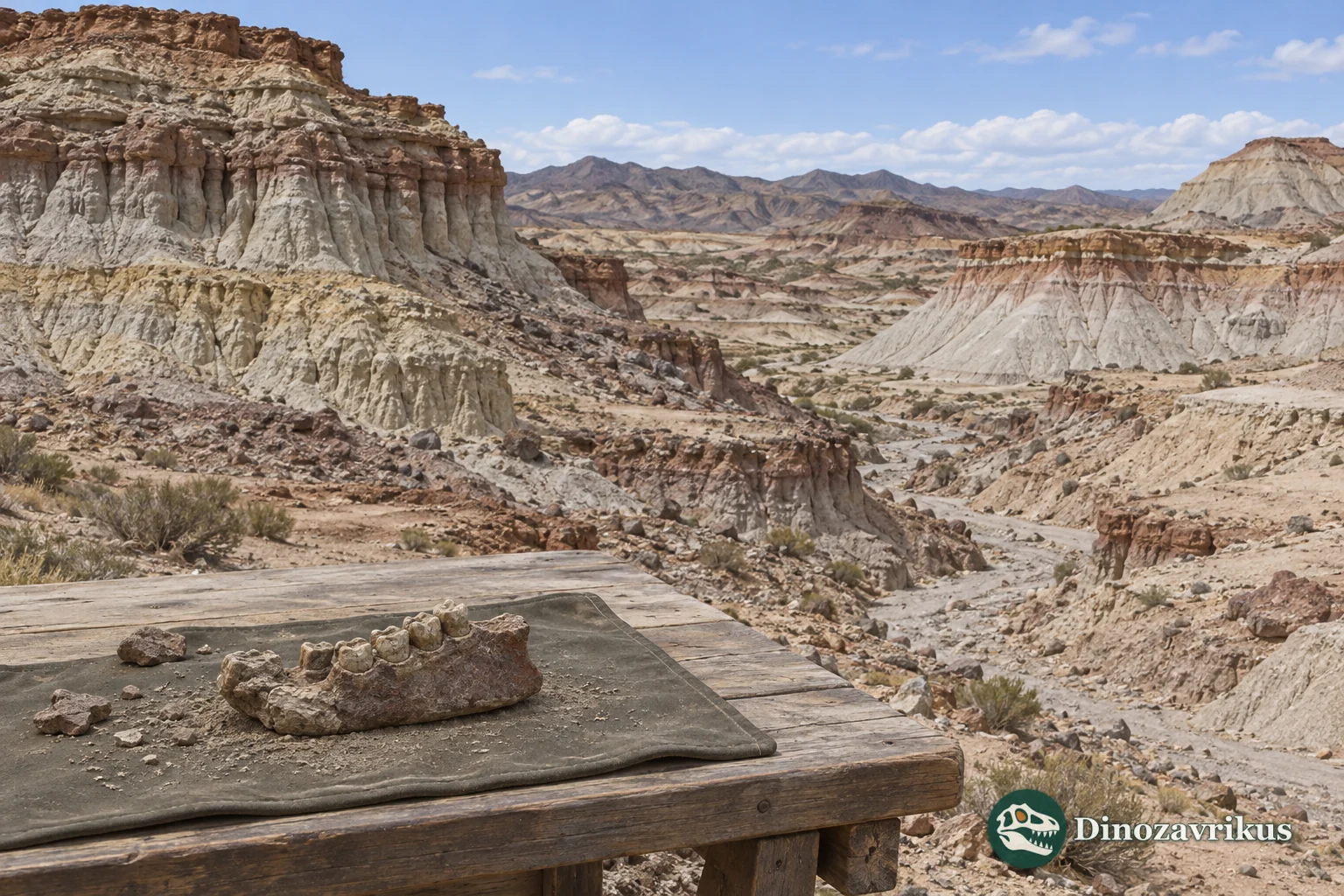
Salla deposits are dated and correlated using stratigraphy, magnetostratigraphy and volcanic ash layers. Estimates place the fauna broadly in the late Oligocene, approximately 28.5 to 24 million years ago, while older accounts for particular P. macfaddeni material used a narrower interval near 27 to 24 million years. These dates describe geological units and correlations; they are not direct measurements of the age of each museum tooth.
How large was Pyrotherium?
Body mass is estimated rather than measured. Shockey and Anaya used the length of the first lower molar in comparative equations and obtained values of about 750 kilograms for P. macfaddeni and about 3,500 kilograms for P. romeroi. A separate approach based on tooth area produced estimates near 1,500 and 6,600 kilograms. The authors considered the area-based values likely too high because the teeth were exceptionally broad.
These numbers show how method choice matters. An equation calibrated on many living mammals can give a useful range, but a specialised tooth shape may not scale like the average tooth in the comparison sample. The 3.5-tonne value is therefore one model’s estimate for P. romeroi, not a direct weighing or an exact consensus value. Fragmentary limb material provides additional comparisons, but it does not yet supply a complete skeleton whose proportions can be measured from head to tail.
The first known calcaneum attributed to P. macfaddeni adds information about the foot. Shockey and Anaya interpreted it as consistent with a plantigrade, weight-bearing animal and a graviportal style of locomotion. That is a functional hypothesis from one bone. It does not establish running speed, daily range, or the precise gait of both species.
Teeth, feeding and what wear can tell us
The cheek teeth of Pyrotherium have two prominent ridges and broad crowns, while the front incisors are enlarged and tusk-like. Their unusual form has prompted comparisons with several mammal groups. A 2020 study of enamel prisms documented microscopic structure; enamel anatomy can add characters for comparison, but it does not by itself resolve the animal’s entire family tree.
A 2026 mesowear study examined 25 specimens of P. romeroi and five of P. macfaddeni. It measured angles formed by wear facets and dentine valleys and interpreted the pattern as browsing in P. romeroi and mixed feeding in P. macfaddeni. Mesowear reflects how teeth were worn over time. It does not identify particular plant species, prove a season-by-season menu, or substitute for direct stomach contents, which are not known.
Where does it fit among mammals?
Pyrotheres are an endemic South American lineage of hoofed mammals. Their exact relationships within the continent’s diverse fossil ungulates remain disputed. Guillaume Billet’s 2009 cranial analysis placed Pyrotherium within Notoungulata when the problematic taxon Proticia was excluded, with similarities to Notostylops contributing to the result. Other analyses have recovered different arrangements among South American ungulates. A cladogram is the outcome of selected characters, specimens and assumptions, not a direct fossil observation.
The resemblance between its enlarged incisors and the tusks of elephants has often encouraged an elephant-like reconstruction. But similar working shapes can evolve in distantly related mammals. The available skull does not preserve a proboscis, and the snout region is incomplete. A trunk remains a possibility in artistic depictions, not an established anatomical fact. The name “fire beast” and its large size likewise tell us nothing about close relationship to elephants.
Building a careful reconstruction
Fossils constrain the teeth, parts of the skull and jaw, the position of some limb joints and the dimensions of a few elements. They leave the colour, hair, external ears, exact outline of the body, soft-tissue snout and any trunk uncertain. A full-body image must interpolate a lot of anatomy between isolated or partial bones. Captions should distinguish those artistic decisions from features visible on the specimens.
Pyrotherium is best understood as a striking but incompletely known Late Oligocene mammal. Its two recognised species differ in size and in the material available for study; tooth measurements support model-based mass estimates, and wear surfaces provide a dietary hypothesis. The skull and evolutionary placement remain incomplete or debated. Those limits do not make the fossils uninformative: they show exactly which parts of the story are strongest and which still depend on interpretation.
Frequently asked questions
Was Pyrotherium related to elephants?
An elephant-like trunk is a reconstruction, not a preserved feature. Analyses have proposed different relationships among South American fossil ungulates, and the resemblance of the incisors does not prove close ancestry.
How many Pyrotherium species are recognised?
Recent treatments generally recognise P. romeroi from Argentina and the smaller P. macfaddeni from Bolivia.
How heavy was Pyrotherium?
One tooth-length model estimated about 3,500 kg for P. romeroi and 750 kg for P. macfaddeni. These are model-based estimates; another tooth-area method produced higher values.
What did Pyrotherium eat?
A 2026 mesowear analysis proposed browsing for P. romeroi and mixed feeding for P. macfaddeni. The evidence is tooth wear, not preserved stomach contents or identified meals.