

Qantas was a temnospondyl amphibian from Early Triassic eastern Europe. The type species, Qantas samarensis, is named from the right half of a lower jaw found at Kamennyi Dol. Small teeth on bones inside the jaw preserve features inherited from earlier temnospondyls.
Quick facts
| Group | Temnospondyls, trematosauroids, qantasids |
|---|---|
| Age | Early Triassic, Olenekian |
| Region | Europe, Russia (Samara Oblast and the Obshchy Syrt) |
| Type species | Qantas samarensis |
| Scientific name | Qantas |
| Diet | Exact prey is unknown |
What can the fossils tell us?
The holotype, PIN 4419/1, is an incomplete right lower jaw. A left premaxilla comes from the same locality.
The jaw combines older tooth features with similarities to benthosuchids and trematosaurids. Together these help place Qantas among early trematosauroids.
The fossils show how the teeth were arranged. They do not establish its body length or the prey it regularly took.
A find in the Samara region
In 1995 an expedition involving the Samara regional museum and the Palaeontological Institute uncovered an incomplete jaw at Kamennyi Dol in Borsky District. Igor Novikov described the genus and species from it in 2012. The type specimen, PIN 4419/1, comes from the upper part of the Rybinskian Horizon, in the early Olenekian. A premaxilla, PIN 4419/2, comes from the same locality, while other sites in the Obshchy Syrt region have yielded additional pieces of jaw.
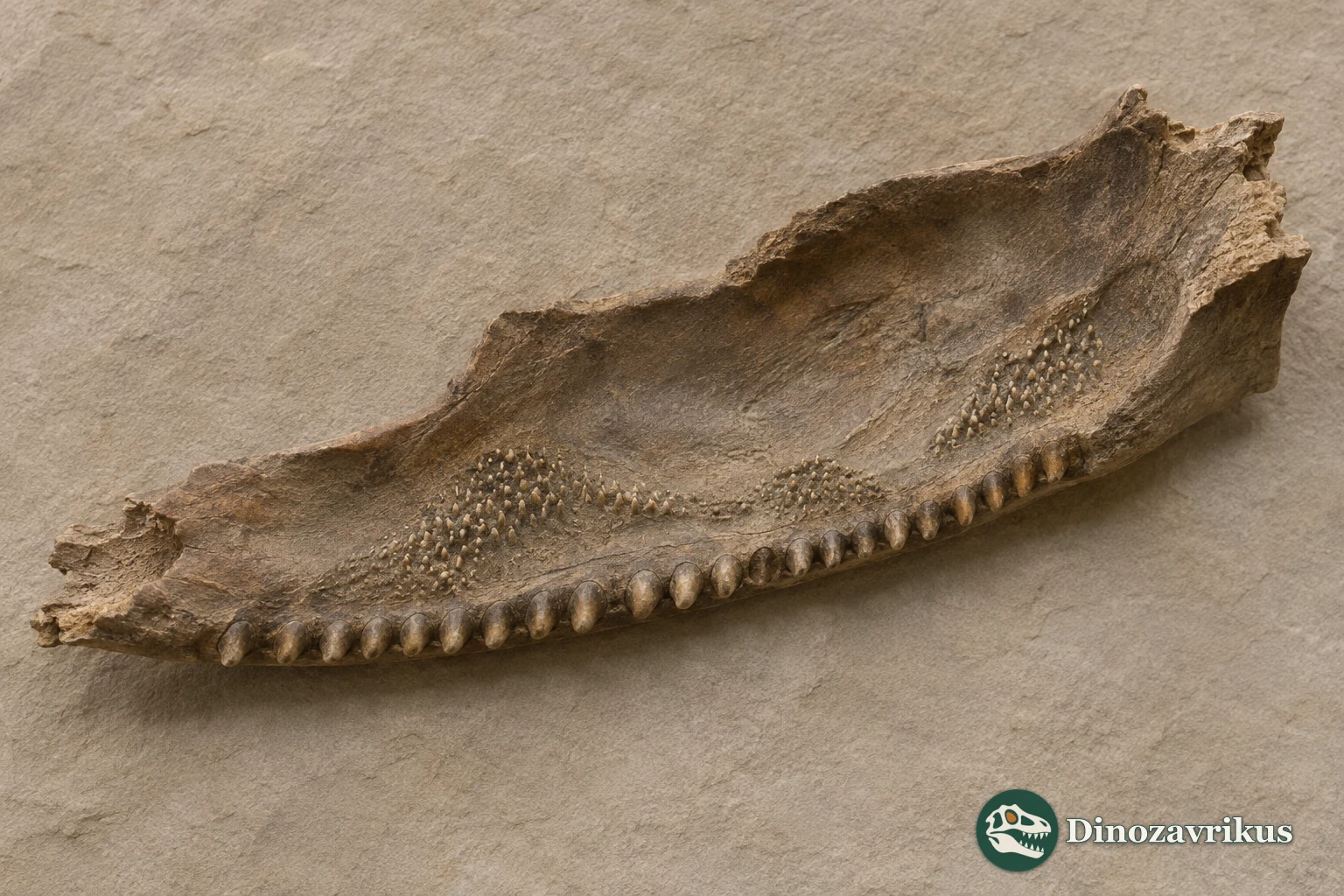
Teeth along the inside of the jaw
Inside the main tooth row sat three jaw bones known as coronoids. All three preserve small teeth and rough patches of still finer toothlets. The marginal teeth have rounded bases, an unusual feature for Triassic temnospondyls. That detail helps identify fossils, but it does not by itself reveal the size or kind of prey the animal caught.
Comparisons with other early branches
The lower jaw combines features associated with benthosuchids and trematosaurids with traits inherited from earlier temnospondyls. Benthosuchus illustrates one of the other Early Triassic lineages used in those comparisons. Subsequent studies treat Qantas as the type genus of Qantasidae. More complete skull material would let researchers test comparisons that currently depend mainly on jaws.
Frequently asked questions
Which fossil was used to name Qantas?
It was named from an incomplete right lower jaw, specimen PIN 4419/1, from Kamennyi Dol.
When did Qantas live?
It lived in the Early Triassic. The type specimen comes from the early part of the Olenekian stage.
What is distinctive about its teeth?
Its marginal teeth have rounded bases. Small teeth and toothlets are preserved on all three coronoid bones along the inside of the jaw.
Which group does Qantas belong to?
It is placed among the trematosauroids, a branch of temnospondyl amphibians. It is the type genus of Qantasidae.