

Rebbachisaurus was a plant-eating diplodocoid sauropod from the early Late Cretaceous of Morocco. Its partial skeleton includes a particularly tall spine on one back vertebra. That striking bone tells us more about the architecture of the backbone than it does about the total size of the animal.
Quick facts
| Group | Sauropods, rebbachisaurids (Rebbachisauridae) |
|---|---|
| Age | Late Cretaceous (Cenomanian) |
| Region | Africa (southeastern Morocco) |
| Diet | Herbivorous |
| Type species | Rebbachisaurus garasbae |
| Type material | Parts of the spine, shoulder, forelimb and pelvis |
| Formation | Gara Sbaa Formation, Kem Kem Group |
What can the fossils tell us?
The material includes sections of the backbone, a shoulder blade, a humerus and an ischium. Some vertebrae were found still in articulation.
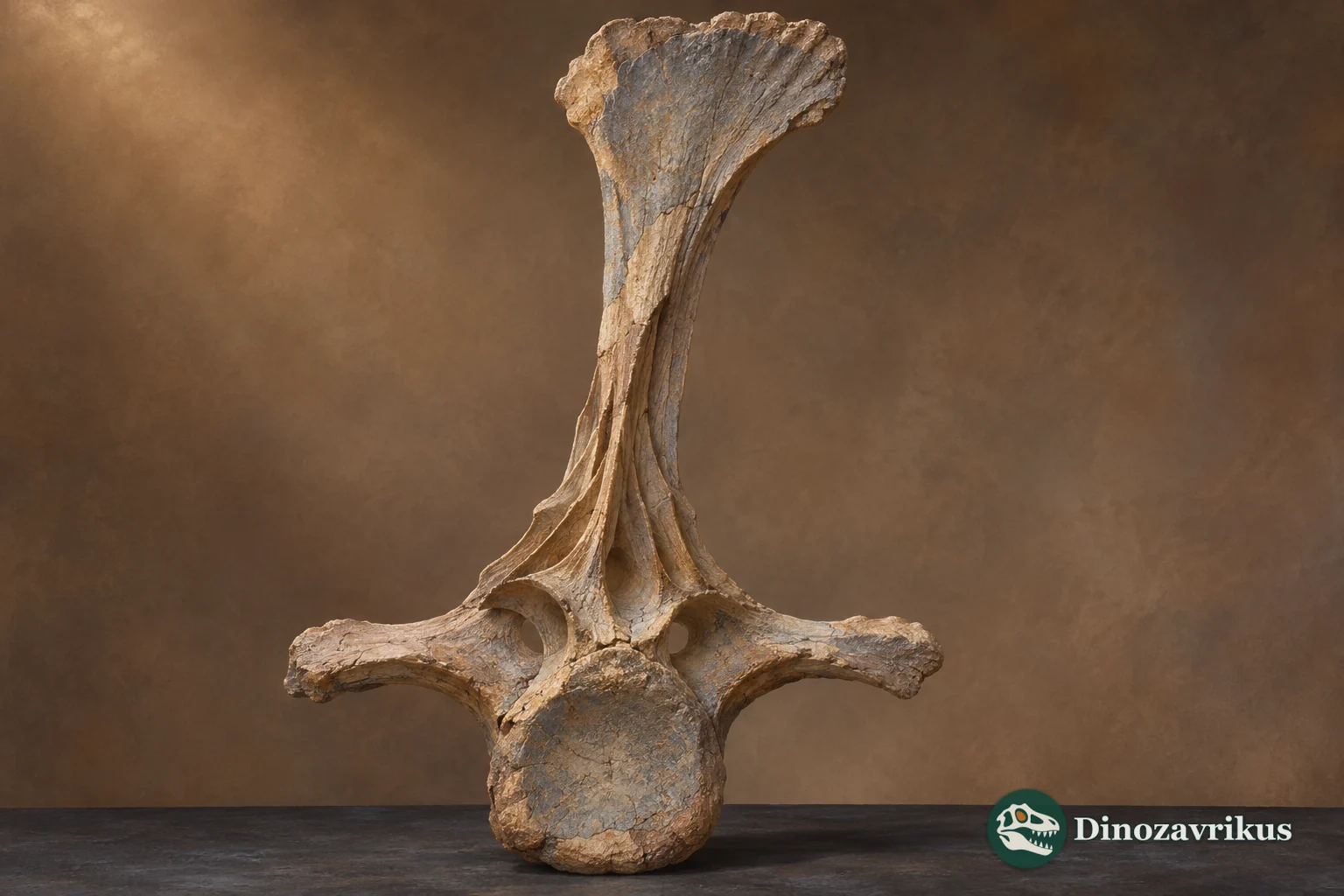
The most complete back vertebra is about 1.45 metres high. It preserves thin bony laminae between the prominent processes.
Humerus length, its cross-sectional area and the dimensions of the vertebral bodies yielded mass estimates of about 8 to 12 tonnes.
A partial skeleton from Gara Sbaa
René Lavocat described Rebbachisaurus garasbae in 1954. The remains were collected near Gara Sbaa in southeastern Morocco and include parts of the backbone, a scapula, a humerus and an ischium. The shoulder blade and a large back vertebra received the most attention in the early descriptions.
Jeffrey Wilson and Ronan Allain published a fuller description in 2015. They fitted many of the small fragments together and used computed tomography to study the most complete vertebra. The prepared material revealed distinctive details in the back and tail.
How a tall vertebra was built
The best-preserved back vertebra measures about 1.45 metres in height. Much of that height comes from the neural spine above the spinal canal. Thin plates of bone, or laminae, link the processes. Pits and spaces in the vertebra are part of an architecture widespread among sauropods.
The authors inferred that the joints would have restricted rotation between neighbouring vertebrae and resisted forces directed down through their side processes. The bony outline alone leaves the thickness of the overlying soft tissue and the contour of the animal’s living back uncertain.
Estimating mass and comparing relatives
The shoulder and spine provided different ways to estimate body mass. Calculations using the humerus and vertebral bodies yielded values of about 8 to 12 tonnes for the type individual. The range reflects the methods and comparative animals used.
The revised anatomy supports a close relationship with Nigersaurus and the Spanish sauropod Demandasaurus. Its placement among sauropods supports a plant diet. The type skeleton lacks a skull, leaving the precise shape of the mouth and its favoured plants unresolved.
Frequently asked questions
Where was Rebbachisaurus found?
The type skeleton comes from the Gara Sbaa area of southeastern Morocco, in the Kem Kem Group.
How tall is its largest preserved vertebra?
The most complete dorsal vertebra measures about 1.45 metres from its base to the top of the spine.
What was the estimated mass of the type individual?
The humerus and vertebral bodies yielded a range of approximately 8 to 12 tonnes.
Do we know the shape of its head?
The skull is missing from the type skeleton. Artists can draw on comparisons with related sauropods.