
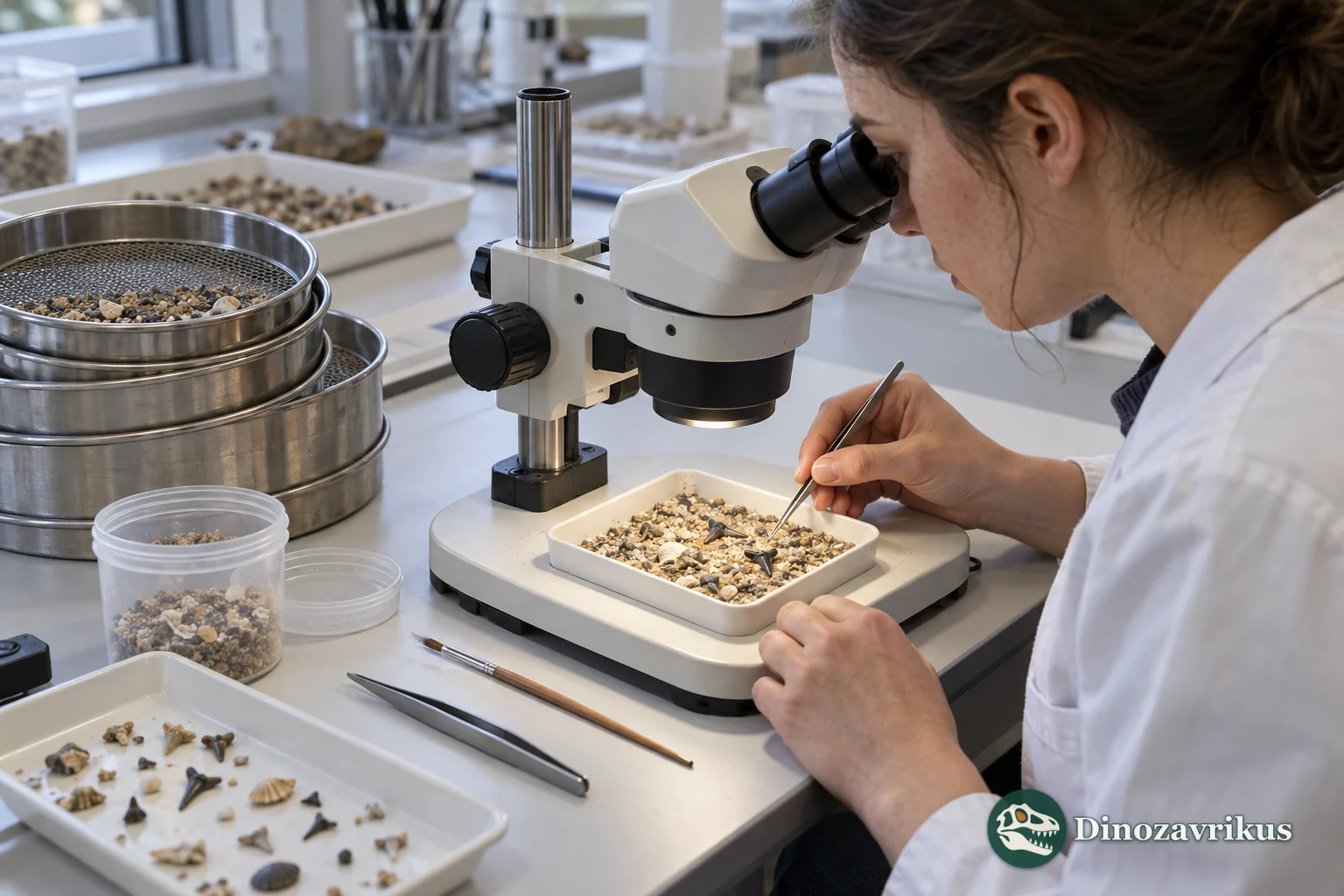
Some fossil-bearing deposits contain abundant remains too small to notice during ordinary excavation. A handful of sediment may include isolated teeth, fish scales, tiny bones, shell fragments and other durable pieces. Recovering them requires processing a larger amount of sediment and then examining the concentrated residue under magnification.
This work can reveal animals that are poorly represented by large skeletons, but it does not provide a neutral census of everything that once lived there. The original sample, the way it breaks apart and the mesh used to retain particles all shape the result.
Collect a sample with geological context
Before processing, researchers record where a sample came from, its stratigraphic position, approximate volume and relation to other material. Separate samples from different beds should remain separate through preparation. Otherwise, a small tooth recovered in the laboratory may be difficult to connect to the layer that gives it geological meaning.
The amount collected depends on the deposit and the research question. A productive bonebed, a sparse marine layer and a fine-grained channel deposit may require different sample sizes. More sediment can improve the chance of finding rare remains, but it also increases processing time and does not remove the need for careful recording.
Disaggregate the sediment without destroying the fossils
The first laboratory step is to help the sediment separate into particles. Loose sand may need little more than soaking and gentle agitation. Clay-rich material, cemented rock and mineral-rich matrix behave differently. Specialists select a treatment after considering both the sediment and the fossils they hope to preserve.
Chemical preparation is not a universal shortcut. A reagent that breaks down one matrix can dissolve shells or alter delicate bone in another. For this reason, laboratories test small amounts, control the process and avoid assuming that one recipe suits every formation. The aim is to free fossil particles while retaining their identifying surfaces.
Wash and screen the disaggregated sample
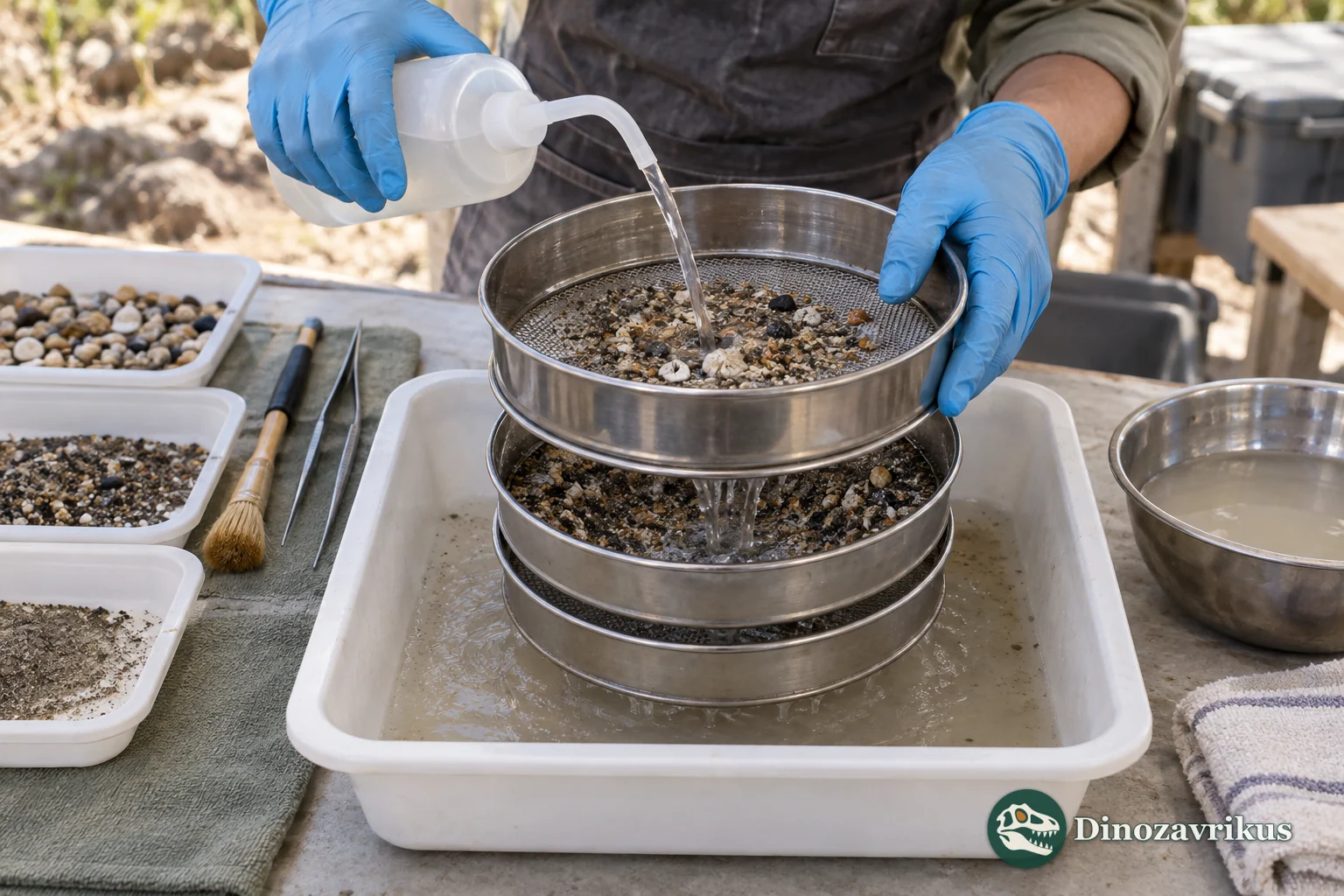
Screen-washing moves water and loose sediment through one or more meshes, retaining particles larger than each opening. Some protocols use nested screens so material can be separated into size fractions. Mesh sizes are chosen for the research goal and the expected fossils; a coarse screen speeds work but can lose the smallest teeth and bones.
Water flow and handling also matter. Strong agitation may break fragile remains, while insufficient washing leaves clay or fine sediment coating the residue. The washed concentrate is dried and labelled by sample before sorting. In marine or carbonate material, laboratories may choose other preparation methods because water washing is not suitable for every matrix or fossil type.
Sort the residue under magnification
A technician spreads small portions of the dried residue in a sorting tray and examines them under a stereomicroscope. Fossil teeth and bones are selected from mineral grains, shell fragments and other particles, then stored with the sample number and size fraction. Recognising a tiny element can require comparison with reference collections and attention to breakage, wear and mineral staining.
The picked fossils are identified, photographed and measured as needed. Some remain fragmentary or uncertain. A smooth tooth may preserve a useful shape, but it does not by itself identify the entire animal, its abundance or its exact place in an ecosystem.
Interpret the sample and its limits
Screened residues can extend the known size range of a fossil assemblage and reveal taxa represented by isolated elements. Results are strongest when sampling locations, processed volumes, mesh sizes and preparation steps are reported. Those details let other researchers judge how comparable two samples are.
Counts require care. One animal may contribute many teeth, remains may be transported or reworked, and different tissues survive processing at different rates. A concentration with many teeth therefore does not translate directly into the same number of individuals. For a broader overview of methods and evidence, see how palaeontologists study fossils.
Microfossil processing is valuable because it makes small evidence visible at a scale that field collection alone often misses. Its conclusions remain tied to a chain of choices, from the original sample through disaggregation, screening and identification. Keeping that chain documented makes the tiny finds scientifically useful.
Frequently asked questions
What kinds of fossils can screen-washing recover?
Depending on the deposit, researchers may find small teeth, bones, scales, shell fragments and other durable remains. The recovered mix depends on preservation, sample location and mesh size.
Why does the mesh size matter?
Particles smaller than a screen opening can pass through it. A coarse mesh may be faster to process but can miss the smallest fossils, so the chosen sizes should match the research question.
Can every rock sample be processed with water?
No. Loose sediment, clay-rich deposits and cemented or carbonate matrices behave differently. Specialists choose a method that separates the matrix without dissolving or damaging the fossils.
Do many isolated teeth mean that many animals lived there?
Not by themselves. One animal can contribute many teeth, remains can be transported or reworked, and preservation differs among tissues. Counts must be interpreted with sampling and geological context.