

Remiornis was a large flightless bird that lived in what is now France during the Late Paleocene. It is studied from scattered bones, particularly remains of the legs. A later discovery of a neck vertebra at Rivecourt added information about the bird’s anatomy, although that specimen was assigned only at genus level.
Quick facts
| Group | Large flightless palaeognaths |
|---|---|
| Localities | Northern France |
| Age | Late Paleocene |
| Main material | Leg bones; a tentatively referred vertebra |
| Named by | Victor Lemoine, 1881 |
What can the fossils tell us?
Material from the Reims region includes tibiotarsi and tarsometatarsi. Their robust proportions and joint anatomy allow comparison with other flightless birds.
The incomplete cervical vertebra MVriv.PP0718 was referred to Remiornis through a combination of characters. It was not confidently identified as the genus’s single named species.
The Rivecourt sediments formed near the end of the Paleocene. The absence of secure younger specimens does not establish the exact moment of extinction.
A bird from the Reims region
Victor Lemoine named Remiornis heberti in 1881 from remains in Paleocene deposits around Reims. The first discoveries were associated with Cernay; material from Berru later expanded knowledge of the bird. Larry Martin reassessed its anatomy and systematic position in 1992.
Among the described remains, the lower-leg and foot bones are particularly important. The tarsometatarsus was robust, and the distal tibiotarsus lacked an ossified supratendinal bridge, a bony arch over a tendon passage. Such features assist comparison with other palaeognaths. Membership of this broad group, however, does not establish Remiornis as a direct ancestor of living ostriches.
A vertebra damaged by quarry machinery
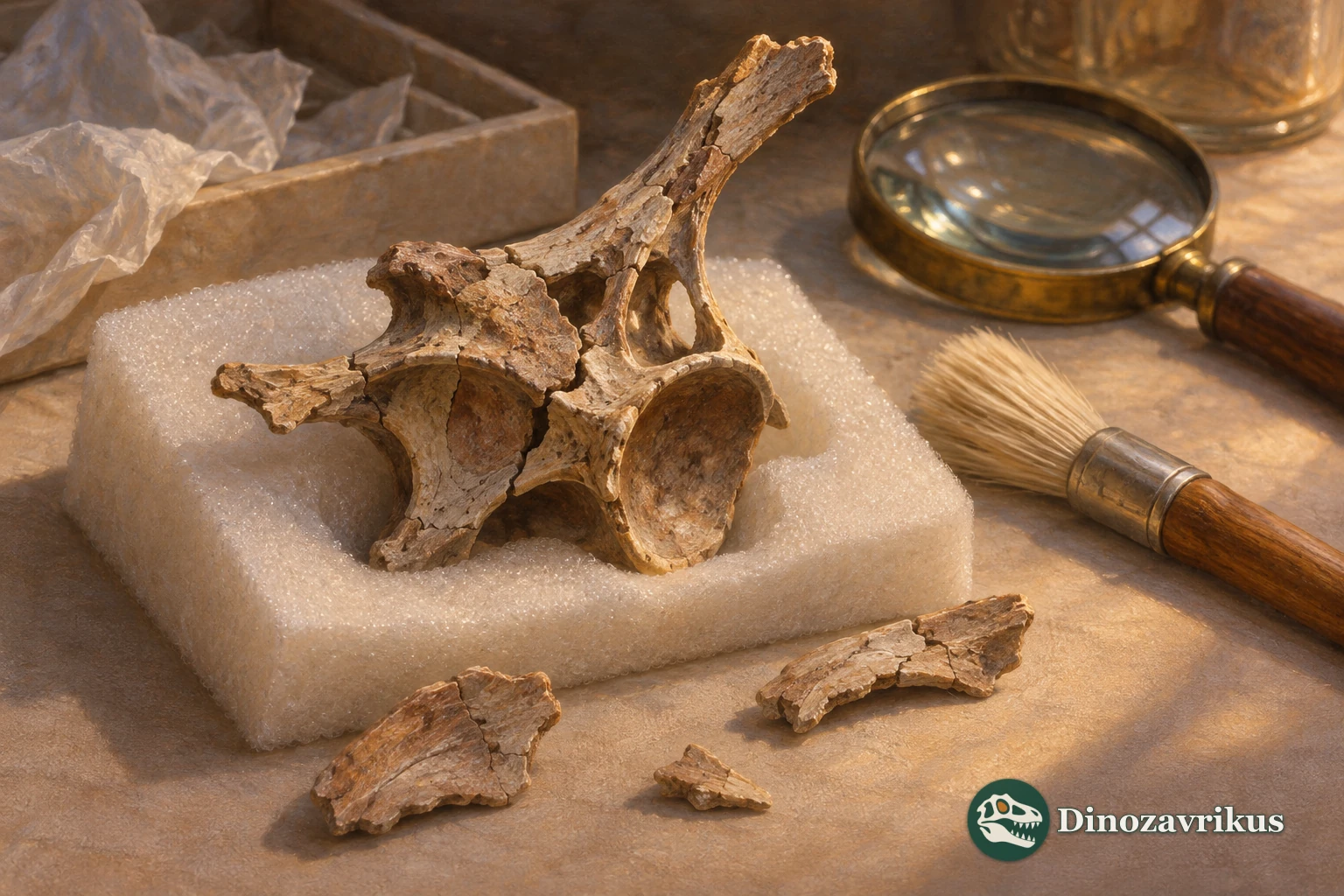
At Petit-Pâtis near Rivecourt, southwest of Compiègne, Gaël de Ploëg found an incomplete vertebra from the rear of a large bird’s neck. Quarry machinery had damaged it before its discovery. Researchers assembled several fragments, but some parts could not be restored. The specimen, MVriv.PP0718, is held at the Musée Vivenel in Compiègne.
The centrum measures approximately 70 millimetres along its ventral surface. It has saddle-shaped articular surfaces, a deep longitudinal groove on the underside and a large opening associated with pneumaticity of the bone. Compared with Gastornis vertebrae, it is more elongated and less robust.
The authors referred the specimen to Remiornis sp. This means an unspecified species of Remiornis, not a confident identification as Remiornis heberti. Neck vertebrae of the genus had not previously been known, so the comparison also relied on other parts of the vertebral column and broader anatomical similarities.
The Rivecourt environment and Gastornis
The bones come from the upper part of the Sables de Bracheux Formation, in lignite-bearing sands deposited in river and river-mouth settings. The Rivecourt fauna is dated to approximately 56–57 million years ago. Alongside birds, the site preserves plants, fish, amphibians, turtles, crocodilians and mammals.
A separate vertebral fragment belonging to Gastornis was discovered at the same locality. It represents another large bird and a different specimen. Their presence in one fauna does not justify combining the bones of the two genera or transferring dietary evidence from Gastornis to Remiornis.
Size, diet and the last known record
Remiornis was a large terrestrial bird, but precise standing height and body mass have not been established from the available material. A vertebra comparable in size to one from an ostrich does not automatically imply the same overall height: the proportions of the neck, trunk and legs could differ.
Predominantly plant-based feeding can be proposed by analogy with other large palaeognaths. For Remiornis itself, this is not direct evidence from stomach contents or chemical analysis of its bones. No secure Eocene occurrence of the genus is currently known, but the youngest discovered fossil and the actual extinction event are different things.
Frequently asked questions
Was Remiornis a kind of Gastornis?
No. They are treated as separate genera of large birds. Rivecourt contains distinct remains of both, differing in anatomical features.
Why was the Rivecourt fossil not identified as heberti?
The material does not permit a confident species-level determination. The authors restricted their identification to the genus and left the species unspecified.
Does seven centimetres describe the whole bird?
No. Approximately 70 millimetres is the measured length of the centrum of one incomplete neck vertebra. It is neither the length of the neck nor the bird’s standing height.
Did Remiornis disappear exactly at the Paleocene–Eocene boundary?
That precision is not demonstrated. No secure Eocene fossils have been assigned to the genus, but gaps in the record prevent its extinction from being dated solely by the youngest known specimen.