

Restes was a lizard from late Paleocene Wyoming. Its frontal bones preserve small plates that once formed in the skin. Several parts of one fragmented skull remained hidden in rock until researchers examined the block with CT scans.
Quick facts
| Group | Anguimorphs (Anguimorpha), relatives of Xenosaurus |
|---|---|
| Age | Late Paleocene |
| Region | North America, United States, Wyoming |
| Type species | Restes rugosus |
| Scientific name | Restes |
| Diet | No direct evidence |
What can the fossils tell us?
The type of Restes rugosus is a partial maxilla from Princeton Quarry. YPM PU 14640 preserves many more skull bones, separated from one another.
The two frontals are fused. Flattened osteoderms cover their outer surface, providing characters to compare with other anguimorph lizards.
Several Eocene fossils formerly assigned to Restes have been identified as other lizards or remain uncertain.
A species that changed genus
Charles Gilmore named Exostinus rugosus in 1942 from PU 14559, a fragment of the right maxilla found at Princeton Quarry in the Polecat Bench area. Jacques Gauthier erected Restes for this species in 1982. The profile of Exostinus shows the diversity of bony plates among related fossil lizards.
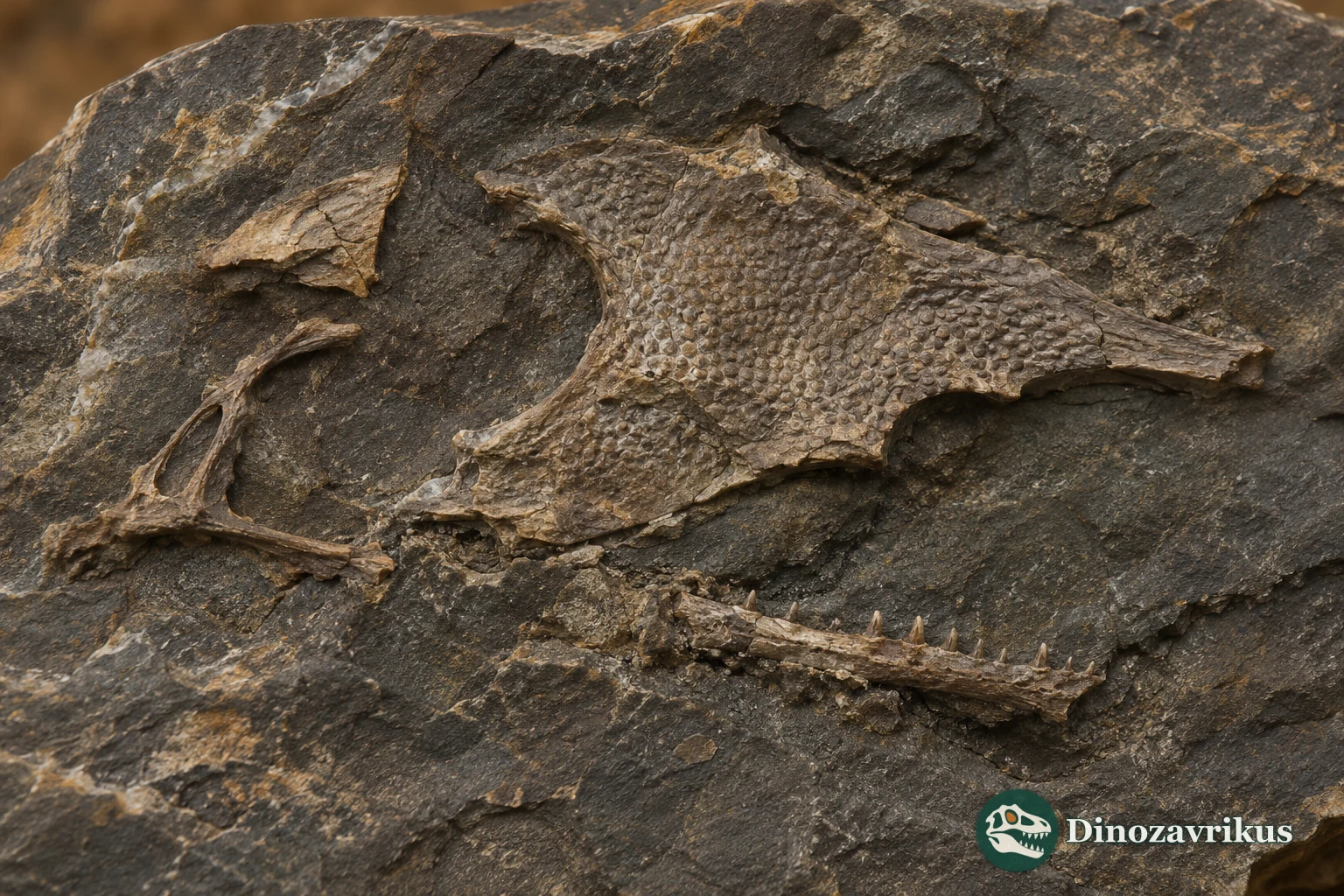
Bones beneath the surface
The skull bones in YPM PU 14640 are disarticulated. CT scans showed that more material was present inside the block than exposure alone suggested. Researchers could examine parts of the orbit and tooth-bearing bones along with the skull roof. Flattened osteoderms cover the fused frontals. The combined skull and jaw characters provide the basis for comparisons.
Its place among lizards
Restes is commonly recovered on the lineage leading to living knob-scaled lizards, the genus Xenosaurus. Its precise position relative to some species of Exostinus varies with the analysis. The osteoderms are useful comparative material but leave the exact skin pattern and habits unresolved.
Why the secure fossil range is shorter
The Princeton fossils come from late Paleocene zone Ti-5a. Published material from site SC-188 belongs to zone Cf-2. A revision reassigned several early Eocene fossils to the shinisaur lineage. A piece of snout once compared with Restes probably belongs to the iguanian Parasauromalus.
Frequently asked questions
Where was the holotype found?
The upper jaw fragment comes from Princeton Quarry in Wyoming, United States.
What covered the head?
The frontal bones carry flattened osteoderms, small bony elements that formed in the skin.
Why scan the block?
The scans show the outline and position of bones still enclosed by rock without removing the material around them.
Is Restes known from the Cretaceous?
The securely attributed fossils are late Paleocene. Older relatives do not extend the range of Restes itself.