

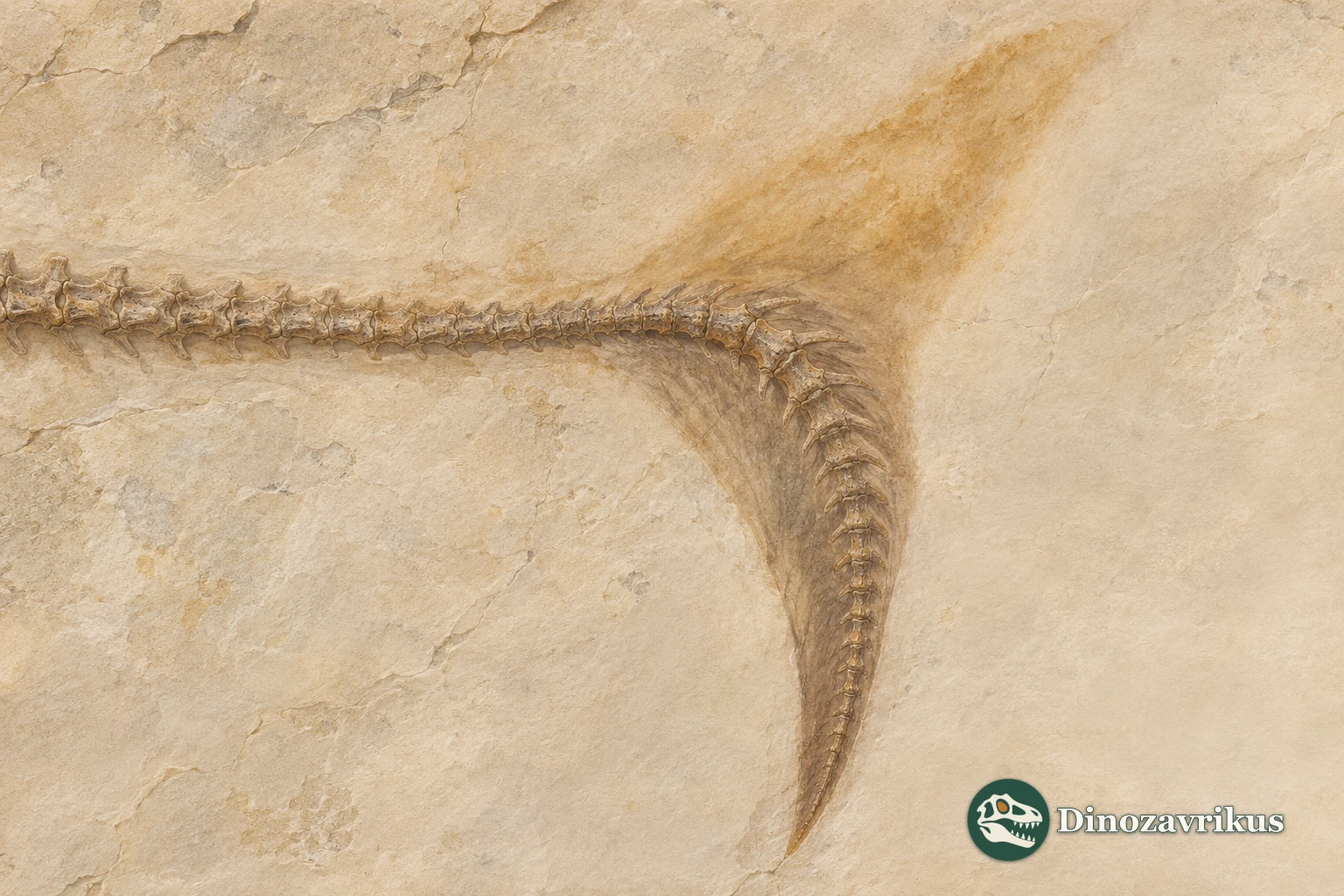
Rhacheosaurus gracilis was a small marine crocodylomorph from the Late Jurassic of Bavaria. A limestone slab preserves a blurred soft-tissue outline around the bend in its tail. The trace reveals an upper lobe that the vertebrae alone could not show.
Quick facts
| Species | Rhacheosaurus gracilis |
|---|---|
| Family | Metriorhynchidae |
| Age | Early Tithonian, Late Jurassic |
| Type locality | Daiting, Bavaria, Mörnsheim Formation |
| Skeleton with a tail outline | NHMUK PV R 3948 |
| Measured length of that skeleton | 1.57 m |
What can the fossils tell us?
The backbone turned down into the lower lobe. A blurred impression helps identify the upper lobe, while its thickness is unknown.
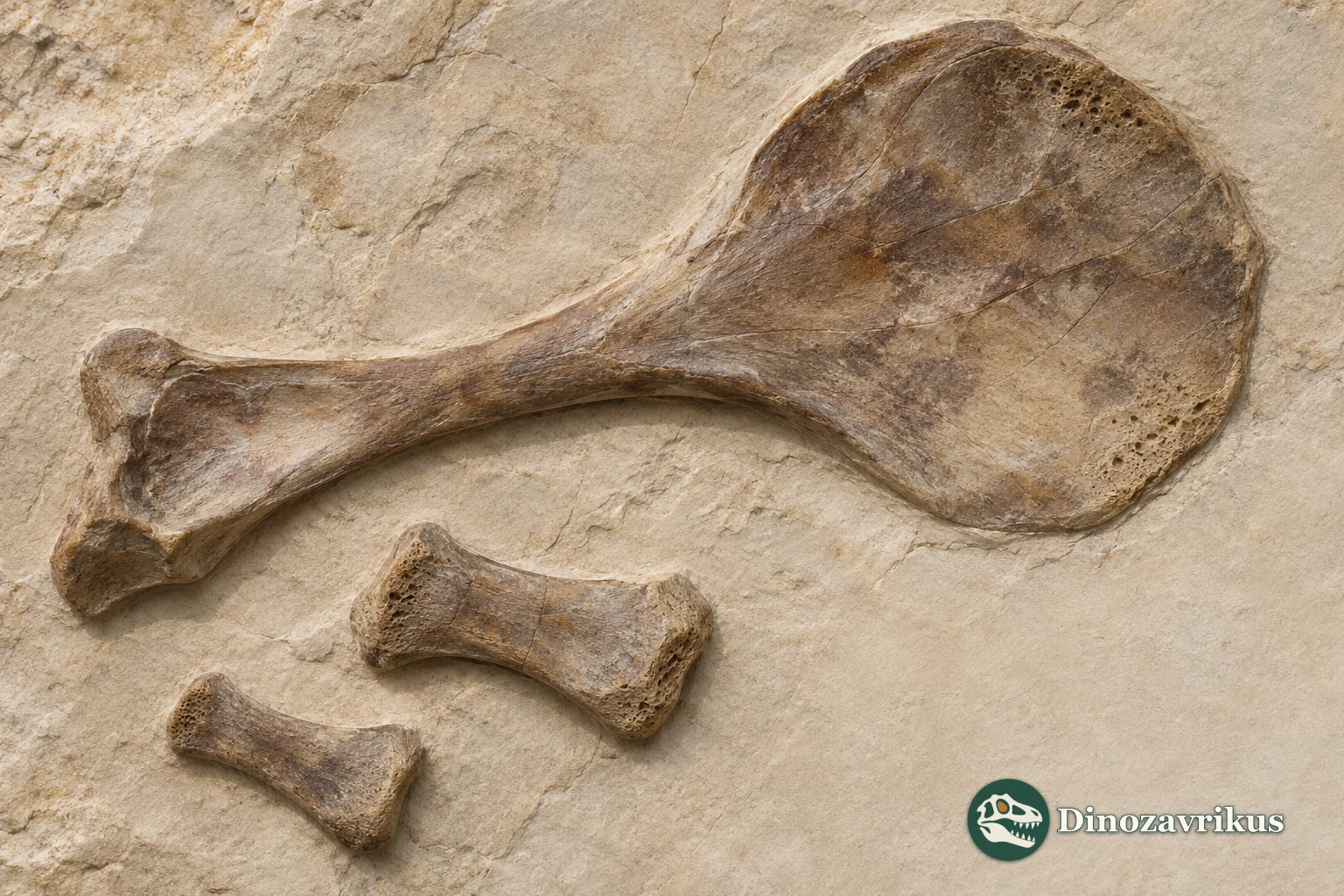
The right shoulder bone constricts where the shaft meets the expanded head. Some of the bone is missing, which leaves the shape of its opening uncertain.
The London skeleton measures 157 cm. That measurement gives the size of an individual and leaves the species maximum open.
The Daiting type and a more complete skeleton
Hermann von Meyer named the species in 1831 from material found at Daiting, including a vertebral column, limbs and limb girdles. The original fossil was lost. Casts AMNH FR 4804 and NHM R.3961 still preserve parts of its anatomy. Ammonites of the Hybonoticeras hybonotum zone place the type beds in the early Tithonian.
NHMUK PV R 3948 preserves much more of the animal. Its skull was removed from the slab and survived in three dimensions. The skeleton measures 157 cm and the skull is 29 cm long. The species was historically placed in Geosaurus, before revisions returned it to Rhacheosaurus.
How the upper lobe was preserved
At the end of the tail the vertebrae curve downwards. Above this bend, the limestone preserves a diffuse trace of the upper lobe. The two structures together show a vertical, two-lobed tail fin, with bones supporting the lower part.
A vertical tail fin fits the side-to-side motion inferred for swimming metriorhynchids. The faint outline on the slab helps constrain its shape. Its colour and the way it flexed in water remain unknown.
The shoulder and its relatives
The right coracoid formed part of the shoulder girdle. In the London skeleton the shaft narrows considerably where it joins the head. Several species of Cricosaurus retain a thicker shaft, though one has a similarly slender form.
Modern classifications place both genera in Rhacheosaurini, a group within Metriorhynchidae. The narrow snout and small teeth suit relatively small prey. Those traits alone give little information about which animals it regularly caught.
Frequently asked questions
Does the original fossil still exist?
The type is lost. Two surviving casts preserve details of the vertebral column and hind limbs.
What evidence shows the upper tail lobe?
A soft-tissue outline above the bend of the tail in the London skeleton.
How large is the London skeleton?
NHMUK PV R 3948 measures 157 cm in total, with a 29 cm skull.
What name was formerly used for the species?
It was often called Geosaurus gracilis. Modern revisions use the original name Rhacheosaurus gracilis.