

Rhinesuchoides was a Permian temnospondyl amphibian from South Africa. It had two parallel rows of teeth on each ectopterygoid, a bone along the side of the palate. This feature and details at the back of the skull helped unite two species from different levels of the Karoo Basin within one genus.
Quick facts
| Group | Temnospondyls, rhinesuchids |
|---|---|
| Age | Middle and Late Permian |
| Region | Africa, South Africa (Karoo Basin) |
| Type species | Rhinesuchoides tenuiceps |
| Scientific name | Rhinesuchoides |
| Diet | Exact prey is unknown |
What can the fossils tell us?
The holotype of the type species is held at the Field Museum. The skull of the second species came from younger rocks near Graaff-Reinet.
The two species share details of the palate teeth and the position of the jaw joint. That combination supports putting their skulls in the same genus.
The skulls establish the shape of the head. They give no secure estimate of overall body length or record of individual prey species.
The skull from Stinkfontein
Everett Olson and Robert Broom described the type species, Rhinesuchoides tenuiceps, in 1937. Its holotype skull, FMNH UC 1519, was found at Stinkfontein farm in the Western Cape. The locality lies in the Tapinocephalus Assemblage Zone of the Middle Permian. The skull was originally associated with part of the left lower jaw, which was considered missing when the material was revised in 2017.
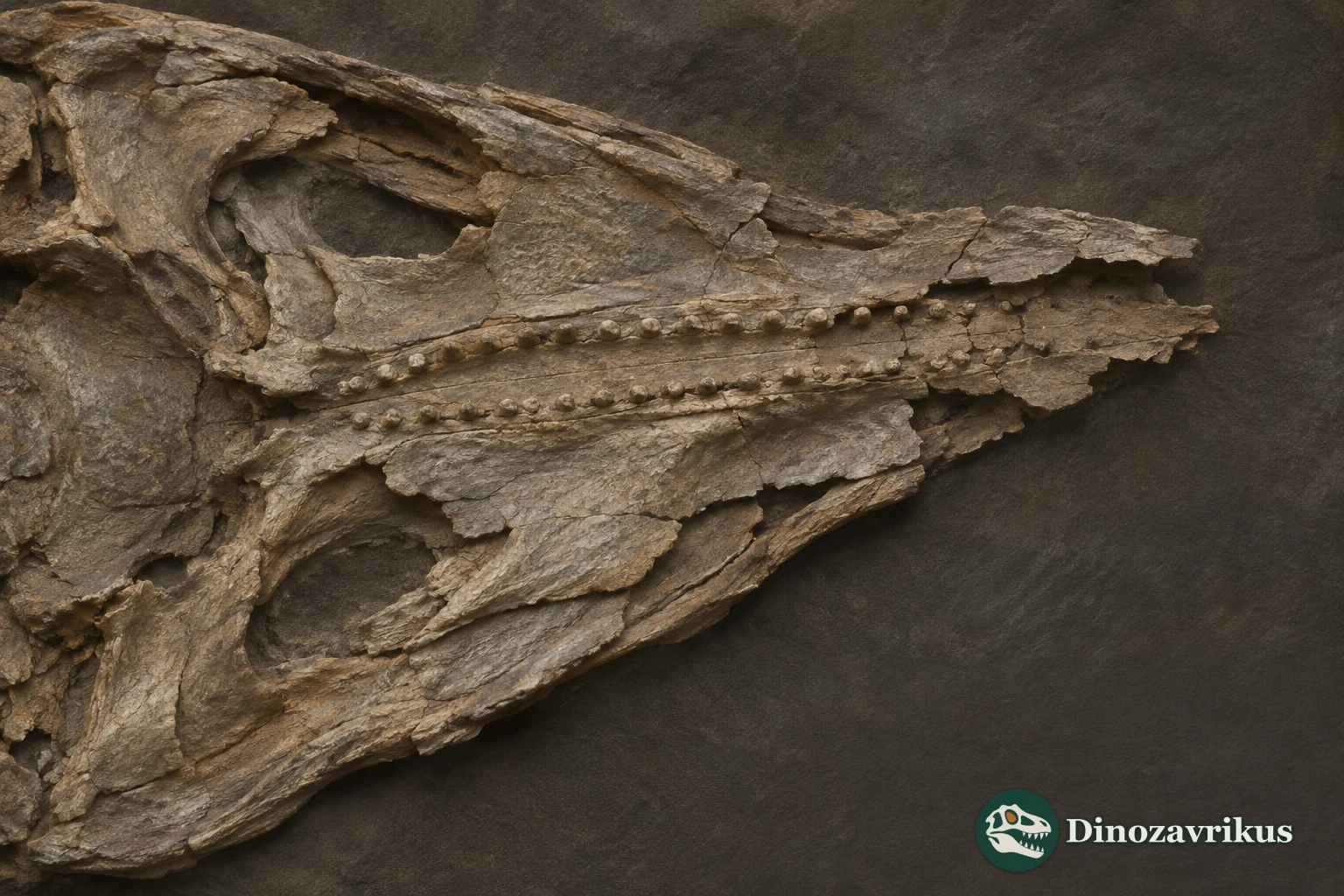
The palate and jaw joint
Two lines of teeth run along the ectopterygoids on each side of the palate. The parasphenoid, a central bone towards the rear of the palate, bears depressions divided by a longitudinal groove. The surfaces that articulated with the lower jaw sit behind the back of the skull roof. Their relationship to that bony margin is particularly useful when comparing adults with other rhinesuchids.
Why the second species changed genera
Sidney Haughton described Rhinesuchus capensis in 1925 from a large skull, SAM-PK-7419, found at Spitzkop farm in the Eastern Cape. It came from the Tropidostoma Assemblage Zone of the Late Permian. A fresh examination of the palate and rear of the skull led researchers to transfer it to Rhinesuchoides. The type species has a relatively slender skull, whereas the skull of R. capensis is broader.
How it differs from Rhinesuchus
The similar names reflect the long history of research into the family. The family revision treated Rhinesuchus avenanti and Rhinesuchus rubidgei as junior synonyms of the type species of Rhinesuchoides. Rhinesuchus remains a distinct genus. In its type species, the jaw articulation lies roughly level with the rear margin of the skull roof. In Rhinesuchoides, it projects farther back.
Frequently asked questions
Where was Rhinesuchoides found?
Both species recognised by the revision come from South Africa’s Karoo Basin. The type specimens were found in the Western Cape and Eastern Cape provinces.
When did Rhinesuchoides live?
The type species is known from the Middle Permian. *R. capensis* comes from younger rocks of Late Permian age.
Were its teeth only along the jaws?
The palate also carried teeth. Two parallel rows ran along each outer palate bone.
How many species are known?
The 2017 revision recognised *R. tenuiceps* and *R. capensis*. The latter had previously been assigned to Rhinesuchus.