

Rhinocolobus was a large extinct colobine monkey in the Plio-Pleistocene of Africa. Meave Leakey established the genus in 1982 for R. turkanaensis. Its skull and teeth are much better documented than its behavior, so the living animal must be reconstructed with care.
This primate appears in the ice-age animal catalogue. A number of East African localities yield material assigned to the genus; the deposits do not all share one age or preservation history.
Quick facts
| Type species | Rhinocolobus turkanaensis Leakey, 1982 |
|---|---|
| Family | Cercopithecidae, subfamily Colobinae |
| Age | Late Pliocene to early Pleistocene |
| Region | East Africa, including the Turkana Basin |
| Notable skull | KNM-ER 1485, East Turkana |
| Evidence | Skulls, teeth and scarce limb bones |
What can the fossils tell us?
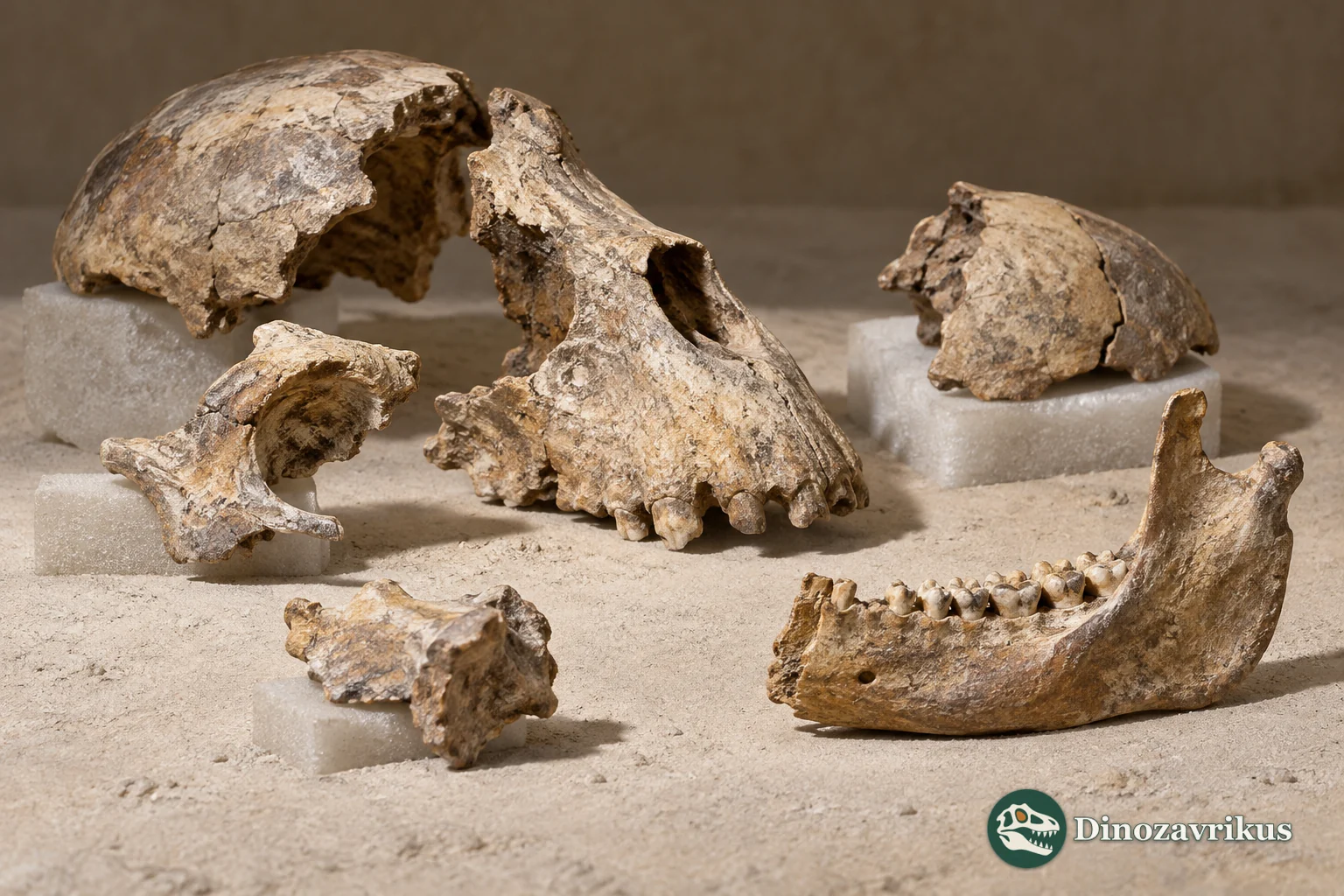
The associated skull and jaw show cranial proportions and teeth. Small canines and the lack of a sagittal crest suggest a female in the museum comparison, but this is an inference.
Shearing cheek teeth distinguish this colobine from some contemporaries. An isolated Lomekwi tooth can overlap Rhinocolobus and Paracolobus, so size alone does not settle its genus.
Comparative anatomy supports substantial arboreal activity. The fossils do not prove the animal never came to the ground or reveal its exact daily routine.
A skull from East Turkana
KNM-ER 1485 is a skull with a lower jaw from East Turkana, recovered in 1972. The National Museums of Kenya places it in the KBS Member, broadly dated to about 1.87–1.56 million years ago. It is an important comparative specimen, but the available museum record does not identify it as the holotype; the name was established in Leakey's 1982 description.
Its small canines and absence of a pronounced sagittal crest have led to an interpretation as female. That conclusion uses comparisons among primate skulls, not a directly preserved biological sex marker. The snout, orbits and teeth can be inspected; fur color, facial expression and social life cannot.
What the teeth and limbs show
The molars have high cusps and sharp shearing edges. These features help distinguish Rhinocolobus from other large fossil monkeys and are compatible with processing fibrous plant material. They do not identify each plant species consumed.
Rare limb bones compared by Leakey support an arboreal component of movement. They do not establish that every individual spent all its time in trees. Anatomy can support a range of movement, while the cover's exact pose is an artistic choice.

Names, locations and uncertain teeth
The original description compared Rhinocolobus with Cercopithecoides and Paracolobus. These are distinct fossil colobines, even when isolated teeth overlap in size. Recent work on Lomekwi material leaves some specimens between Rhinocolobus and Paracolobus rather than assigning them from size alone.
The animal is recorded from East African Plio-Pleistocene contexts, including the Turkana Basin and Omo Valley. A locality gives geological context to a particular specimen; it does not prove every proposed occurrence belongs to one species. A precise mass, group size and extinction cause are not established by the cited material.
Frequently asked questions
When did Rhinocolobus live?
Material assigned to the genus occurs in late Pliocene and early Pleistocene African deposits. Different localities have different dates.
What is KNM-ER 1485?
It is a well-preserved skull and lower jaw from East Turkana. The female interpretation is based on canine and crest comparisons.
Did it live only in trees?
Its limited limb record supports substantial climbing, but does not prove a wholly arboreal life.
Can one tooth always distinguish it from Paracolobus?
No. Some isolated Lomekwi teeth overlap both genera and remain uncertain at genus level.