

Rhynchaeites was a small, long-billed Eocene bird generally interpreted as an early relative of ibises. It differed from most living members of that family in its short legs and in the absence of dense sensory pits at the tip of its bill. Discoveries in several countries show that the genus included species with distinct anatomical features.
Quick facts
| Group | Probable stem relatives of ibises |
|---|---|
| Age | Early and Middle Eocene |
| Distribution | Europe and North America |
| Material | Multiple partial skeletons |
| Genus named | Ernst Wittich, 1898 |
What can the fossils tell us?
Compressed Messel skeletons show overall proportions, while three-dimensional English bones reveal details of joints and the palate. Not every English specimen has a species-level identification.
The bony bill tip lacks the dense pits characteristic of living ibises. This supports a different feeding strategy but does not identify a particular diet.
The American species retains the head, part of the spine, wings and feet despite losing the trunk and upper legs. The proposed explanation remains a taphonomic hypothesis.
The first bird described from Messel
Ernst Wittich named Rhynchaeites messelensis in 1898. It was the first fossil bird scientifically described from Messel in Germany. More than a dozen compressed skeletons of the genus were subsequently recognised there. They are approximately 48 million years old, near the boundary between the Early and Middle Eocene.
Rhynchaeites was initially compared with painted snipes. Some material received the new name Plumumida lutetialis in 1980, later treated as a junior synonym of the earlier species. Dieter Stefan Peters argued for ibis affinities in 1983. Affinity and exact position within an evolutionary tree are different questions, however: a 2023 analysis provided only weak support for placing Rhynchaeites next to the lineage of living ibises.
What the English skeletons added
Gerald Mayr and Andrew Kitchener described Rhynchaeites litoralis from the London Clay of Walton-on-the-Naze, Essex, in 2023. Michael Daniels collected its holotype, NMS.Z.2021.40.28, in 1991. Held at National Museums Scotland, the specimen includes a partial skull with mandible, vertebrae and elements of the shoulder girdle, wings and legs.
The English fossils are approximately 54.6–55 million years old, substantially older than the Messel material. Alongside the holotype, the researchers examined remains of six additional individuals. They retained these as Rhynchaeites sp.: size differences might reflect sex, but some anatomical differences could indicate another species.
Three-dimensional preservation revealed that paired upper-jaw elements in the palate are widely separated. This condition is termed schizognathous and differs from the arrangement in living ibises. Limb proportions are also distinctive: the tarsometatarsus is shorter than the femur. The left femur of the English holotype measures 49 millimetres, a measurement of one bone rather than the length of the complete bird.
Short legs and finding food
The short tarsometatarsi and toes have been interpreted as indicating more terrestrial locomotion than in most living ibises. A long bill may have evolved in this lineage before the legs became elongated. That sequence of anatomical features should not be converted into a direct genealogy of modern species.
Numerous pits in the bony bill tip of living ibises house sensory structures involved in locating concealed prey. Rhynchaeites lacks this densely pitted surface. The authors of the 2023 study proposed that vision played a greater role during feeding. This is a functional inference from anatomy, not evidence from preserved stomach contents.
Ibises later evolved diverse ways of life. The Hawaiian Apteribis, for example, independently became a flightless island bird. Its much younger history does not imply that the short legs of the Eocene Rhynchaeites also demonstrate flightlessness.
An American species with a sharp bill tip
In 2026, Daniel Ksepka and colleagues described Rhynchaeites mcfaddeni from the Fossil Butte Member of the Green River Formation. Its partial skeleton retains the skull, presacral vertebral column, wings and feet in approximately life position, although the trunk, pelvis, tail and upper legs are missing.
The researchers proposed that substances released during decay might have fixed part of the carcass firmly to the sediment while other portions separated. This model offers an explanation for the unusual combination of associated and missing bones; it is not a direct observation of the bird’s death.
The American species has a sharply tapering bill tip. The authors suggested a distinctive feeding method, potentially including prying molluscs from their shells. Its rarity in otherwise rich lake deposits also prompted the hypothesis that it foraged in streams. Both suggestions remain hypotheses: a single described specimen cannot establish the species’ complete ecology.
Different deposits, different settings
A partial skeleton from Denmark’s Early Eocene Fur Formation was referred to Rhynchaeites in 2011. Together with the German, English and American records, it documents a broad Northern Hemisphere distribution.
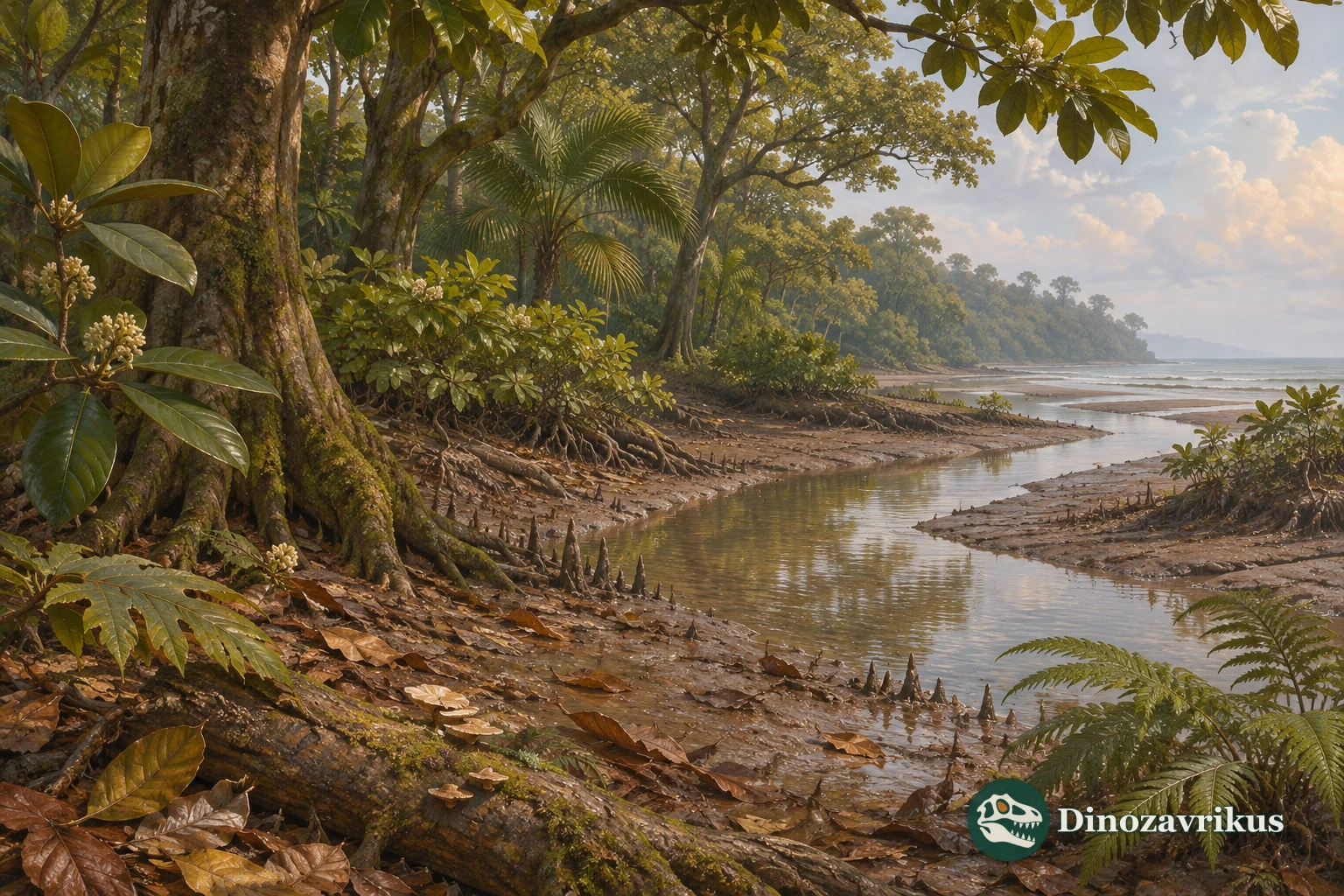
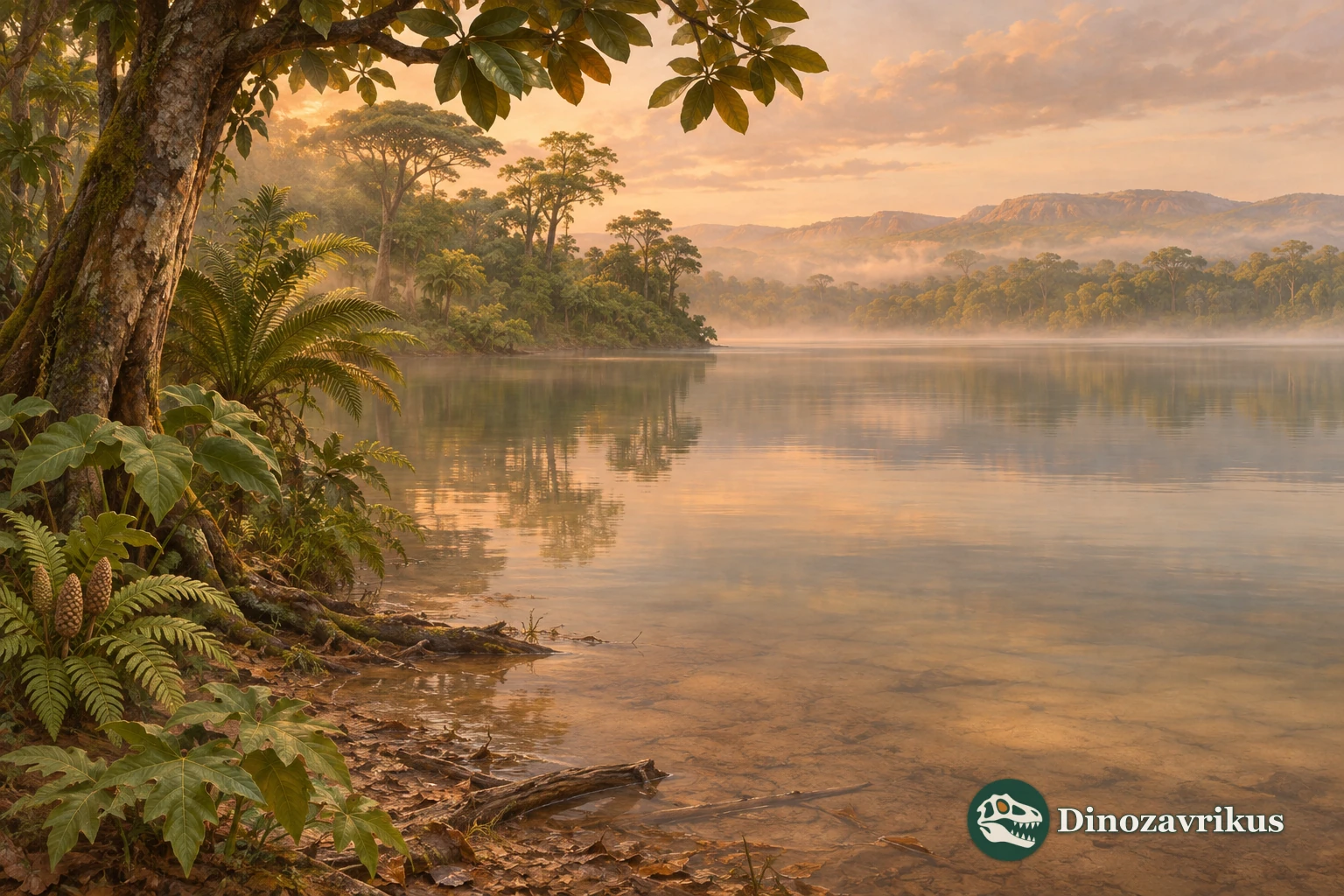
The lake deposits of Messel and the Green River Formation differ from the marine sediments of the London Clay and Fur Formation. A bird’s place of burial need not be the place where it obtained food. The environmental illustrations therefore convey possible surroundings, while plumage and soft tissues in the reconstruction remain artistic choices.
Frequently asked questions
Was Rhynchaeites a modern ibis?
It is generally placed outside the group containing all living ibises and their most recent common ancestor. Anatomy supports ibis affinities, but its exact placement is not equally secure in every analysis.
Why did it have such short legs?
Short legs are a genuine feature of the skeleton. They may indicate more terrestrial locomotion, but do not by themselves establish flightlessness or a particular diet.
Do all the English bones belong to R. litoralis?
No. Only the holotype was confidently assigned to that named species. Other examined individuals were left without a species identification because of differences in size and anatomy.
Is mollusc feeding proven for the American species?
No. Extracting molluscs was proposed as one possible use of its sharply pointed bill. The account does not report direct dietary remains demonstrating that behaviour.