

Rocasaurus was a titanosaur that lived in northern Patagonia near the end of the Cretaceous. The type skeleton came from a juvenile. Isolated vertebrae assigned to the same genus have allowed researchers to trace pneumatic cavities well beyond the base of its tail.
Quick facts
| Group | Sauropods, titanosaurs (Saltasaurinae) |
|---|---|
| Age | Late Cretaceous (late Campanian to early Maastrichtian) |
| Region | South America (Río Negro Province, Argentina) |
| Diet | Herbivorous |
| Type species | Rocasaurus muniozi |
| Holotype | MPCA-Pv 46, vertebrae, pelvic bones and left femur |
| Formation | Allen Formation at Salitral Moreno |
What can the fossils tell us?
The arch of one neck vertebra from the type skeleton remains separate from the centrum. That lack of fusion supports the interpretation of a juvenile animal.
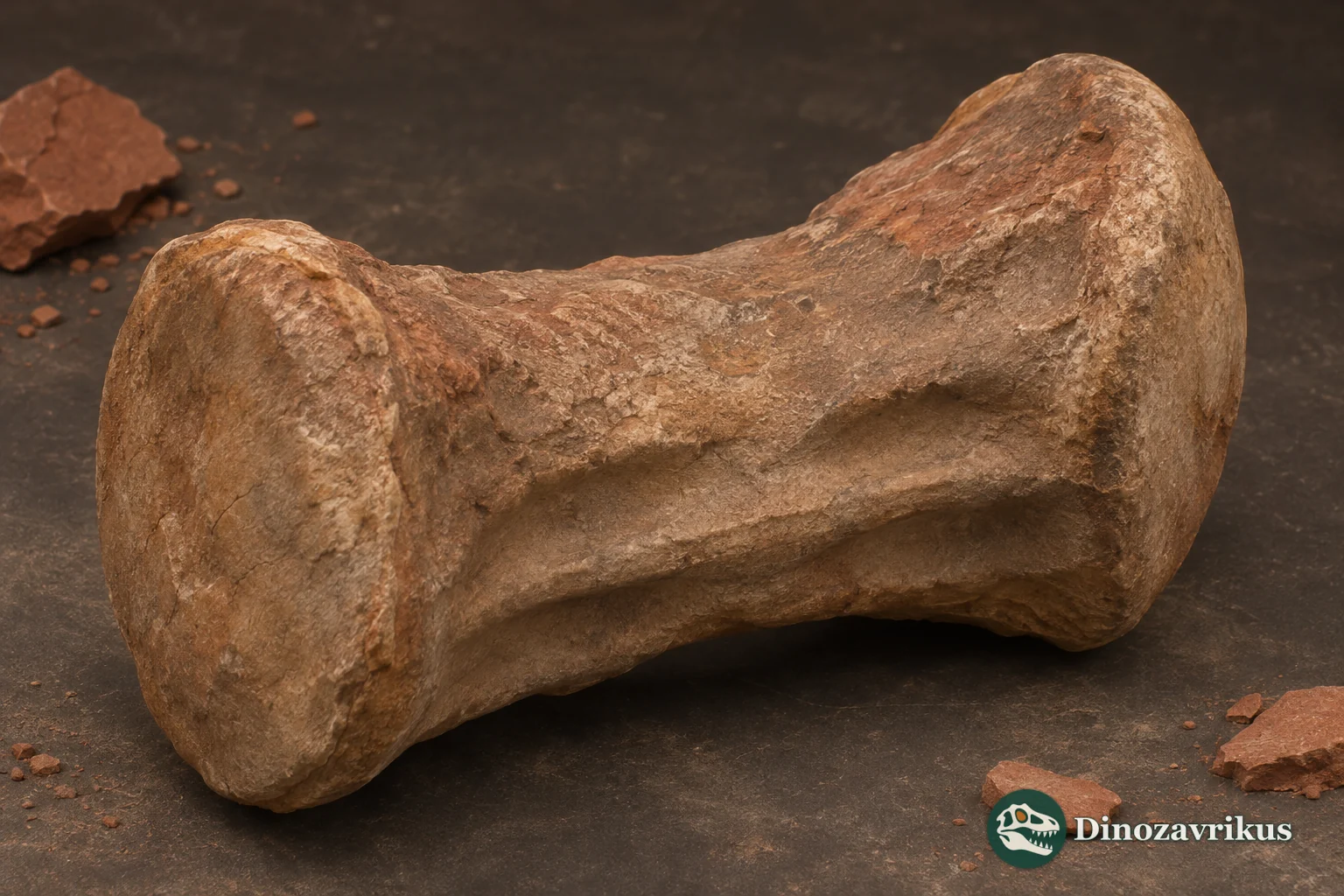
A lengthwise ridge divides a depression on the underside of the tail vertebrae. A similar feature occurs in Saltasaurus.
Internal cavities extend far beyond the tail base. Their structure and position support a connection with air-filled extensions of the respiratory system.
A skeleton from Salitral Moreno
Leonardo Salgado and Claudia Azpilicueta described Rocasaurus in 2000. The genus refers to the city of General Roca, and the species honours Juan Carlos Muñoz for his support of regional palaeontology.
The type specimen, MPCA-Pv 46, is held at the Carlos Ameghino museum in Cipolletti. It includes portions of neck, trunk and tail vertebrae, parts of the pelvis and the left femur. In one neck vertebra the neural arch had yet to fuse to the centrum, one reason the skeleton is regarded as juvenile.
The quarries at Salitral Moreno yielded several different titanosaurs. Some bones picked up alongside the type were reassigned to a more slender sauropod when the material was redescribed. Differences in limb proportions and tail vertebrae helped distinguish the two animals.
What makes the tail vertebrae distinctive
A number of tail vertebrae have a depression along the underside, divided by a ridge down the middle. The original description used this feature to support a close relationship with Saltasaurus. In some vertebrae from the middle of the tail, the rear joint sits a little above the long axis of the centrum.
What the cavities tell us
Internal pneumatic cavities are familiar in the neck and trunk vertebrae of sauropods. In Rocasaurus, traces also occur in the middle and rear of the tail. The prevailing interpretation is that small extensions of the air-sac system entered these bones while the animal was alive.
A later study took thin sections of six tail vertebrae to look for fibres that might mark contact between bone and a pneumatic extension. Potential traces were rare and hard to identify with confidence. The pattern and internal structure of the cavities offer additional evidence that does not depend on the fibres alone.
Frequently asked questions
Where was Rocasaurus found?
At Salitral Moreno, about 25 kilometres south of General Roca in northern Patagonia.
What bones make up the type specimen?
Vertebrae from several parts of the spine, parts of the pelvis and the left femur.
Why is the type specimen regarded as a juvenile?
The neural arch on one of its neck vertebrae had yet to fuse to the centrum.
How far did pneumatic cavities extend along the tail?
They are recorded beyond the base, including in vertebrae from the middle and rear of the tail.