

Saltoposuchus connectens was a terrestrial crocodylomorph from the Late Triassic of southern Germany. Its fossils preserve long limbs, paired armour plates and a thigh bone that was still growing rapidly in a relatively large individual.
Quick facts
| Species | Saltoposuchus connectens |
|---|---|
| Family | Saltoposuchidae |
| Age | Norian, Late Triassic |
| Locality | Pfaffenhofen, Baden-Württemberg, Germany |
| Holotype | SMNS 12597a–d, disarticulated skeleton |
| Femur length | 106 mm in SMNS 12596 |
What can the fossils tell us?
The type specimens differ in size, but the 2023 revision found no consistent anatomical differences that warrant two species.
The plates preserve pits and ridges. Their positions help reconstruct parts of the covering, while its colour is unknown.
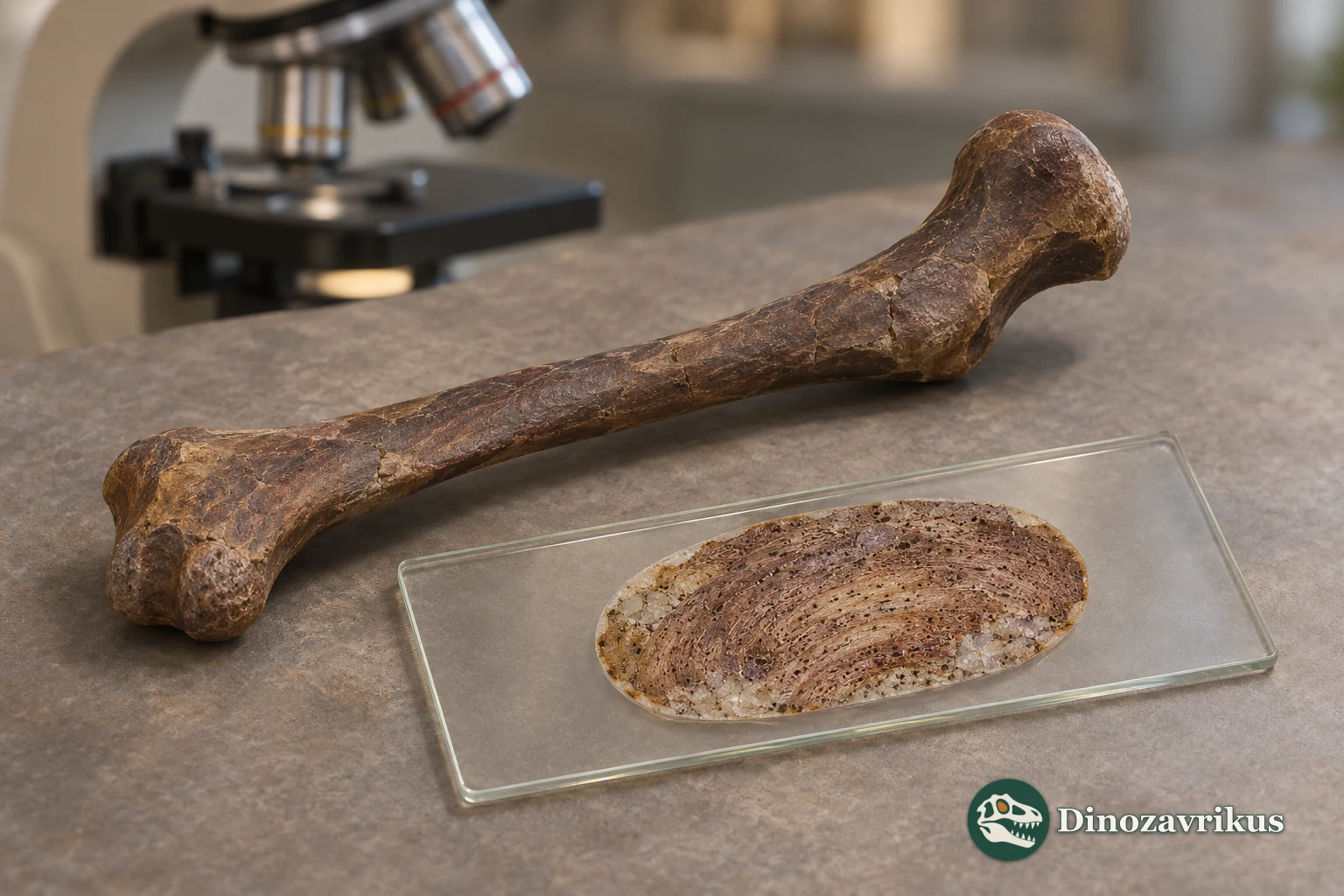
The bone tissue suggests rapid growth. Open vertebral sutures and the absence of an outer growth-arrest layer indicate that the individual was still growing.
Two skeletons from the Pfaffenhofen quarries
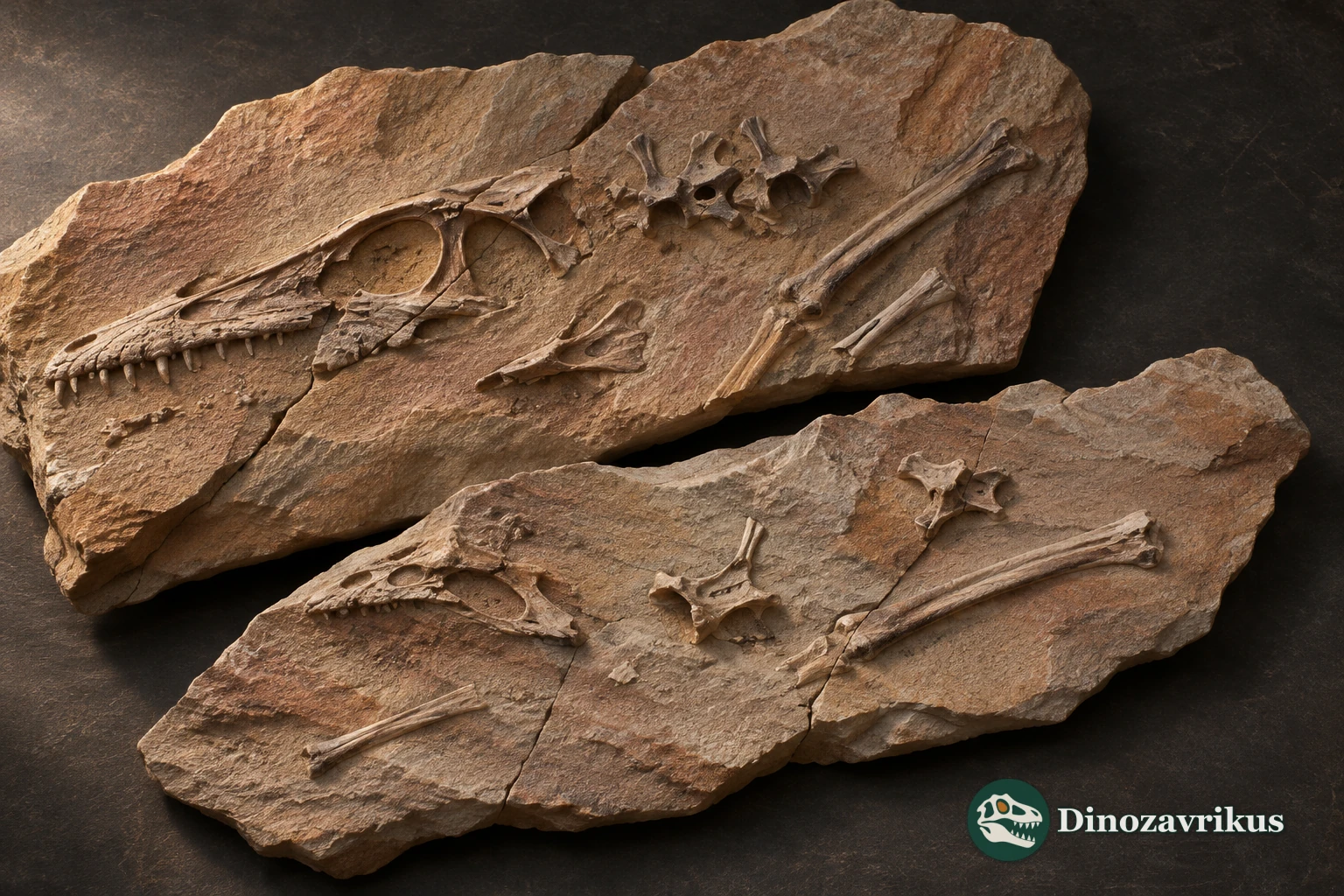
Friedrich von Huene named Saltoposuchus in 1921. He assigned the smaller skeleton SMNS 12597 to S. connectens and the larger SMNS 12596 to S. longipes. Both came from the Stubensandstein and are held by the State Museum of Natural History Stuttgart.
Stephan Spiekman’s 2023 revision assigned both skeletons to S. connectens. It also attributed the skull SMNS 12591a to this species. The skull was once treated as part of a specimen of the small dinosaur Procompsognathus. The associated postcranial material still belongs to a theropod.
Teeth, legs and armour
The front teeth on the maxilla were enlarged. In some skulls the opening in front of the eye is about half as large as the eye socket. Different specimens were crushed in different directions, so comparing them helps correct distortions of the snout.
Saltoposuchus has a stouter femur and broader, more sculpted armour plates than Terrestrisuchus. Its femur is longer than its lower leg bones. Both genera grouped with Litargosuchus in the 2023 analysis. Their long-limbed skeletons are consistent with an active terrestrial habit.
A record in the thigh bone
A thin section of the femur of SMNS 12596 shows fibrolamellar bone, a fast-forming tissue rich in vascular canals. Robust bones and well-developed plates suggest that the animal was past its earliest juvenile stage. Several vertebral sutures were still open, and the bone lacks the dense outer layer associated with the cessation of growth.
Growth therefore remained rapid beyond the earliest stages of life. A single thin section gives neither an exact age nor a year-by-year record.
Frequently asked questions
What happened to the name S. longipes?
It is treated as a junior synonym of S. connectens. The name originally referred to the larger of two specimens.
Where was the type found?
In Late Triassic sandstone near Pfaffenhofen in south-western Germany.
Was it a dinosaur?
Saltoposuchus was an early crocodylomorph. One skull was historically associated with the dinosaur Procompsognathus.
Which bone shows that it was still growing?
The femur of SMNS 12596. Its tissue is highly vascular and lacks a mature outer growth-arrest layer.