

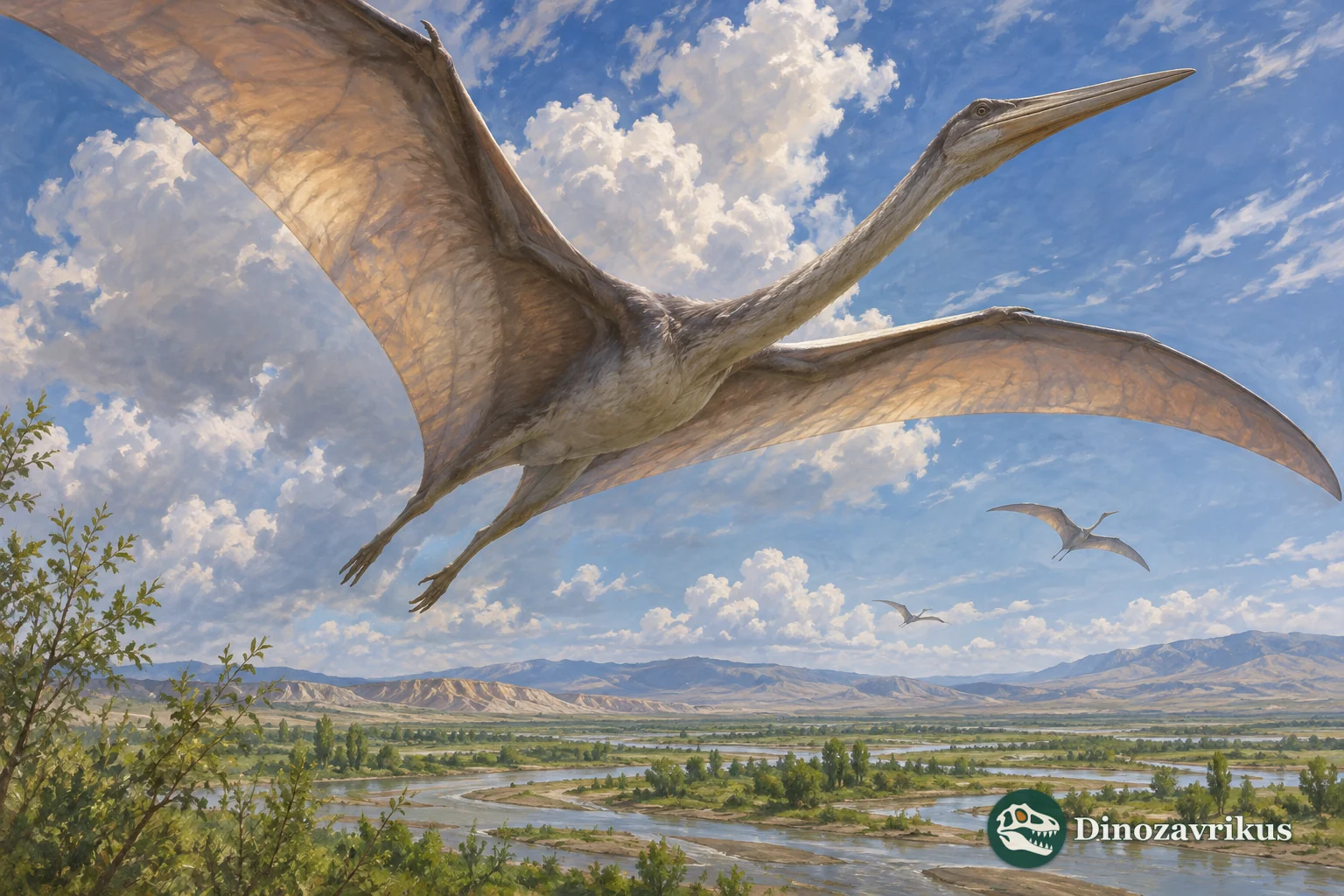
Samrukia nessovi was originally presented as a very large Late Cretaceous bird from Kazakhstan. Its type fossil is the rear of a lower jaw, not a wing or a skeleton. Comparative work identified pterosaur jaw-joint features instead. Whether this named material belongs to a separate genus or to Aralazhdarcho is still a hypothesis, so the cover is a generic azhdarchid-inspired interpretation.
Quick facts
| Named species | Samrukia nessovi, Naish and colleagues, 2012 journal volume |
|---|---|
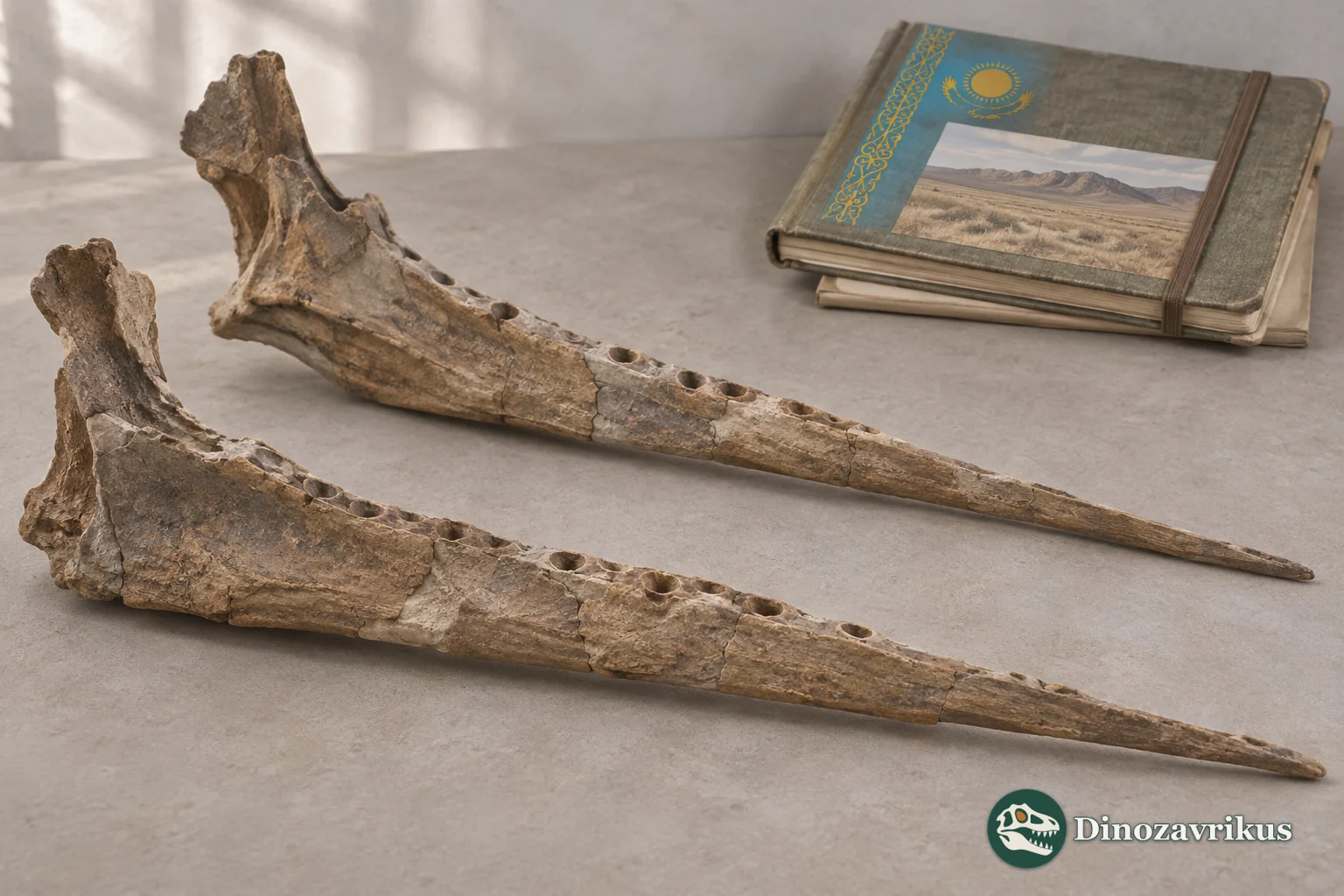
| Holotype | WDC Kz-001, posterior parts of two lower-jaw rami |
| Locality | Akkurgan, southern Kazakhstan |
| Rock unit | Bostobe Formation |
| Geological age | Santonian to early Campanian, Late Cretaceous |
| Identification | Originally a bird; later recognized as a pterosaur |
| Affinity | Likely azhdarchid in a later review; possible Aralazhdarcho synonym |
| Wingspan | Unknown without wing bones |
What can the fossils tell us?
WDC Kz-001 lacks the jaw tip, skull and wings. Even the complete jaw length was not measured directly.
A later comparison noted pterosaur features absent from the original bird-focused phylogenetic test.
Samrukia is based on a jaw from Akkurgan; Aralazhdarcho is based on a neck vertebra from Shakh Shakh.
Geological work reconstructs the Bostobe floodplain near the Turgai Sea, not the behaviour of an individual pterosaur.
A mythic bird name attached to a jaw
Darren Naish and colleagues published the name Samrukia nessovi online in 2011, with the paper appearing in a 2012 journal volume. Samruk is a mythic bird of Kazakh tradition, while the species honours palaeontologist Lev Nessov. They interpreted the large posterior jaw fragments as belonging to a bird. The surviving rami exceed 27.5 cm, but their missing anterior end prevents a direct measurement of full jaw length.
The type specimen WDC Kz-001 came from Akkurgan in southern Kazakhstan. The Bostobe Formation at that locality is assigned to the Santonian to early Campanian interval of the Late Cretaceous. This is an age range for the deposit, not a date measured on the individual animal.
A pterosaurian jaw joint
Eric Buffetaut compared the published anatomy with pterosaur mandibles. The complex joint, with two oblique contact surfaces separated by a ridge, matches pterosaur features. He argued that characters presented as evidence of a giant bird did not exclude pterosaurs. The original phylogenetic analysis had not included pterosaurs as candidates.
Later reviews accepted a pterosaur identification and suggested azhdarchid affinity. The specimen still lacks the upper jaw, most of the lower jaw, neck and wings. It cannot establish a precise head contour, wingspan or feeding strategy.
The Aralazhdarcho question
Aralazhdarcho is known mainly from a cervical vertebra from Shakh Shakh, another Bostobe locality. Alexander Averianov and colleagues suggested Samrukia may be its synonym. Yet the type fossils are different skeletal parts from different localities, with no direct anatomical overlap. The shared formation supports a question, not a proof of one species.
The comparison with Azhdarcho and other azhdarchids is an interpretation of jaw-joint morphology. A separate catalogue entry records the history of this named fossil without asserting that two distinct genera necessarily lived in Bostobe.
A landscape, not a measured life portrait
Geological research places Akkurgan on a coastal fluvial plain near the Turgai Sea. That setting informs the illustrated environment, while the animal's wings, whole head, colour and pose are borrowed from comparative reconstruction. The jaw fragments contain no record of exact diet, group behaviour or flight style.
Frequently asked questions
Why was Samrukia first called a bird?
The initial study interpreted its rear lower-jaw fragments as avian. A subsequent comparison found characteristic pterosaur features in the jaw joint.
Where was its fossil found?
WDC Kz-001 came from Akkurgan in Kazakhstan, within the Late Cretaceous Bostobe Formation.
Is it the same animal as Aralazhdarcho?
That is possible but unproven. The names rest on a jaw and a neck vertebra from different localities, so their type bones cannot be directly matched.
Can its wingspan be estimated?
Not reliably from the named fossil. No wing bones accompany the posterior jaw fragments.